
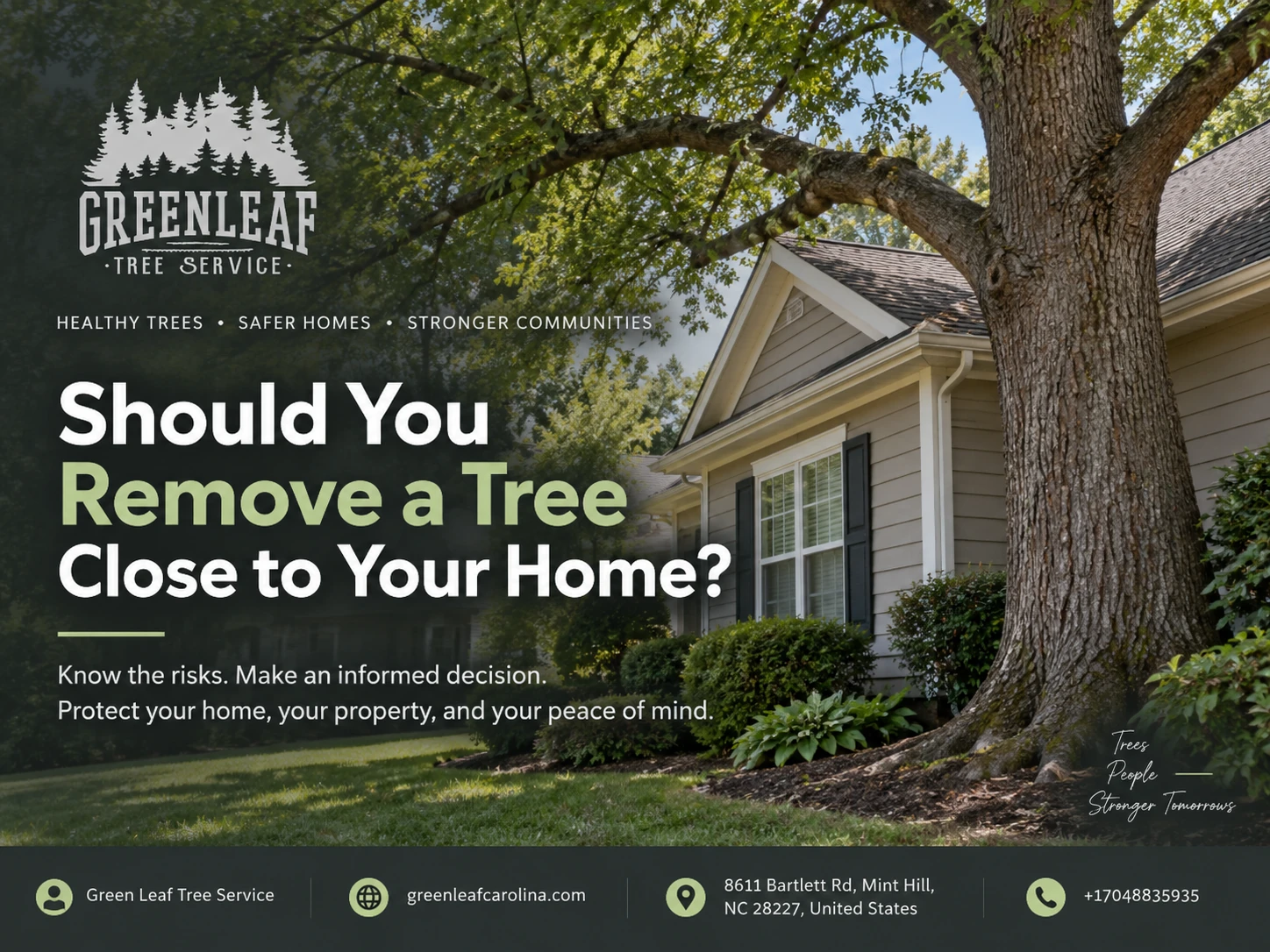
A tree too close to a house does not automatically need to be removed. Many trees grow safely near homes for decades when they are healthy, structurally stable, and appropriately sized for the available space.
The real concern is not distance alone. Tree species, mature canopy width, root behavior, trunk condition, soil quality, branch overhang, storm exposure, and the location of nearby structures all influence risk. In some cases, pruning and monitoring are enough. In others, severe decay, unstable roots, repeated branch failure, or unavoidable property conflicts may make removal the safest long-term choice.
Tree Too Close to Your Home?
Protect your property with professional tree removal. Call today for a safe assessment.
When Is a Tree Too Close to a House?
There is no single measurement that determines whether every tree is planted too close to a home. A small ornamental tree may fit comfortably near a building, while a large oak or maple may eventually overwhelm the same space.
Homeowners should evaluate the tree based on its mature size rather than how it looks today. A young tree may appear several feet away from the house but eventually develop a broad canopy, thick trunk, and extensive root system.
A nearby tree may become a concern when:
- Large branches regularly touch or hang over the roof
- The trunk is growing toward the building
- The tree blocks access to siding, windows, gutters, or utilities
- Roots are lifting pavement or damaging shallow structures
- The canopy requires frequent heavy pruning
- The species will eventually outgrow the available space
- The tree leans toward the home
- Major limbs have failed more than once
- The trunk or roots show signs of decay
The amount of available soil also matters. Large trees growing in narrow planting areas between a house, driveway, fence, or sidewalk may have limited room for healthy root development.
A tree can be physically close to a home without being dangerous, especially when it has a strong structure and enough space to grow naturally. The concern increases when normal growth repeatedly creates contact, damage, or difficult maintenance.
Can Nearby Trees Damage Foundations or Roofs?
Trees can contribute to property damage, but they are often blamed for problems caused by drainage, aging materials, poor construction, or existing structural weaknesses.
A nearby tree should be evaluated carefully before assuming removal is necessary.
Roof and Gutter Concerns
Branches over a roof may drop leaves, twigs, fruit, seeds, or bark into gutters. When gutters become clogged, water may overflow near siding or foundations.
Branches may also:
- Rub against shingles
- Damage gutters during storms
- Block vents or chimneys
- Strike windows or siding
- Create access problems for roof repairs
- Fall during high winds
A healthy branch over a roof is not automatically unsafe. The greater concern is a branch that is dead, cracked, poorly attached, excessively heavy, or weakened by decay.
Selective pruning may provide enough clearance without removing the entire tree. However, repeated aggressive trimming may indicate that the tree is too large for the location.
Foundation Concerns
Tree roots generally grow where soil provides moisture, oxygen, nutrients, and room. Healthy roots do not normally seek out a sound concrete foundation simply to break through it.
Problems are more likely when:
- The foundation already contains cracks
- Pipes near the foundation are leaking
- Soil remains consistently wet
- The structure has shallow or weakened masonry
- The tree has very limited rooting space
- Large roots are already pressing against a wall or slab
- Expansive clay soil repeatedly dries and swells
In some clay soils, large trees may affect surrounding moisture levels during extended dry periods. However, foundation movement can also be caused by grading, plumbing leaks, poor drainage, soil settlement, or construction issues.
Removing a tree without identifying the actual cause may not solve the foundation problem.
Storm Damage
A tree close to a house may become more concerning during storms because even a limited structural failure could damage the roof or walls.
The risk increases when the tree has:
- Large dead branches
- Deep trunk cracks
- Weak branch unions
- Root damage
- Internal decay
- A new lean
- A heavily one-sided canopy
- Previous storm failures
Healthy trees can also lose limbs during severe weather, but defects increase the likelihood of significant damage.
What Should Homeowners Check First?
Homeowners can perform a basic visual inspection from the ground before deciding whether professional evaluation is needed.
Avoid climbing the tree, pulling on broken branches, cutting large roots, or standing beneath unstable limbs.
Look for a New or Increasing Lean
Some trees naturally grow at an angle. A long-standing lean may not indicate a problem.
A lean becomes more concerning when it:
- Appeared recently
- Increased after a storm
- Points toward the house
- Occurs with raised soil
- Is accompanied by exposed roots
- Develops near a trunk crack
Soil lifting or separating near the base may indicate movement of the root plate.
Inspect the Canopy
Look throughout the branches rather than focusing only on the side closest to the house.
Warning signs may include:
- Large dead limbs
- Broken or hanging branches
- Sparse foliage
- Premature leaf discoloration
- Smaller-than-normal leaves
- Repeated branch loss
- Branches resting on the roof
- A canopy that is heavily weighted to one side
Minor dead twigs are common, but large dead branches over a roof or driveway require more attention.
Check the Trunk
Look for visible structural defects, including:
- Vertical cracks
- Splits between large stems
- Cavities
- Loose or missing bark
- Fungal growth
- Soft or crumbling wood
- Lightning scars
- Sap or fluid leakage
- Previous topping cuts
A hollow area does not always mean the tree must be removed. The amount and position of remaining sound wood are more important than the presence of a cavity alone.
Examine the Base
The area where the trunk widens into the main roots is called the root flare. It should normally be visible at the soil surface.
Possible concerns include:
- Mulch piled against the trunk
- Soil covering the root flare
- Girdling roots
- Mushrooms near the base
- Soft or dark bark
- Root wounds
- Cracking soil
- Recent excavation
- New movement after storms
Problems near the base may affect both tree health and stability.
Review Recent Construction
Tree decline may begin after work occurs nearby, even when symptoms do not appear immediately.
Consider whether there has been:
- Foundation repair
- Driveway replacement
- Utility trenching
- Patio installation
- Drainage work
- Grading
- Soil filling
- Heavy equipment traffic
- Root cutting
- Removal of nearby trees
Construction can compact soil, damage roots, change drainage, and reduce tree stability.
How Root Systems Affect Structures Over Time
Tree roots can extend well beyond the visible canopy. Most roots grow within the upper portion of the soil, where oxygen and moisture are easiest to access.
The size and behavior of the root system depend on the tree species, soil conditions, water availability, and surrounding obstacles.
Roots and Foundations
Roots often grow alongside foundations because the soil there may be loose or moist. They are more likely to follow an existing crack than create one in a structurally sound wall.
Large roots may still cause pressure against:
- Shallow foundations
- Older masonry
- Lightweight retaining walls
- Landscape edging
- Patios
- Small garden structures
Conflicts are more likely when a large tree is growing in a very narrow strip beside the home.
Roots and Sidewalks
Sidewalk and driveway lifting is common when large trees are planted close to shallow pavement.
Roots may grow beneath pavement because:
- The surrounding soil is compacted
- The pavement traps moisture
- There is little open soil available
- The tree naturally forms surface roots
Cutting roots without professional guidance can weaken the tree. Large structural roots help anchor the trunk, and removing them may increase the risk of failure.
Roots and Underground Utilities
Roots may enter sewer or drainage pipes through existing cracks or loose joints. Once inside, they can grow within the moist environment and contribute to blockage.
An intact modern pipe is less likely to be invaded than an older damaged line. A plumbing inspection may be needed before deciding whether the tree is responsible.
Homeowners should also consider:
- Water lines
- Irrigation systems
- Septic tanks
- Drain fields
- Gas lines
- Electrical lines
- Underground communication cables
Root Damage During Construction
Excavation near a tree can remove important roots and increase instability.
The effect depends on:
- Root size
- Number of roots cut
- Distance from the trunk
- Tree species
- Soil type
- Existing health
- Direction of prevailing winds
Major root cutting on the side facing away from the home can sometimes increase the chance of the tree falling toward the structure.
Roots and Soil Moisture
Large trees remove water from the soil through their roots. In some clay soils, this may contribute to drying and shrinkage during drought.
Removing the tree may also change soil moisture patterns. Roots gradually decompose, and the surrounding ground may retain more water afterward.
When foundation movement is suspected, advice may be needed from both a tree professional and a structural specialist.
When Should You Remove a Nearby Tree?
Removal may be recommended when the tree presents an unacceptable risk that cannot be reasonably managed with pruning, monitoring, structural support, or site improvements.
The Tree Is Dead
A dead tree will continue losing structural strength as wood decays. Branches may become brittle, and roots may no longer anchor the tree effectively.
A dead tree near a house, driveway, road, or utility line should be evaluated promptly.
The Trunk Is Severely Damaged
Deep trunk cracks, major splits, large cavities, or advanced decay may make the tree structurally unstable.
Removal becomes more likely when:
- The split extends through the main trunk
- The damaged sections move independently
- Decay surrounds a large portion of the trunk
- The crack is directed toward the home
- Major stems have begun separating
Cabling or bracing may help selected trees, but support systems cannot restore decayed or broken wood.
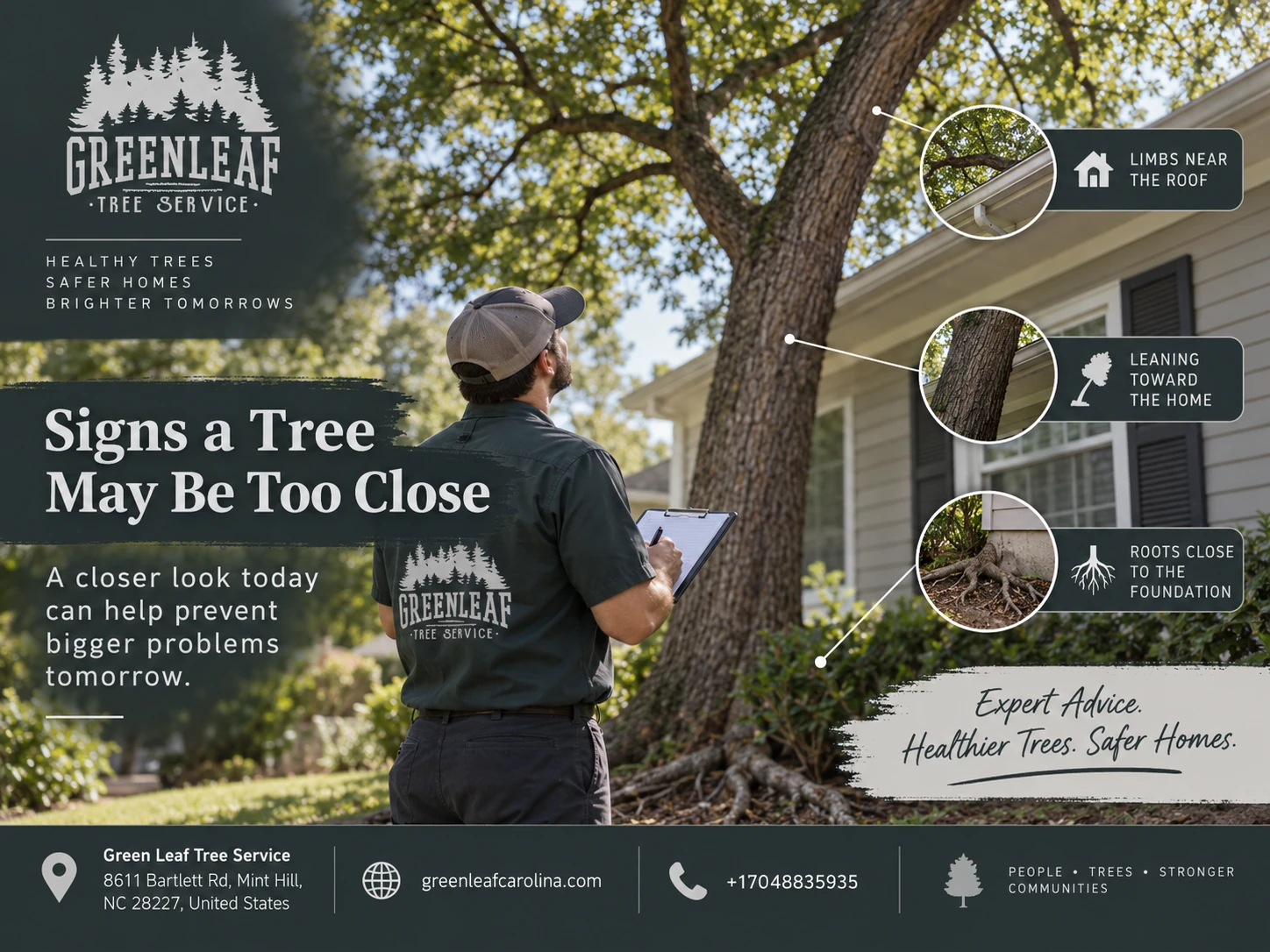
The Roots Are Unstable
A tree may need removal when its root system can no longer provide dependable support.
Warning signs include:
- Raised soil
- Exposed or broken roots
- A newly leaning trunk
- Root plate movement
- Extensive root decay
- Large roots removed during construction
- Cracks forming in the ground
Severe root damage may not be visible from above, especially when it results from trenching or excavation.

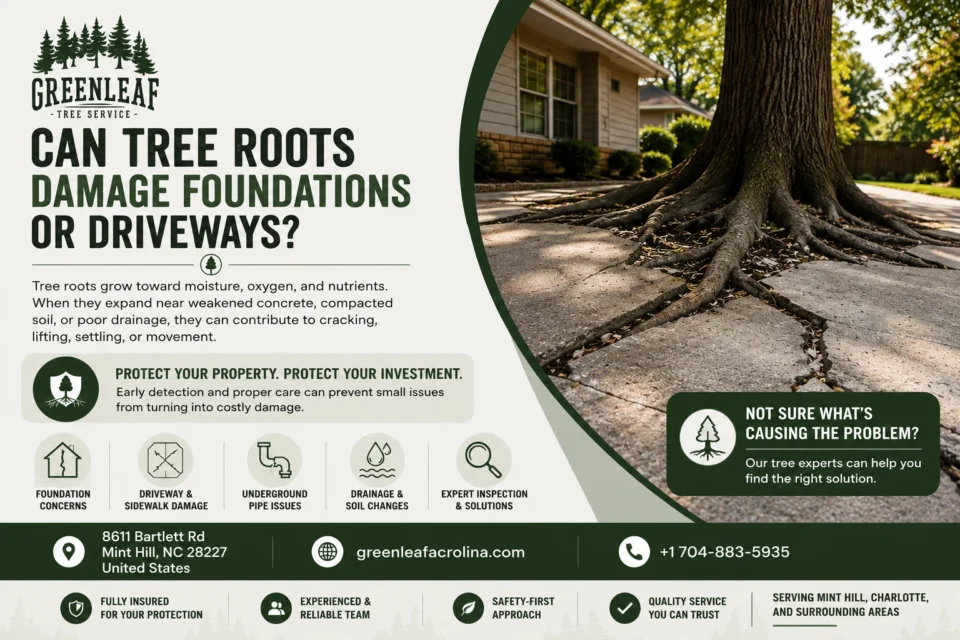
Can Tree Roots Damage Foundations or Driveways?
Yes, tree roots can damage driveways, sidewalks, patios, and sometimes contribute to foundation problems, but they usually do not “attack”…
Large Limbs Keep Failing
One broken branch does not always mean a tree should be removed. Repeated failures may indicate poor structure, decay, weak unions, or declining health.
Removal may be considered when corrective pruning cannot create a reasonably stable canopy.
The Tree Has Outgrown the Location
A healthy tree can still be unsuitable for the available space.
Removal may become the practical option when:
- The trunk is nearly touching the home
- Branches must be cut back repeatedly
- The tree blocks necessary maintenance access
- Roots repeatedly damage pavement or utilities
- The canopy cannot be managed without topping
- The species will continue growing far beyond the available area
Topping is not a healthy way to keep a large tree small. It creates large wounds and often leads to weakly attached new growth.
The Tree Creates an Unmanageable Risk
A tree may still be alive but present too much risk because of its position over a bedroom, entrance, driveway, public road, or neighboring structure.
Possible alternatives should be considered before removal, including:
- Deadwood pruning
- Structural pruning
- Cabling or bracing
- Moving vehicles or play equipment
- Improving soil conditions
- Monitoring defects
- Restricting access beneath the tree
Removal may be appropriate when these measures cannot reduce the risk to an acceptable level.
What Will a Tree Inspection Include?
A professional inspection evaluates the tree as a complete system rather than focusing only on its distance from the house.
Species and Mature Size
The inspector will consider the tree’s normal height, canopy width, growth rate, root characteristics, wood strength, and response to pruning.
This helps determine whether the tree can realistically remain in the available space.
Canopy Health
The canopy may be inspected for:
- Dead branches
- Sparse foliage
- Storm damage
- Weak unions
- Excessive weight
- One-sided growth
- Previous topping
- Pest or disease symptoms
A full canopy does not always mean the tree is structurally sound, but widespread dieback may indicate significant decline.
Trunk Structure
The inspector may check for:
- Cracks
- Cavities
- Decay
- Multiple trunks
- Included bark
- Lightning damage
- Peeling bark
- Fungal growth
- Old pruning wounds
- Loose branches
The location and extent of a defect matter more than its appearance alone.
Root Condition
The root zone may be evaluated for:
- Root flare visibility
- Soil compaction
- Girdling roots
- Drainage problems
- Construction damage
- Root decay
- Pavement conflicts
- Restricted soil space
- Root plate movement
A tree with healthy branches but damaged roots may still be unstable.
Nearby Targets
The inspection considers what could be struck if the tree or a branch fails.
Targets may include:
- The house
- Garage
- Vehicles
- Utility lines
- Walkways
- Patios
- Play areas
- Neighboring property
- Roads
The same tree defect may require different action depending on its location.
Available Management Options
Recommendations may include:
- Monitoring
- Pruning
- Roof clearance
- Deadwood removal
- Cabling or bracing
- Soil improvement
- Mulch correction
- Drainage changes
- Pest or disease care
- Root-zone protection
- Removal
The goal is to choose the least invasive option that manages the risk effectively.
How Green Leaf Carolina Can Help
Green Leaf Carolina helps homeowners evaluate whether a nearby tree can be safely maintained or whether removal should be considered.
A tree inspection can examine:
- Tree-to-house distance
- Mature size
- Roof overhang
- Trunk condition
- Root stability
- Soil movement
- Canopy health
- Previous storm damage
- Utility conflicts
- Pavement issues
- Maintenance access
- Nearby people and structures
When the tree remains healthy and structurally stable, the recommended approach may involve pruning, clearance, soil care, or ongoing monitoring.
When the tree is dead, severely decayed, unstable, repeatedly failing, or unable to remain in the space without constant heavy pruning, removal may be the safest long-term solution.
The purpose of an inspection is not to remove every tree growing near a house. It is to identify genuine hazards, preserve healthy trees when possible, and address serious problems before they lead to property damage or injury.
FAQs
Does every tree close to a house need to be removed?
No. Many healthy trees grow near homes without creating unacceptable risk. The tree’s species, size, condition, roots, canopy, and location must be evaluated.
How close is too close for a tree?
There is no universal distance. Small ornamental trees may fit closer than large shade trees. Mature canopy width, trunk size, root space, and maintenance access are more useful than one general measurement.
Can tree roots damage a foundation?
Roots may create pressure against shallow or already damaged structures, but they do not normally break through a sound concrete foundation. Existing cracks, leaking pipes, and limited soil space increase the chance of conflict.
Do tree roots seek out foundations?
Roots seek moisture, oxygen, nutrients, and open soil. They may grow along a foundation or into existing cracks, but they do not actively target buildings.
Can a nearby tree cause roof damage?
Yes. Dead or damaged branches may fall onto the roof, while smaller branches can rub against shingles or clog gutters. Healthy overhanging branches are not automatically dangerous.
Should every branch over the roof be removed?
No. Excessive pruning can stress or unbalance the tree. Pruning should focus on dead, damaged, weak, or interfering branches.
Can roots lift a driveway or sidewalk?
Yes. Surface roots may lift shallow pavement, especially when large trees have limited soil space.
Is it safe to cut roots near a driveway?
Not without professional evaluation. Cutting large roots may weaken the tree and increase its risk of falling.
Is a leaning tree always unsafe?
No. Some trees naturally lean. A new or increasing lean accompanied by soil movement or exposed roots is more concerning.
What does raised soil around a tree mean?
Raised or cracked soil may indicate that the root plate has shifted, particularly after a storm.
Should a dead tree near a house be removed?
A dead tree close to a home or occupied area should generally be evaluated promptly because its branches, trunk, and roots will continue losing strength.
Does a hollow trunk mean removal is necessary?
Not always. Some trees remain stable with internal cavities. An inspection is needed to determine how much sound wood remains.
Can pruning make a nearby tree safe?
Pruning may remove dead branches, improve clearance, and reduce structural stress. It cannot correct severe root instability or extensive trunk decay.
Can cabling save a tree with a weak branch union?
Cabling may support certain weak unions, but it does not repair damaged or decayed wood. Support systems require professional installation and future inspection.
Should a tree be removed if it touches the house?
Not necessarily. Selective pruning may create sufficient clearance when the tree is otherwise healthy and appropriately sized.
Can tree roots enter sewer pipes?
Roots may enter older or damaged pipes through cracks and loose joints. An intact pipe is less vulnerable.
Can construction make a nearby tree unsafe?
Yes. Root cutting, soil compaction, trenching, grading, and drainage changes may weaken the tree or reduce stability.
What signs suggest root damage?
Warning signs include a new lean, raised soil, exposed roots, canopy thinning, premature leaf color, and recent excavation near the trunk.
When is removal usually recommended?
Removal may be recommended when the tree is dead, severely decayed, uprooted, deeply split, repeatedly losing major limbs, or creating a risk that cannot be reduced adequately.
Is removal always safer than monitoring?
No. Healthy trees offer shade, wildlife habitat, energy benefits, and property value. Monitoring or pruning may be more appropriate when defects are limited and manageable.
How often should a mature tree near a house be inspected?
The appropriate schedule depends on size, health, defects, location, and storm exposure. Additional inspections may be useful after severe weather, construction, or branch failure.
Who should inspect a tree close to a home?
A qualified tree professional or arborist should evaluate significant health, root, or structural concerns. Tree-risk assessment experience is especially valuable for large trees near occupied buildings.
Can removing a tree affect foundation soil?
Yes. Tree removal changes how much water is drawn from the soil, and roots decay gradually. Significant foundation concerns may require input from both tree and structural professionals.
What should homeowners avoid doing themselves?
Avoid cutting large roots, climbing unstable trees, removing heavy overhanging branches, working near utility lines, or attempting to take down a large tree beside a structure.
Is That Tree Putting Your Home at Risk?
Have a tree expert inspect it and recommend the safest solution. Call now.