
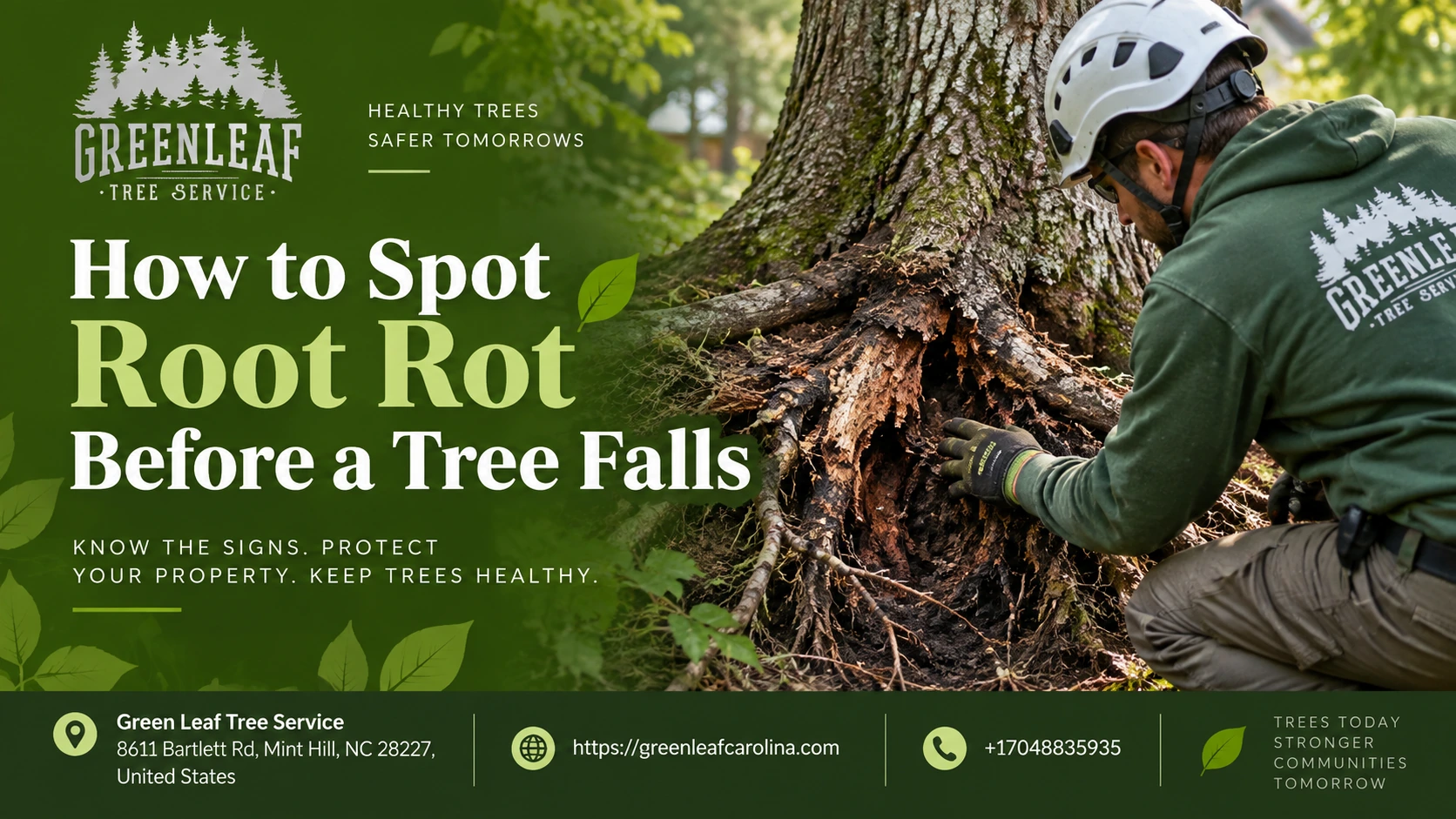
Common root rot tree signs include thinning foliage, yellow or undersized leaves, branch dieback, fungal growth near the trunk, soft roots, cracked soil, and a tree that begins leaning unexpectedly. Because most roots are hidden underground, the earliest warning signs often appear in the canopy or around the base rather than directly on the decaying roots.
Root rot can weaken both the health and structural stability of a tree. Mild cases may improve when drainage and other growing conditions are corrected, while advanced decay can leave the tree unable to support itself during strong winds or saturated soil conditions. Early evaluation gives homeowners the best chance to preserve the tree or manage the risk before failure occurs.
Worried About Root Rot?
Don’t wait for a weakened tree to fall. Call today to have your tree inspected by an expert.
What Causes Root Rot in Trees?
Root rot is a general term for diseases and decay that damage a tree’s root system. Fungal pathogens are common causes, but they usually become most destructive when the tree is already growing in stressful conditions.
Healthy roots need oxygen as well as water. When soil remains saturated for long periods, air spaces fill with water and roots receive less oxygen. This weakens the root system and creates conditions that favor fungi capable of damaging root tissue.
Common causes and contributing conditions include:
- Poorly drained soil
- Repeated overwatering
- Heavy clay that stays saturated
- Flooding
- Soil compaction
- Planting too deeply
- Excess mulch against the trunk
- Drainage changes
- Root injuries
- Construction near the tree
- Prolonged drought followed by excessive moisture
- Existing fungal pathogens in the soil
Root rot does not always begin with standing water. A tree can also become vulnerable when roots are cut, crushed, buried, or weakened by long-term stress.
Poor Drainage
Poor drainage is one of the most common environmental conditions associated with root problems. Water may collect around a tree because of low elevation, compacted soil, downspout discharge, irrigation, or changes to nearby grading.
A tree planted in a wet area may initially appear healthy. Over time, roots may decline because they cannot obtain enough oxygen.
Signs of poor drainage include:
- Water remaining after rain
- Soggy soil several days after irrigation
- Moss or moisture-loving weeds
- Dark, compacted soil
- Water flowing toward the trunk
- Erosion channels
- A buried root flare
Some tree species tolerate wet conditions better than others. A species that prefers well-drained soil may decline quickly in a location where a bald cypress or another moisture-tolerant tree could perform well.
Compacted Soil
Compacted soil limits air movement, water infiltration, and root growth. It is common around homes where heavy equipment, vehicles, foot traffic, or construction have compressed the ground.
Roots may remain shallow or grow unevenly when they cannot penetrate compacted soil. This reduces both water uptake and structural anchorage.
Root Injury
Roots can be damaged during:
- Trenching
- Driveway installation
- Foundation repairs
- Utility work
- Grading
- Patio construction
- Soil excavation
- Stump removal nearby
- Repeated vehicle traffic
Large structural roots are especially important for stability. Cutting or crushing them may weaken the tree immediately or allow decay to develop over several years.
Deep Planting and Excess Mulch
A tree planted too deeply may have its root flare buried below soil. This keeps the lower trunk and upper roots too moist and reduces oxygen around the root collar.
Excess mulch can create a similar problem when it is piled against the trunk. Mulch should form a broad, shallow layer rather than a mound around the tree.
Long-Term Stress
Drought, heat, insect activity, nutrient problems, and repeated defoliation can reduce a tree’s ability to defend itself. A stressed tree may be less capable of containing fungal infections or replacing damaged roots.
Root rot is therefore often the result of several problems working together rather than one isolated cause.
Is Root Rot Dangerous?
Root rot can become dangerous because roots perform two essential jobs. They absorb water and nutrients, and they anchor the tree in the ground.
When absorbing roots decline, the canopy may begin showing signs of stress. When larger structural roots decay, the tree may lose stability.
A tree with advanced root rot can fail even when the trunk looks solid and portions of the canopy remain green. The hidden nature of root decay is one reason professional evaluation is important.
Health Concerns
Root damage may reduce the tree’s ability to move water into the canopy. This can lead to:
- Yellow leaves
- Small leaves
- Sparse foliage
- Wilting
- Premature leaf drop
- Branch dieback
- Reduced annual growth
- Delayed leaf development
These symptoms can also result from drought, insects, soil compaction, or other diseases, so root rot should not be diagnosed from canopy appearance alone.
Stability Concerns
Structural roots spread from the trunk and help resist wind and gravity. As these roots decay, the tree may become less securely anchored.
The risk increases when root rot occurs with:
- Saturated soil
- High winds
- A heavy canopy
- A leaning trunk
- Root plate movement
- Cracks near the base
- Large dead branches
- Trunk decay
A tree may remain upright in calm weather but fail during a thunderstorm when wind loads and wet soil place additional force on the weakened root system.
Risk to Nearby Property
The seriousness of root rot depends partly on what the tree could strike.
A declining tree near a house, driveway, road, playground, utility line, or frequently used area creates more concern than a similar tree in an unused wooded location.
A tree does not need to be completely dead to pose a risk. A living tree with severe root decay may be less stable than a dead tree with an intact root system.
What Should Homeowners Check Near the Base of the Tree?
Homeowners should inspect the lower trunk, root flare, and surrounding soil from the ground. They should not dig aggressively around roots, pull away attached bark, or cut into the trunk to investigate.
Several signs may indicate that the root system or lower trunk needs professional attention.
Mushrooms or Fungal Growth
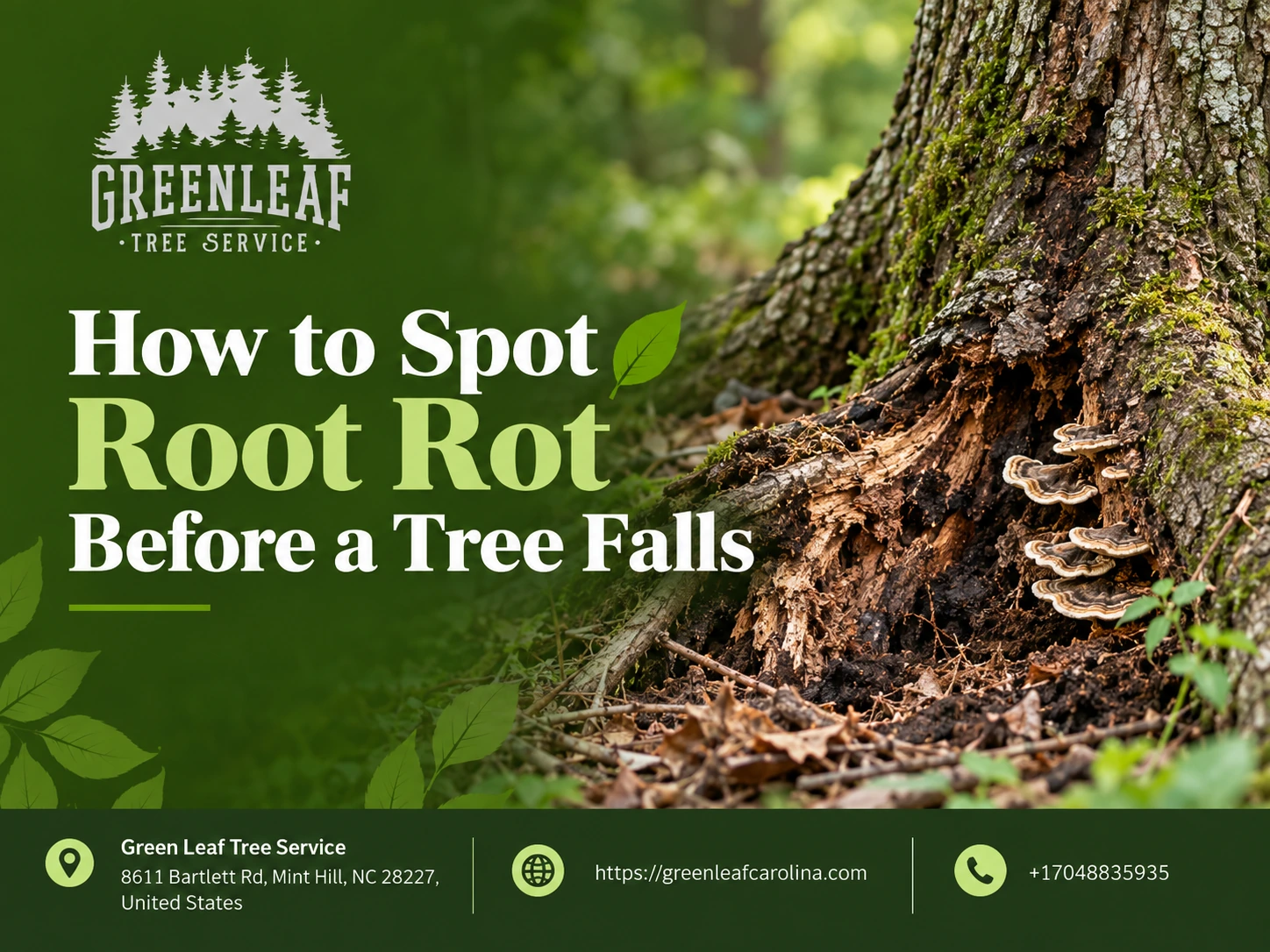
Mushrooms, conks, or shelf-like fungal structures near the trunk may indicate decaying roots or wood below the surface.
Fungal growth may appear:
- Directly against the trunk
- Between major roots
- In a ring around the tree
- Several feet from the trunk
- On exposed roots
- Near an old stump or buried wood
Not every mushroom means the tree has root rot. Some fungi break down mulch or unrelated organic material. However, repeated fungal growth near the root flare should not be ignored, especially when other symptoms are present.
Soft or Dark Wood
The root flare and lower trunk should feel firm. Soft, spongy, dark, or crumbling wood may indicate decay.
Homeowners may also notice:
- Loose bark
- A hollow area
- Wet-looking tissue
- Dark staining
- A foul smell
- Insect galleries
- Cavities near the soil line
Avoid probing deeply with tools because this can create new wounds and does not provide a reliable measure of internal damage.
Missing Root Flare
A healthy tree usually widens where the trunk meets the main roots. This widened area is the root flare.
If the trunk enters the ground like a straight post, the tree may be planted too deeply or covered by soil and mulch. Buried root flares can hide decay, girdling roots, and moisture damage.
Cracked or Lifted Soil
Cracks in the ground around the trunk may indicate movement of the root plate.
Watch for:
- Raised soil on one side
- Depressions around the base
- Gaps between soil and trunk
- Turf lifting
- Exposed roots
- Soil separating after wind
- Recent changes following storms
Root plate movement is more urgent than ordinary surface cracking caused by dry soil.
Girdling Roots
Roots that circle around the trunk or one another may restrict water and nutrient movement. They can also weaken the root flare over time.
Possible signs include:
- Roots wrapping around the trunk
- A flat or compressed trunk base
- One side of the trunk lacking a visible flare
- Canopy decline on one side
- Bark compressed beneath a root
Girdling roots can occur when a tree is planted too deeply or remains in a container too long before installation.
Excess Moisture
Check whether the soil stays wet long after rainfall. Irrigation leaks, downspouts, grading, and compacted clay can keep roots saturated.
A tree surrounded by constantly wet soil may have a higher risk of root decline, especially if the species requires good drainage.
Leaning
A newly leaning tree should be treated as a warning sign, particularly when the lean appears after heavy rain or strong winds.
Look for:
- Exposed roots
- Lifted soil
- Cracks around the base
- A widening gap on one side
- New contact with nearby structures
- Changes compared with older photographs
A long-standing lean may be stable. A new or increasing lean may indicate root failure.
How Root Decay Leads to Falling Risks
Root decay reduces the tree’s ability to resist wind and support its canopy. The process may begin underground and continue for years before obvious movement occurs.
Loss of Structural Roots
Large roots extend outward from the base and act like anchors. If several major roots decay, the tree may no longer resist force from certain directions.
A tree may become particularly vulnerable when decay is concentrated on one side. Wind pushing from the weakened side can cause the root plate to rotate.
Reduced Root Plate Strength
The root plate includes the trunk base, major roots, and surrounding soil. It works as a connected system.
Root rot can weaken this system by:
- Decaying major roots
- Separating roots from surrounding soil
- Creating cavities below ground
- Reducing new root growth
- Allowing soil to remain saturated
- Weakening the root collar
When wet soil is combined with decayed roots, the tree may become easier to overturn.
Canopy Imbalance
A heavy or one-sided canopy places uneven force on weakened roots. Large branches extending over a house or open area can act like levers during high winds.
The risk may increase after:
- Removal of neighboring trees
- Storm damage on one side
- Improper pruning
- Topping
- Construction that exposes the tree to more wind
- Loss of stabilizing roots
Delayed Failure
Root-damaged trees do not always fall immediately. They may remain standing through several storms and then fail under conditions that would not normally affect a healthy tree.
This delayed response can create a false sense of security. A tree that survived one storm is not necessarily stable if roots continue decaying.
Trunk and Root Decay Together
Root rot may spread into the lower trunk, or trunk decay may extend into major roots. When both areas are affected, structural strength can decline significantly.
Warning signs include:
- Cavities near the base
- Fungal conks
- Bark loss
- Soft wood
- Deep cracks
- A new lean
- Repeated branch dieback
A tree with lower trunk and root decay requires careful assessment because the entire structure may be compromised.
When Should You Schedule a Tree Inspection?
A professional tree inspection is recommended when several symptoms appear together or when the tree stands close to people or property.
Homeowners should schedule an evaluation when they notice:
- Mushrooms near the trunk
- Soft or decaying roots
- A thinning canopy
- Yellow or undersized leaves
- Premature leaf drop
- Large dead branches
- A new lean
- Cracked or lifting soil
- Root flare decay
- Fungal conks
- Significant construction near the roots
- Repeated flooding
- Sudden canopy decline
- Soil that remains saturated
The urgency increases when the tree is near:
- A home
- A driveway
- A road
- A utility line
- A garage
- A playground
- A patio
- A neighboring structure
After Severe Weather
Trees with suspected root problems should be checked after major storms, flooding, or prolonged rain. Wet soil reduces resistance around roots, while wind adds force to the trunk and canopy.
Keep people and vehicles away from a tree that is leaning, moving, or surrounded by lifted soil.
After Construction
An inspection is also useful after trenching, grading, driveway work, foundation repair, or utility installation near a mature tree.
Root injury may not produce immediate symptoms. Canopy decline and instability can develop later.
When Symptoms Are Unclear
Many root rot symptoms resemble other problems. Yellow leaves may result from drought, nutrient issues, pests, compacted soil, or root disease.
A professional can evaluate the whole tree and site rather than treating one symptom in isolation.

Can Tree Roots Damage Foundations or Driveways?
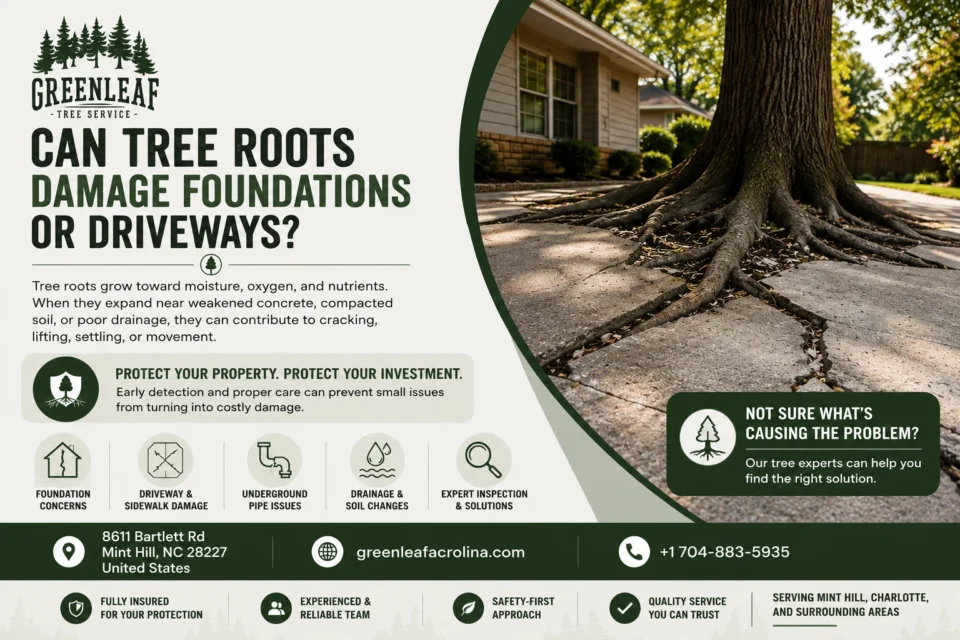
Yes, tree roots can damage driveways, sidewalks, patios, and sometimes contribute to foundation problems, but they usually do not “attack”…
What Treatment or Removal Options Exist?
Root rot treatment depends on the cause, severity, tree species, location, and amount of living root tissue that remains.
There is no single treatment that restores roots already destroyed by decay.
Improve Drainage
If the problem is identified early and the tree remains stable, improving drainage may reduce stress and slow further decline.
Possible steps include:
- Redirecting downspouts
- Adjusting irrigation
- Correcting low areas
- Reducing soil saturation
- Improving surface drainage
- Avoiding repeated watering near the trunk
Drainage work should be planned carefully so excavation does not damage additional roots.
Reduce Soil Compaction
Compacted soil may be improved through professional soil management methods. The goal is to increase air and water movement without cutting major roots.
Heavy equipment, vehicles, and repeated foot traffic should be kept away from the root zone.
Correct Mulch and Soil Depth
Excess mulch should be pulled back from the trunk. The root flare should remain visible.
Soil should not be removed aggressively without understanding where roots are located. A professional root collar excavation may be appropriate when the base is buried.
Reduce Other Stress
A tree with limited root damage may benefit from:
- Consistent watering during drought
- Proper mulch placement
- Protection from construction
- Pruning dead branches
- Avoiding unnecessary fertilizer
- Pest management when confirmed
- Ongoing monitoring
Fertilizer does not repair decayed roots and may not be appropriate unless a deficiency has been identified.
Targeted Arboricultural Care
Some root diseases may have specific management options, but treatment must be based on a confirmed diagnosis.
The appropriate plan may involve:
- Soil management
- Disease-specific treatment
- Root collar care
- Canopy management
- Monitoring
- Tree-risk reduction
Homeowners should avoid applying fungicides without identifying the pathogen. Many products do not reach infected structural roots or reverse advanced decay.
Monitoring
A tree with limited decay and acceptable stability may remain in place with regular inspections.
Monitoring may focus on:
- Changes in lean
- New fungal growth
- Canopy thinning
- Additional root movement
- Branch dieback
- Soil cracking
- Trunk decay
- Storm-related changes
The inspection interval depends on the tree’s size, location, defects, and rate of decline.
Removal
Removal may be recommended when the root system can no longer support the tree safely.
Common reasons include:
- Major structural root decay
- Significant root plate movement
- A rapidly increasing lean
- Extensive lower trunk decay
- Severe canopy decline
- Repeated branch failure
- Large cavities at the base
- Unacceptable risk to nearby property
- No practical way to restore stability
A tree with advanced root rot may be difficult to remove because the trunk and roots can fail unpredictably. Homeowners should avoid attempting removal themselves near structures or occupied areas.
How Green Leaf Carolina Can Help
Green Leaf Carolina helps homeowners evaluate trees showing possible root rot, structural instability, or unexplained canopy decline.
A professional inspection can consider:
- Canopy density
- Leaf size and color
- Branch dieback
- Fungal growth
- Root flare condition
- Soil moisture
- Drainage
- Root plate movement
- Construction history
- Tree lean
- Nearby homes and occupied areas
The goal is to determine whether symptoms are related to root rot, another tree health problem, or site conditions that can be corrected.
When the tree remains stable and has enough healthy root tissue, recommendations may include drainage improvements, root-zone protection, stress reduction, pruning, and ongoing monitoring.
When decay has significantly weakened structural roots or the lower trunk, removal may be the safest option. Early evaluation helps homeowners make that decision before the tree becomes more unstable or fails during severe weather.
FAQs
What are the first signs of root rot in a tree?
Early signs may include thinning foliage, yellow leaves, small leaves, reduced growth, premature leaf drop, and branch dieback. Mushrooms or soft wood near the base may also indicate root decay.
Can a tree have root rot without mushrooms?
Yes. Fungal structures are not always visible. Root rot may be present even when no mushrooms appear above the soil.
Do mushrooms around a tree always mean root rot?
No. Some mushrooms grow on mulch, buried wood, or unrelated organic material. Repeated growth near the root flare combined with tree decline is more concerning.
Can overwatering cause root rot?
Yes. Repeated overwatering can keep soil saturated, reduce oxygen around roots, and create favorable conditions for fungal pathogens.
Can clay soil cause root rot?
Clay does not directly cause root rot, but poorly drained or compacted clay can remain wet for long periods and increase root stress.
Can drought cause root rot?
Drought can weaken roots and reduce the tree’s defenses. If heavy rainfall or overwatering follows, stressed roots may become more vulnerable to decay.
What do rotten roots look like?
Decayed roots may appear dark, soft, hollow, stringy, or crumbly. Healthy roots are generally firm. Homeowners should not dig up major roots simply to inspect them.
Why is my tree leaning suddenly?
A new lean may result from root plate movement, root decay, saturated soil, storm damage, or broken structural roots. It should be evaluated promptly.
Is cracked soil around a tree dangerous?
Ordinary dry soil can crack, but cracks combined with leaning, lifted turf, exposed roots, or recent storms may indicate root movement.
Can root rot make a tree fall without warning?
Yes. Advanced decay can weaken major roots below ground, allowing the tree to fail during wind or saturated soil conditions with limited visible warning.
Can a tree recover from root rot?
A tree may stabilize when decay is limited and the underlying moisture or soil problem is corrected. Roots already destroyed by decay do not regrow, but new healthy roots may develop if conditions improve.
Is root rot always fatal?
No. The outcome depends on the pathogen, severity, tree species, site conditions, and amount of healthy root tissue remaining.
Can fungicide cure root rot?
Not in every case. Some diseases may have targeted treatment options, but fungicides do not restore decayed structural roots. Correct diagnosis is necessary before treatment.
Should I remove mulch from around a tree with root rot?
Excess mulch touching the trunk should be pulled back. A thin mulch layer can remain over the wider root zone, but the root flare should stay visible.
Can root rot spread to other trees?
Some fungal pathogens can spread through soil, root contact, or infected material. Others remain limited to one tree. Identification is needed to determine whether nearby trees are at risk.
Does root rot cause dead branches?
Yes. Damaged roots may not supply enough water to the canopy, leading to branch dieback and thinning foliage.
Can roots rot while the tree still has green leaves?
Yes. Trees may retain green foliage while structural roots are declining. Canopy appearance alone does not confirm stability.
What is a root flare?
The root flare is the widened area where the trunk transitions into the main roots. It should usually be visible at the soil surface.
Why is a buried root flare a problem?
A buried root flare can keep bark and roots too moist, reduce oxygen, encourage girdling roots, and hide decay.
Can construction cause root rot?
Construction can cut or crush roots, compact soil, change drainage, and create wounds where decay may develop.
Should roots be cut away if they look rotten?
No. Cutting large roots can reduce stability further. Root removal should only be considered after professional evaluation.
What will an arborist check for root rot?
An arborist may inspect the canopy, trunk base, root flare, visible roots, soil moisture, fungal growth, tree lean, construction history, and signs of root plate movement.
Can root rot be diagnosed without digging up the tree?
Often, yes. Diagnosis begins with visual inspection, tree history, site conditions, and symptoms. Limited root collar excavation or other testing may be recommended when necessary.
When should a root-rotted tree be removed?
Removal may be appropriate when major roots are extensively decayed, the tree is leaning or moving, lower trunk decay is severe, or the tree presents a risk that cannot be managed safely.
Is a tree with root rot more likely to fall during rain?
Yes. Saturated soil provides less resistance around weakened roots, and storms may add wind force to the canopy.
Should I stay away from a leaning tree after a storm?
Yes. Keep people, pets, and vehicles out of the potential fall area until the tree has been evaluated.
Can pruning make a root-rotted tree safe?
Pruning may reduce deadwood or canopy load in selected cases, but it cannot restore decayed structural roots. The tree’s stability must be evaluated first.
How often should a tree with suspected root rot be inspected?
The frequency depends on the severity, tree size, location, and rate of change. Additional inspections may be recommended after storms, flooding, or visible movement.
Can improving drainage save the tree?
Improving drainage may help when root damage is limited and enough healthy roots remain. It is less likely to restore safety when major structural roots are already decayed.
Who should evaluate suspected root rot?
A qualified arborist or experienced tree professional should assess the tree. Large trees near homes or occupied areas may also require a formal tree-risk evaluation.
Spot Root Rot Before It’s Too Late
Hidden root damage can make a tree dangerous. Call now for a professional tree inspection.