
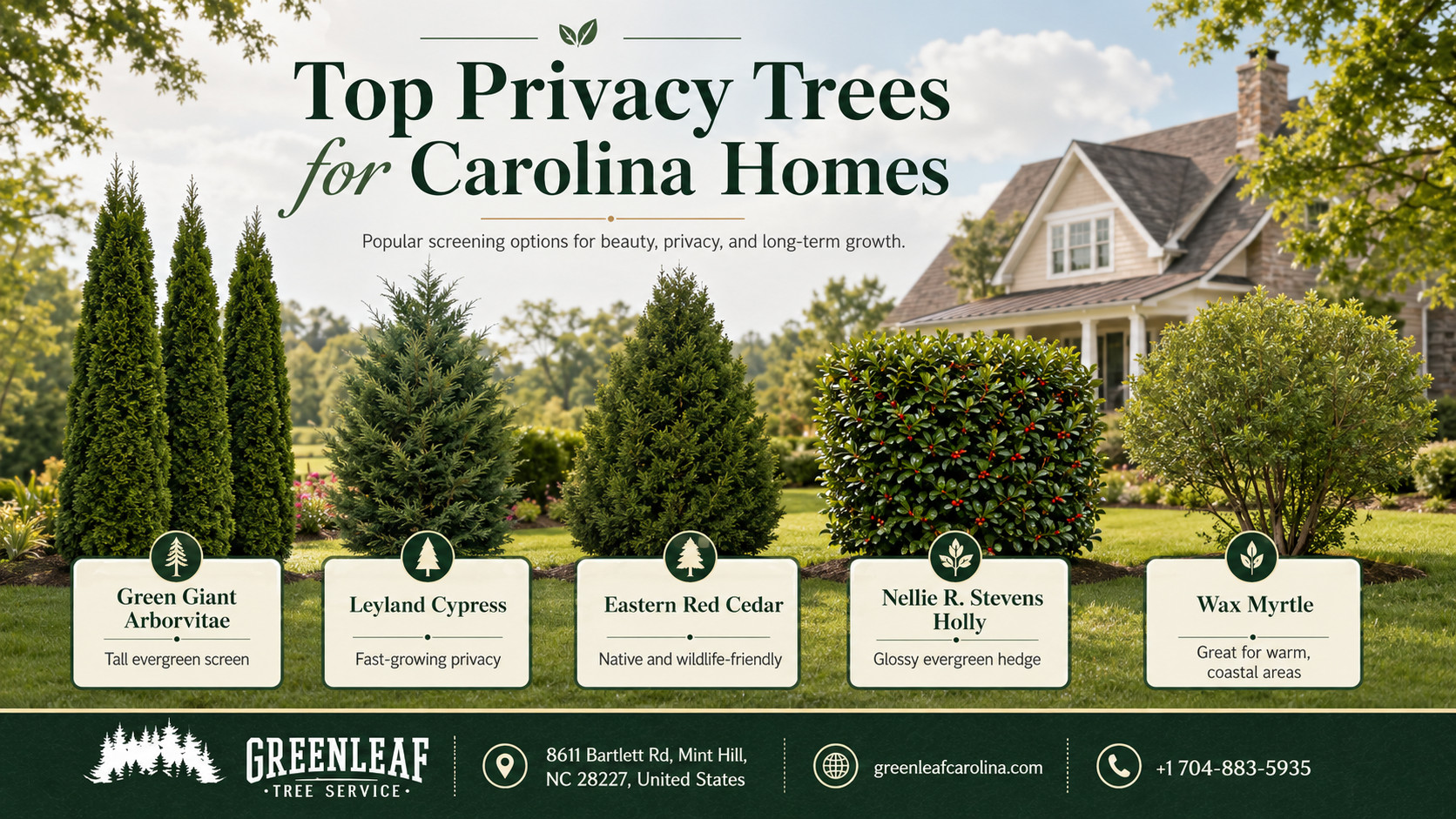
The best fast growing privacy trees NC homeowners can plant include Green Giant Arborvitae, Leyland Cypress, Nellie R. Stevens Holly, Wax Myrtle, and Eastern Red Cedar. Each can create an attractive living screen, but they differ significantly in mature size, maintenance needs, disease resistance, and suitability for small residential yards.
Rapid growth can provide privacy sooner, but speed should not be the only consideration. A tree that grows several feet per year may eventually overwhelm its planting area, require regular pruning, or become vulnerable to disease when planted too closely. The most successful privacy screen uses trees that fit the property at maturity, not just trees that look appropriately sized at the nursery.
Want Privacy Without the Wait?
Choose fast-growing trees that add natural screening and beauty to your property. Call today to get started.
What Privacy Trees Grow Fastest in North Carolina?
North Carolina’s climate supports several evergreen trees capable of forming dense privacy screens. Growing conditions vary between the mountains, Piedmont, and coastal areas, so homeowners should consider their specific region before selecting a species.
Annual growth rates are estimates rather than guarantees. Soil drainage, sunlight, rainfall, root competition, planting depth, and early care can all affect how quickly a tree becomes established.
Green Giant Arborvitae
Green Giant Arborvitae is one of the most popular choices for homeowners who want a tall evergreen screen relatively quickly. Under favorable conditions, it may grow approximately two to three feet per year after becoming established.
It develops a dense, pyramidal shape and can become a substantial tree. Mature specimens may exceed 40 feet in height and reach approximately 15 to 20 feet wide, which means they need considerably more room than their narrow nursery appearance suggests.
Green Giant Arborvitae performs well in full sun or light afternoon shade and prefers moist, well-drained soil. It tolerates different soil types, periodic drought after establishment, and many common insect and disease problems. It is also more resistant to deer browsing than many other arborvitae varieties. However, it does not tolerate salty soil or coastal salt spray well.
Expected growth: About 2 to 3 feet annually under good conditions
Mature size: Commonly 40 feet or taller and 15 to 20 feet wide
Maintenance: Low to moderate when given enough space
Best use: Tall screens on medium or large properties
Main concern: Becomes too large for many narrow yards
Green Giant Arborvitae usually needs less shearing when it is planted where its natural shape can develop. Trees installed too close to fences, buildings, or one another may eventually require frequent trimming.
Leyland Cypress
Leyland Cypress is widely known for fast growth. Young trees may grow approximately three to four feet per year when they receive full sun, adequate moisture, and good drainage. Mature trees commonly reach 60 to 70 feet tall and 12 to 20 feet wide, with some becoming even larger.
This rapid growth can create privacy quickly, but Leyland Cypress has important long-term drawbacks. It is commonly affected by disease and insect problems when trees are crowded, stressed, poorly placed, or planted repeatedly as a single-species screen.
Clemson Extension recommends full sun and moist, well-drained soil for maintaining healthy Leyland Cypress trees. Stressed plants are less able to withstand cankers, root problems, bagworms, and other damaging conditions.
Expected growth: About 3 to 4 feet annually when young
Mature size: Approximately 60 to 70 feet tall and 12 to 20 feet wide
Maintenance: Moderate to high in confined spaces
Best use: Large, sunny properties with good drainage
Main concern: Disease pressure and excessive mature size
Leyland Cypress can still work as a screen, but it should not be treated as a narrow hedge. Homeowners need to plan for its mature canopy and monitor trees for signs of stress or decline.
Nellie R. Stevens Holly
Nellie R. Stevens Holly is a broadleaf evergreen with glossy leaves, dense branching, and red berries. It generally grows more moderately than Leyland Cypress, but it can still establish an effective privacy screen within a reasonable period.
The tree quickly matures to approximately 15 to 30 feet tall and 8 to 25 feet wide. It grows in full sun or partial shade and tolerates heat, drought, and heavy clay better than many other hollies. However, it prefers acidic, well-drained soil and should not be planted in consistently wet ground.
Expected growth: Often around 1 to 2 feet annually
Mature size: Approximately 15 to 30 feet tall and 8 to 25 feet wide
Maintenance: Moderate, depending on the desired shape
Best use: Medium-height screens and broad evergreen hedges
Main concern: Its mature width is often underestimated
Nellie R. Stevens Holly can be pruned into a formal hedge, but repeated heavy shearing increases maintenance. It performs best when given enough room to maintain a broad pyramidal or rounded form.
Wax Myrtle
Wax Myrtle is a fast-growing broadleaf evergreen shrub or small tree that works especially well in warmer parts of North Carolina and nearby South Carolina communities.
It may reach approximately 20 to 25 feet tall and 8 to 10 feet wide, although many plants remain shorter. Wax Myrtle grows in full sun or partial shade and tolerates a wide range of soil conditions. Once established, it can perform in both wet areas and relatively dry sites.
Because Wax Myrtle is only semi-evergreen in colder portions of its growing range, it may not provide the same dependable winter screening in the North Carolina mountains as it does in the Piedmont, Sandhills, coastal areas, or the Fort Mill region.
Expected growth: Often around 2 to 3 feet annually
Mature size: Up to 20 to 25 feet tall and approximately 8 to 10 feet wide
Maintenance: Moderate; responds well to pruning
Best use: Informal screens, coastal areas, and medium-height privacy
Main concern: May lose some foliage during colder winters
Wax Myrtle tends to produce a looser, more natural screen than arborvitae or cypress. Multiple stems and irregular branching can be beneficial for informal properties but may not suit homeowners seeking a formal wall of foliage.
Eastern Red Cedar
Eastern Red Cedar is a native evergreen with dense foliage and strong wildlife value. It is generally slower than Green Giant Arborvitae or Leyland Cypress, but it can still provide steady growth and durable long-term screening.
Its tolerance of drought, heat, poor soil, and deer browsing makes it useful on rural properties or sites where less adaptable trees might struggle. It is often planted as a windbreak or naturalized privacy boundary.
Standard Eastern Red Cedar trees need substantial space. NC State Extension recommends spacing them approximately 12 to 24 feet apart, depending on their intended use and growing conditions.
Expected growth: Commonly around 1 to 2 feet annually
Mature size: Often 30 to 50 feet tall with a broad spread
Maintenance: Generally low after establishment
Best use: Natural screens, windbreaks, and larger properties
Main concern: Too broad for many small suburban lots
Eastern Red Cedar is often a stronger long-term choice than a very fast-growing species when homeowners value durability, wildlife habitat, and lower maintenance more than immediate coverage.
Are Fast-Growing Trees Harder to Maintain?
Fast-growing trees are not automatically high-maintenance, but their growth rate can create additional responsibilities.
A tree that adds three feet of height in one season also expands outward. When trees are planted too close to fences, buildings, sidewalks, or property lines, homeowners may need to prune them repeatedly to keep branches within the available area.
Common maintenance concerns include:
- Pruning branches away from fences and structures
- Removing dead or storm-damaged limbs
- Monitoring for insects and diseases
- Watering during establishment and drought
- Correcting uneven or crowded growth
- Managing branches that cross property lines
- Replacing trees that decline within a single-species row
Leyland Cypress is a clear example of how fast growth can create long-term difficulties. Its popularity has led to extensive use in dense, single-species screens. Clemson Extension reports that disease and insect damage can spread readily from tree to tree in these monoculture plantings.
Green Giant Arborvitae generally has stronger disease resistance, but it still becomes a large tree. It may require little pruning on a spacious property while becoming a constant maintenance problem in a planting strip only a few feet wide.
Nellie R. Stevens Holly and Wax Myrtle respond well to pruning, but homeowners should decide whether they want a natural screen or a formal hedge. Formal hedges usually require regular shaping, while naturally growing screens need less intervention.
Maintenance is determined as much by placement as by species. A large tree in an appropriately sized area may be easier to manage than a smaller tree planted too close to a house.
What Should Homeowners Consider Before Planting?
Tree selection should begin with the property’s limitations and the homeowner’s privacy goal. Choosing a species before evaluating the site can lead to crowded trees, poor growth, and unnecessary maintenance.
Determine What Needs to Be Screened
The required tree height depends on the view being blocked. Ground-level screening around a patio may only need foliage 8 to 12 feet high. Screening a neighboring second-story window may require trees that mature above 20 feet.
Homeowners should identify whether they need privacy:
- Around a patio or pool
- Along a backyard boundary
- From a road or parking area
- Between neighboring homes
- From an elevated deck
- Around an entire property
- During every season
The screen does not always need to be extremely tall. Selecting a smaller tree that reaches the necessary height can reduce pruning and long-term crowding.
Measure the Available Width
The planting area’s width is often more important than its length. A tree that matures 15 feet wide cannot remain healthy indefinitely in a four-foot strip between a fence and driveway.
Measurements should account for:
- Distance from buildings
- Distance from fences
- Access for future maintenance
- Sidewalks and driveways
- Neighboring property
- Septic systems and drainage fields
- Underground and overhead utilities
Trees should be positioned so their mature canopies remain mostly within the property and do not obstruct access.
Evaluate Sunlight
Green Giant Arborvitae and Leyland Cypress generally perform best in full sun. Nellie R. Stevens Holly and Wax Myrtle can tolerate partial shade, although denser foliage usually develops with adequate light.
Homeowners should observe the site throughout the day rather than judging sunlight during one visit. Buildings, mature trees, and tall fences may cast long periods of shade.
Check Soil Drainage
Many privacy trees tolerate North Carolina clay, but tolerance of clay does not mean tolerance of standing water.
Green Giant Arborvitae prefers moist but well-drained soil. Leyland Cypress also requires good drainage, while Nellie R. Stevens Holly should not be planted in persistently wet areas. Wax Myrtle is more adaptable to changing moisture levels.
Signs of drainage problems include:
- Water remaining after rainfall
- Moss or moisture-loving weeds
- Eroded channels
- Soil that remains sticky for several days
- Downspouts draining into the planting area
- Runoff from neighboring property
Correcting major drainage problems may be necessary before planting.
Allow for Mature Spacing
Privacy trees are often planted closely because homeowners want immediate coverage. This approach may produce a solid screen quickly, but it can also cause long-term competition for water, nutrients, sunlight, and airflow.
Spacing should be based on mature width and planting design. A staggered double row may provide better visual coverage than a tightly packed single row.
Homeowners should avoid relying on universal spacing recommendations. The appropriate distance depends on the species, cultivar, intended height, expected pruning, and available growing area.
Review Utility and HOA Restrictions
Tall privacy trees should not be planted under power lines. Underground utilities, septic components, irrigation lines, easements, and drainage corridors should also be identified.
Homeowners associations may regulate tree species, hedge height, placement, or visibility near streets. These requirements should be reviewed before trees are purchased.
Consider the Local Climate
North Carolina includes several distinct growing regions. A tree that performs well near Charlotte may respond differently in Boone or along the Outer Banks.
The Fort Mill area is technically in South Carolina, just south of the North Carolina state line, but its Piedmont climate and soil conditions are similar to those in the greater Charlotte region. Hot summers, clay soils, occasional drought, intense thunderstorms, and winter cold snaps all influence privacy-tree performance.
Coastal properties should also account for salt exposure. Green Giant Arborvitae is not tolerant of salt spray or salty soil, making it less suitable for exposed coastal sites.
Which Trees Work Best for Small Yards?
Most fast-growing privacy trees are not naturally small. Green Giant Arborvitae, Leyland Cypress, and standard Eastern Red Cedar can eventually overwhelm narrow lots.
Small yards require trees with narrow mature forms, controlled heights, or manageable growth habits.
Narrow Eastern Red Cedar Cultivars
Taylor Eastern Red Cedar is a narrow cultivar that grows approximately 20 to 25 feet tall but only three to four feet wide. Its upright shape can provide vertical screening without occupying the width required by the standard species.
It is not as fast-growing as Leyland Cypress, but its narrow habit may provide better long-term performance in confined spaces.
Smaller Holly Cultivars
Nellie R. Stevens Holly may be too broad for very small yards. A narrower or more compact holly cultivar can provide evergreen coverage while reducing the need for constant pruning.
Homeowners should check the exact cultivar name and mature measurements. The word “holly” covers hundreds of species and cultivars with very different sizes.
Wax Myrtle With Planned Pruning
Wax Myrtle can work in a small or medium yard when homeowners have sufficient width and are comfortable with occasional pruning. Its multi-stemmed growth can be shaped into an informal hedge, although standard Wax Myrtle may still become too large for a very narrow planting bed.
Layered Shrub Screens
A small yard may not need a row of tall trees. A layered screen using compact evergreen shrubs, small trees, and ornamental plants can block common sightlines while preserving usable space.
This approach works particularly well around patios, decks, and ground-level windows. Screening the exact view is often more practical than enclosing the entire property.
Trees to Use Carefully
Leyland Cypress is rarely a good long-term choice for a narrow backyard. Its rapid growth and large mature size can lead to excessive shearing, bare lower branches, property-line conflicts, and increased stress.
Green Giant Arborvitae also needs more room than many homeowners expect. It is best used where its natural width can be accommodated.
What Are the Pros and Cons of Fast Growth?
Rapid growth offers clear benefits, but homeowners should consider the entire lifespan of the privacy screen.
Advantages of Fast-Growing Privacy Trees
Privacy develops sooner. Fast-growing species can begin closing gaps within a few growing seasons.
Young trees can be more affordable. Homeowners may plant smaller nursery stock and allow natural growth to create the screen.
Large areas can be screened effectively. Tall species work well along roads, fields, commercial boundaries, and spacious property lines.
Evergreens provide year-round coverage. Most popular fast-growing screen trees retain foliage through winter.
They may reduce visual exposure and wind. A well-positioned screen can soften views and provide some protection from prevailing winds.
Disadvantages of Fast-Growing Privacy Trees
Mature size can exceed the available space. Many fast-growing trees become 40 to 70 feet tall.
More pruning may be required. Trees planted near buildings or boundaries may need repeated trimming.
Some species experience disease problems. Leyland Cypress is particularly vulnerable when planted in crowded or stressful conditions.
Dense single-species rows are vulnerable. One pest, disease, or weather event can affect multiple trees at once.
Storm damage may create gaps. Tall screens exposed to wind or saturated soil can lose branches or entire trees.
Replacement becomes difficult. Installing a young replacement within a mature row may result in shade and root competition.
Rapid initial growth does not guarantee longevity. Site suitability, root health, spacing, and ongoing care have a greater influence on long-term success than speed alone.
A mixed screen can reduce some of these risks. Combining several compatible evergreen species creates variation in height, texture, and disease susceptibility. Clemson Extension recommends diverse screens as an alternative to uniform Leyland Cypress plantings.
When Should You Hire a Tree Planting Professional?
Homeowners may be able to plant a few small trees themselves, but professional help becomes valuable when the screen involves many trees, large nursery specimens, difficult terrain, or precise sightline requirements.
Professional planting may be appropriate when:
- The property has heavy or compacted clay
- Drainage is uncertain
- The screen extends along a long boundary
- Large trees must be transported and positioned
- Underground utilities are nearby
- The planting area is sloped
- Several species will be combined
- The available width is limited
- The screen must block a specific elevated view
- Long-term spacing is difficult to calculate
Correct planting depth is critical. Trees placed too deeply may struggle to develop healthy roots, while shallow or poorly stabilized trees may dry out or lean.
Professionals can also evaluate the planting area before trees are purchased. This prevents homeowners from investing in trees that are too large, poorly adapted, or unable to tolerate the site’s drainage and sunlight.
Fall is often a favorable planting season in the North Carolina Piedmont because cooler air reduces heat stress while the soil remains warm enough for root development. Early spring can also work well. Summer planting may succeed, but newly installed trees require close moisture monitoring during hot and dry weather.
How Green Leaf Carolina Can Help
Green Leaf Carolina helps homeowners plan privacy screens based on the property’s available space, sunlight, soil, drainage, and desired screening height.
The process may include comparing fast-growing options such as Green Giant Arborvitae, Leyland Cypress, Nellie R. Stevens Holly, Wax Myrtle, and Eastern Red Cedar. A recommended screen does not need to use only one species. Mixed or staggered plantings may provide better coverage, stronger visual interest, and improved resilience.
Professional planting can also help ensure that each tree is positioned at the correct depth and given enough room to develop. Proper spacing may take slightly longer to create complete coverage, but it can reduce crowding, disease pressure, and future pruning.
The objective is not simply to install the fastest-growing trees available. It is to establish a healthy privacy screen that fits the property and remains manageable as the trees mature.
FAQs
What is the fastest-growing privacy tree in North Carolina?
Leyland Cypress is among the fastest and may grow approximately three to four feet per year when young. Green Giant Arborvitae may grow around two to three feet annually. Actual growth depends on soil, sunlight, moisture, planting quality, and tree health.
Is Green Giant Arborvitae better than Leyland Cypress?
Green Giant Arborvitae generally has better resistance to many common diseases and insects. Leyland Cypress may grow faster initially but is more likely to experience problems when stressed or planted in crowded rows. Both trees need considerable space.
How quickly does Nellie R. Stevens Holly grow?
Nellie R. Stevens Holly commonly grows around one to two feet per year under suitable conditions. It is not usually as fast as Leyland Cypress, but it provides dense broadleaf foliage and better size options for some residential properties.
Is Wax Myrtle suitable for North Carolina?
Yes, particularly in the Piedmont, Sandhills, coastal plain, and warmer locations. It tolerates varied soil moisture and may grow quickly. In colder parts of North Carolina, however, it may become semi-evergreen and provide less winter coverage.
Is Eastern Red Cedar a fast-growing tree?
Eastern Red Cedar has a moderate growth rate rather than an extremely fast one. Its drought tolerance, deer resistance, native habitat value, and long-term durability can make it a better choice than faster trees for certain properties.
Which privacy tree is best for a small yard?
A narrow cultivar such as Taylor Eastern Red Cedar may work better than standard Green Giant Arborvitae or Leyland Cypress. Taylor Eastern Red Cedar reaches approximately 20 to 25 feet tall while remaining around three to four feet wide.
How far apart should fast-growing privacy trees be planted?
Spacing depends on mature width, cultivar, planting arrangement, and whether the trees will be pruned. Homeowners should not base spacing on the trees’ current nursery size. Crowded planting may create fast initial coverage but can reduce long-term health.
How long does a privacy screen take to fill in?
Fast-growing trees may begin providing noticeable coverage within two to four growing seasons. Complete screening may take longer depending on starting size, spacing, growth rate, sunlight, soil, rainfall, and maintenance.
Can privacy trees be planted near a fence?
Yes, but they should be positioned far enough away to accommodate their mature width and permit maintenance access. Branches should not be expected to remain within a narrow space without regular pruning.
Can privacy trees grow in North Carolina clay soil?
Several species tolerate clay, including Green Giant Arborvitae and Nellie R. Stevens Holly, as long as drainage is adequate. Persistent standing water can damage roots even when a species is described as clay-tolerant.
Do fast-growing privacy trees need frequent watering?
Newly planted trees need consistent moisture while roots become established. Watering frequency depends on tree size, rainfall, soil type, drainage, temperature, and season. The soil should remain moist without staying waterlogged.
Are mixed privacy screens better than single-tree rows?
Mixed screens can be more resilient because diseases and insects are less likely to affect every plant in the same way. They also provide varied heights, textures, and seasonal interest.
Should Leyland Cypress be avoided?
Not necessarily. It can perform well on a large, sunny, well-drained property with appropriate spacing. However, homeowners should understand its eventual size and susceptibility to stress-related disease and insect problems.
What is the best time to plant privacy trees in North Carolina?
Fall and early spring are commonly favorable because temperatures are cooler and trees experience less heat stress. Summer planting is possible but requires dependable watering and careful monitoring.
How can homeowners make privacy trees grow faster?
Homeowners should choose a suitable species, plant it at the correct depth, provide adequate spacing, maintain consistent moisture, protect the root zone, and avoid unnecessary stress. Excess fertilizer does not correct poor drainage, deep planting, or inadequate sunlight.
Create a Private Backyard Faster
Find the right privacy trees for North Carolina’s climate and your landscape. Call now for expert help.