
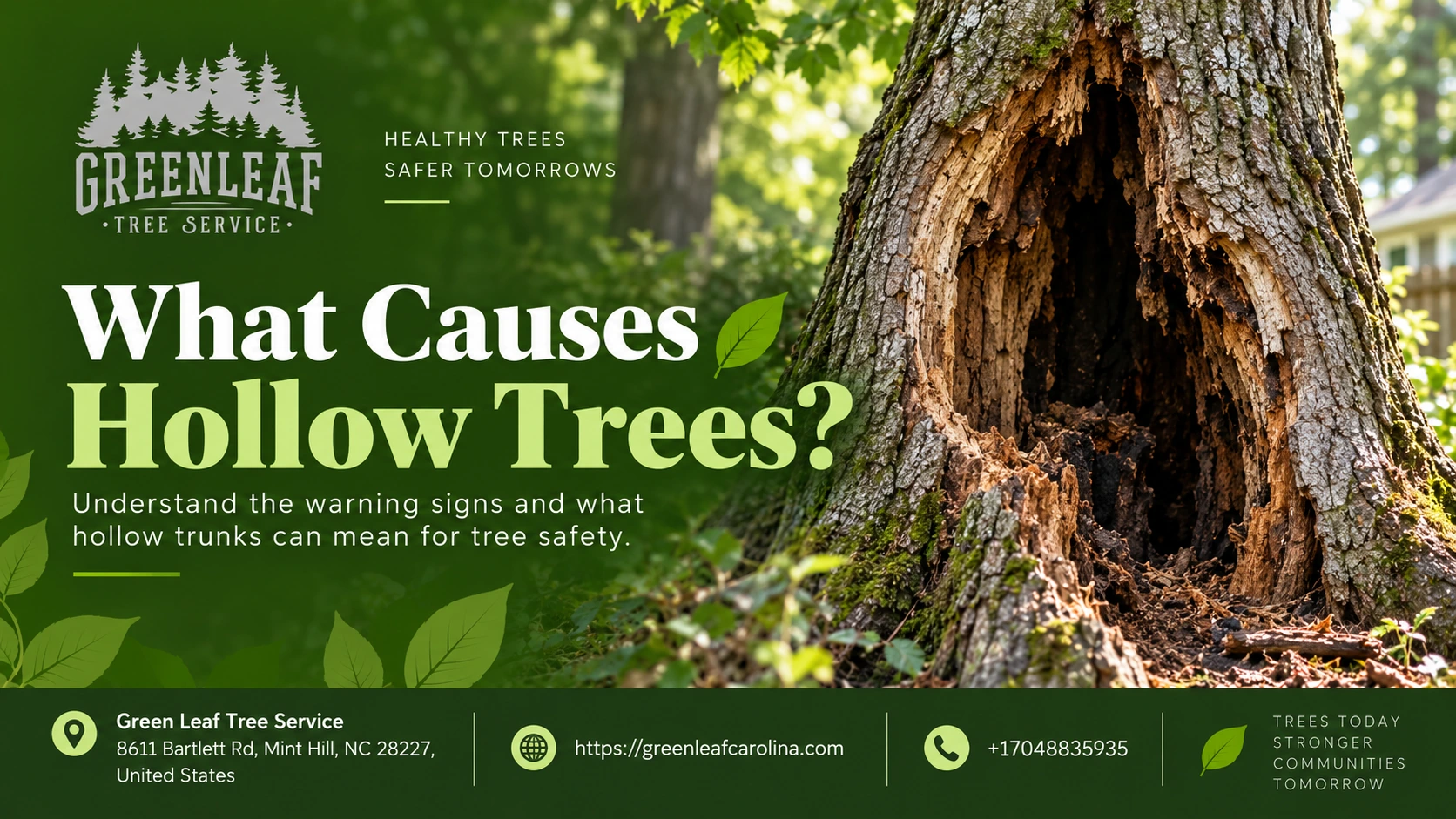
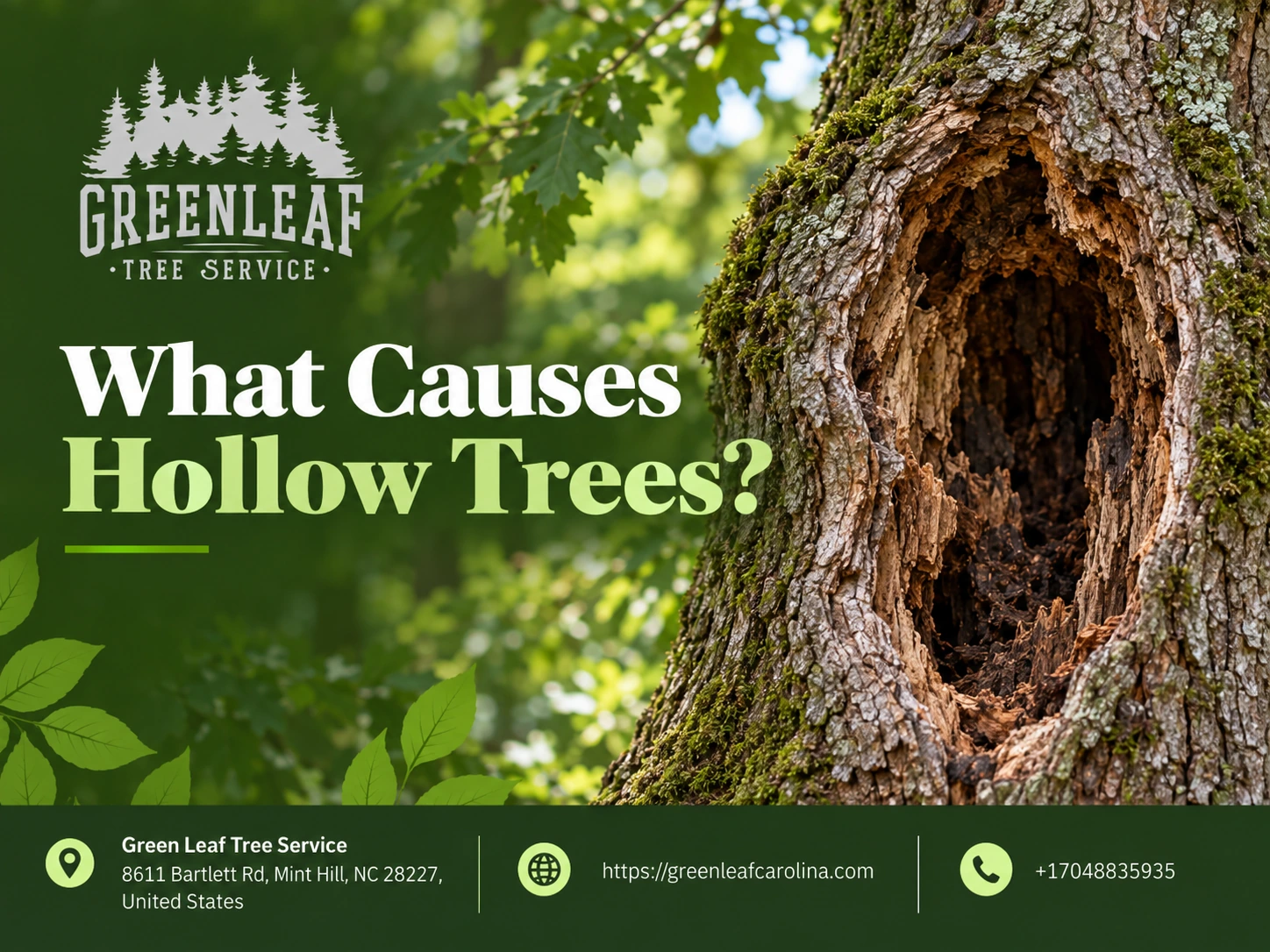
Common hollow tree causes include fungal decay, old pruning wounds, storm damage, broken branches, insect activity, disease, trunk injuries, and the natural aging process. In most cases, a tree does not become hollow suddenly. Internal decay develops slowly as fungi break down damaged or dead wood inside the trunk.
A hollow tree is not automatically dangerous. Some trees remain stable for many years because the living outer wood continues to support the trunk and transport water and nutrients. The level of concern depends on how much sound wood remains, where the hollow area is located, whether roots are affected, and what the tree could strike if it failed. A professional inspection is the safest way to determine whether the tree can be monitored, treated, or removed.
Worried About a Hollow Tree?
A hollow trunk can signal hidden decay or structural weakness. Call now for a professional tree inspection.
What Causes Trees to Become Hollow?
Trees usually become hollow after an injury allows decay organisms to enter the wood. The tree may continue growing around the damaged area, while fungi slowly decompose the inner wood over many years.
Unlike people, trees do not heal damaged tissue by replacing it. They grow new wood around injuries and attempt to isolate the damaged area from healthy tissue. This process can be effective, but large or repeated wounds may allow decay to continue inside the trunk.
Fungal Decay
Wood-decay fungi are one of the most common causes of hollow trunks. Fungal spores may enter through:
- Broken branches
- Pruning wounds
- Cracks
- Cavities
- Bark injuries
- Root damage
- Lightning scars
- Construction wounds
Once established, fungi gradually break down structural wood. Depending on the organism, decay may affect the center of the trunk, the outer supporting wood, the roots, or the base of the tree.
The tree may remain alive because the youngest wood and living tissues are located closer to the outside of the trunk. This explains why a tree can have green leaves and normal growth while the center is hollow.
Old Branch Wounds
When a large branch breaks or is removed improperly, the resulting wound may remain open for years. Water can collect inside the opening, and fungi may enter the exposed wood.
Large flush cuts, branch stubs, and topping wounds are especially likely to develop decay because the tree may have difficulty sealing off such extensive injuries.
The cavity may begin at the branch attachment and gradually extend into the trunk.
Storm Damage
Wind, ice, lightning, and heavy rain can split trunks, tear branches, or expose wood beneath the bark. A storm injury may look relatively minor at first, but internal decay can develop long after the visible damage occurred.
Storm-related hollowing may begin after:
- A major limb tears away
- Two trunks split apart
- Lightning removes bark
- The trunk cracks
- The tree partially uproots
- Branches twist within their unions
The tree may produce wound tissue around the damaged area while decay continues inside.
Mechanical Injury
Lawn equipment, vehicles, construction machinery, and repeated impacts can damage bark and expose the trunk.
Common causes include:
- Mowers striking the base
- String trimmers removing bark
- Vehicles backing into trees
- Nails or screws placed in trunks
- Excavation near roots
- Heavy equipment compacting soil
- Improper support wires
- Fencing attached to trees
A small wound may close successfully, while a large or repeated injury can lead to internal deterioration.
Insect Activity
Insects may contribute to hollowing, although they are often secondary to existing decay.
Carpenter ants, beetles, and other insects frequently enter wood that is already soft or damaged. Carpenter ants do not eat the wood. They remove decayed material to create nesting galleries.
Wood-boring beetles may tunnel beneath the bark or through weakened wood. Their activity can enlarge existing cavities and indicate that the tree is under stress.
Possible signs include:
- Small exit holes
- Sawdust-like material
- Galleries beneath loose bark
- Carpenter ant activity
- Woodpecker feeding
- Sections of bark falling away
Insects found in a hollow tree do not necessarily mean they caused the original problem.
Disease
Some fungal and bacterial diseases create cankers, kill bark, or weaken branch unions. Over time, dead tissue may separate from the trunk and expose wood to decay.
A disease-related cavity may develop around:
- A sunken canker
- Dead bark
- An infected branch union
- A recurring crack
- A root collar lesion
The tree species and pattern of symptoms must be identified before the cause can be confirmed.
Aging
Older trees have had more time to experience storms, pruning, drought, branch loss, and environmental stress. As a result, cavities and hollow sections are more common in mature trees.
Age alone does not make a tree unsafe. Many old trees survive with significant internal cavities because they continue adding new wood around the outside of the trunk.
The concern is whether the remaining outer shell can support the canopy and withstand wind.
Is a Hollow Tree Dangerous?
A hollow tree can be dangerous, but hollowing alone does not determine whether failure is likely.
Trees are naturally capable of surviving with missing internal wood. The outer trunk can function much like a tube, providing strength while carrying water and nutrients through living tissue near the surface.
The risk depends on several factors.
Amount of Sound Wood
The thickness and condition of the remaining outer wood are important. A tree with a small central cavity and a thick, healthy outer shell may remain stable.
A tree with only a thin shell of sound wood, multiple openings, deep cracks, or advanced decay may be much weaker.
The percentage of hollow space cannot be judged accurately by looking through one cavity. Internal decay may extend farther than the visible opening.
Location of Decay
Decay near the base or roots is often more concerning than a small cavity higher in the trunk because the base supports the weight of the entire tree.
Particular concern may be warranted when decay affects:
- The root flare
- Major structural roots
- The lower trunk
- A trunk split
- A major branch union
- The attachment point of a heavy limb
A hollow branch is also different from a hollow trunk. A large decayed limb over a roof or driveway may present an immediate hazard even if the rest of the tree is healthy.
Trunk Shape
A cavity on one side of the trunk can create an uneven shell of supporting wood. Cracks extending from the cavity may further reduce strength.
Open cavities can also collect water and debris, although filling or sealing them is generally not a reliable way to restore structural strength.
Tree Lean
A hollow tree with a stable, long-standing lean may not be dangerous. A new or increasing lean is more concerning, especially when combined with root movement, cracking soil, or decay near the base.
Canopy Size
A large canopy places greater force on the trunk during wind. A hollow tree with long, heavy branches may experience more stress than a similarly hollow tree with a smaller, well-balanced canopy.
Nearby Targets
The consequences of failure matter. A hollow tree in an unused wooded area presents a different level of risk than one beside a house, road, playground, driveway, utility line, or outdoor seating area.
A tree can be biologically capable of surviving but still create an unacceptable risk because of its location.
What Should Homeowners Look For?
Homeowners can perform a visual inspection from the ground. The goal is to identify warning signs, not to determine the full extent of decay without professional help.
Do not climb into cavities, strike the tree with tools, pull away attached bark, or cut roots to investigate the problem.
Visible Cavities
A cavity may appear where a branch broke, a wound failed to close, or bark has fallen away.
Look for:
- Large openings in the trunk
- Darkened interior wood
- Soft or crumbly material
- Water collecting inside
- Insect activity
- Cracks extending from the cavity
- New sections of bark falling away
A visible hole may be only the entrance to a larger internal hollow.
Fungal Conks
Conks are shelf-like fungal structures growing from trunks, roots, or branches. Mushrooms may also appear near the base.
These structures can indicate that fungi are actively decomposing wood. The location and type of fungus may provide clues about whether the decay affects heartwood, sapwood, or roots.
Fungal growth does not automatically mean the tree will fall, but it should be taken seriously when combined with cracks, cavities, or canopy decline.
Cracks and Splits
Deep cracks can indicate that the remaining shell is under stress.
Warning signs include:
- Vertical trunk cracks
- Splits between multiple stems
- Cracks above or below a cavity
- Openings that widen during wind
- Fresh exposed wood
- Sounds of movement during storms
A crack extending through decayed wood may significantly reduce the tree’s stability.
Peeling or Missing Bark
Bark may loosen when the tissue beneath it has died. Large sections of missing bark can reveal decay, insect galleries, or previous injury.
Some species naturally shed bark, so homeowners should consider the tree species and look for additional symptoms.
Dead Limbs
Large dead branches may be related to internal decay, root damage, disease, or interrupted water movement.
A few small dead twigs are not unusual. Large dead limbs, repeated branch failure, or dieback spreading through the canopy are more concerning.
Excessive Leaning
A lean becomes more serious when it develops suddenly or increases after wind or heavy rain.
Check for:
- Raised soil on one side
- Exposed roots
- Cracks in the ground
- Gaps around the trunk base
- Root plate movement
- A trunk leaning toward a structure
Sawdust-Like Material
Fine or coarse wood particles around a cavity may indicate carpenter ants, beetles, or other insects.
The material may collect:
- At the base of the trunk
- Inside the hollow
- On nearby roots
- Beneath bark
- On surfaces below branches
Insect activity may signal existing decay even when the outer trunk still looks solid.
Soft or Spongy Wood
Wood that feels soft, fibrous, crumbly, or easily penetrated is likely decayed.
Homeowners should not probe deeply with screwdrivers or drills. Unnecessary testing can create additional wounds and may provide misleading information about internal stability.
Canopy Decline
A hollow trunk does not always affect the canopy. However, widespread decline can indicate that the problem extends into the roots or living tissues.
Watch for:
- Sparse leaves
- Small leaves
- Early fall color
- Dead branch tips
- Delayed leaf growth
- Wilting
- Uneven canopy development
- Excessive sprouting from the trunk
How Internal Decay Weakens Tree Structure
Internal decay gradually removes wood that helps the tree resist bending, twisting, and compression.
A trunk does not need to remain completely solid to be strong. However, as decay expands, the remaining shell may become too thin or uneven to support the canopy during storms.
Heartwood Decay
Heartwood is the older wood near the center of the trunk. It no longer carries water but contributes to structural support.
A tree may survive extensive heartwood decay because living tissues remain near the outside. This is why hollow trees can continue producing leaves.
The structural concern increases as the hollow area expands and the outer shell becomes thinner.
Sapwood Decay
Sapwood lies closer to the outside and helps transport water. Decay affecting this area can harm both strength and tree health.
Sapwood damage may cause:
- Canopy thinning
- Branch dieback
- Reduced growth
- Bark loss
- Increased insect activity
Root Decay
Root decay can be especially dangerous because it affects anchorage. A tree with a solid-looking trunk may still be unstable if major roots have deteriorated underground.
Possible signs include:
- Mushrooms near the base
- A new lean
- Soft tissue around the root flare
- Soil movement
- Dead roots
- Canopy decline
- Previous root injury

Arborist Records That Boost Property Value
Trees do more than shade your yard and boost curb appeal. They tell a story about how a property has…
Uneven Wall Thickness
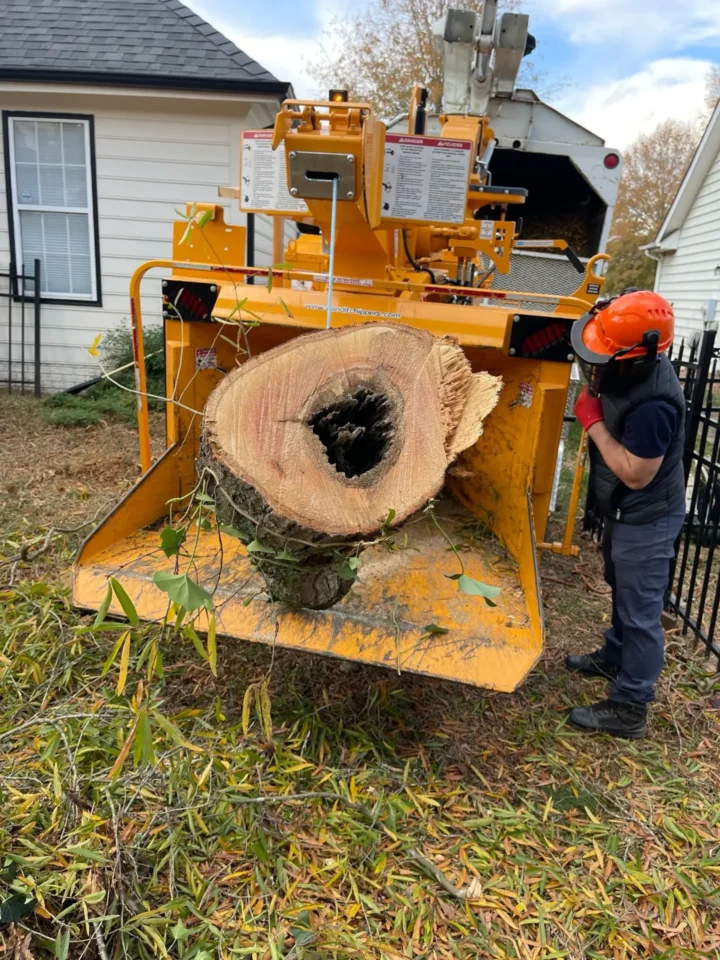
A tree may have a thick shell on one side and very little sound wood on the other. This uneven support can make the trunk more vulnerable to wind from certain directions.
Cracks often develop where the remaining shell is weakest.
Large Openings
An open cavity changes how forces move through the trunk. The shape, height, and position of the opening all affect stability.
A tall vertical cavity may weaken the trunk differently than a small round opening. Cavities near branch unions or roots may be more significant than similar openings higher in the trunk.
Repeated Wounding
A tree may continue closing one wound while new injuries occur elsewhere. Repeated branch loss, pruning cuts, mower damage, and storms can create multiple decay columns that eventually connect.
At that point, the remaining sound wood may be less continuous and less able to distribute stress.
When Should You Schedule a Tree Inspection?
A professional tree inspection is recommended when a hollow or decayed tree is close to people, structures, roads, utilities, or other valuable property.
Homeowners should arrange an inspection when they notice:
- A large trunk cavity
- Fungal conks or mushrooms
- Deep cracks
- Peeling bark around decayed wood
- Large dead branches
- Repeated branch failure
- A new or increasing lean
- Root movement
- Soft wood at the base
- Sawdust-like material
- Extensive insect activity
- Canopy thinning
- Storm damage
- Construction near the roots
The need becomes more urgent when several warning signs appear together.
For example, a small cavity in a tree with a full canopy and stable roots may be monitored. A cavity combined with a trunk crack, fungal conk, and lean toward a house requires faster attention.
Homeowners should also schedule an inspection after:
- Severe wind
- Lightning
- Flooding
- Root excavation
- Foundation work
- Driveway replacement
- Utility trenching
- Major branch loss
Damage below the soil or inside the trunk may not be immediately visible.
Early evaluation can help identify management options before decay becomes more extensive. A tree may benefit from pruning, support, soil improvement, root protection, or monitoring. In other situations, removal may be the safest recommendation.
What Will an Arborist Evaluate?
An arborist evaluates the whole tree, not just the visible cavity.
Tree Species
Species differ in their ability to isolate decay, withstand hollowing, close wounds, and resist storm forces.
Some trees can remain stable with substantial internal decay, while others develop cracks or branch failures sooner.
Age and History
The arborist may ask about:
- Previous storms
- Branch loss
- Pruning history
- Construction activity
- Root cutting
- Lightning
- Changes in drainage
- When the cavity first appeared
- Whether the opening is expanding
Older photographs may help show changes in lean, canopy density, and wound size.
Canopy Condition
The canopy may be examined for:
- Dead branches
- Sparse foliage
- Uneven growth
- Weak branch unions
- Storm damage
- Excessive weight
- Previous topping
- Repeated failures
A healthy canopy is encouraging, but it does not prove that the trunk or roots are structurally sound.
Trunk Condition
The inspection may include:
- Cavity size
- Wall thickness
- Crack location
- Bark condition
- Wound closure
- Fungal growth
- Insect evidence
- Trunk lean
- Multiple stems
- Decayed branch unions
The arborist will consider how forces move through the remaining wood.
Root and Soil Conditions
The root flare and surrounding soil may be checked for:
- Root decay
- Soil movement
- Girdling roots
- Compaction
- Poor drainage
- Construction damage
- Added soil
- Trenching
- Pavement conflicts
- Fungal growth
Root problems may have a greater effect on stability than the visible trunk cavity.
Nearby Targets
The inspection considers what could be damaged if the tree or a branch fails.
Potential targets include:
- Houses
- Garages
- Roads
- Vehicles
- Utility lines
- Patios
- Walkways
- Play areas
- Neighboring property
A tree with a significant defect may still be retained in a low-use area, while the same defect beside a home may require stronger action.
Specialized Diagnostic Tools
Visual inspection is often the first step. When the extent of internal decay is uncertain, an arborist may recommend specialized tools.
Depending on the situation, these may include:
- Sounding with a mallet
- Resistance drilling
- Sonic tomography
- Root collar excavation
- Aerial inspection
- Measuring devices
- Structured tree-risk assessment
Resistance drilling measures how much resistance a fine drill encounters as it passes through wood. Sonic tomography uses sound waves to create an image of relative wood density within the trunk.
These tools can help estimate internal decay, but results still require professional interpretation. No single test can guarantee that a tree will or will not fail.
Management Options
After the evaluation, recommendations may include:
- Monitoring
- Removing dead limbs
- Structural pruning
- Reducing canopy weight
- Cabling or bracing
- Improving root-zone conditions
- Restricting access beneath the tree
- Scheduling follow-up inspections
- Removing the tree
The recommendation should consider the tree’s condition, benefits, location, and level of risk.
How Green Leaf Carolina Can Help
Green Leaf Carolina helps homeowners understand whether a hollow tree can remain safely on the property or requires further action.
A tree inspection can review:
- Visible cavities
- Internal decay indicators
- Fungal growth
- Trunk cracks
- Root stability
- Branch structure
- Canopy health
- Insect activity
- Soil conditions
- Storm or construction damage
- Nearby homes and occupied areas
When the tree remains structurally manageable, recommendations may focus on pruning, reducing stress, protecting the root zone, or monitoring changes over time.
When decay has severely reduced stability, the roots are compromised, or the tree presents an unacceptable risk to nearby people and property, removal may be recommended.
The purpose of an inspection is not to assume every hollow tree is dangerous. It is to determine how much sound structure remains, whether the tree is changing, and which course of action best protects the property while preserving suitable trees whenever possible.
FAQs
Why do trees become hollow?
Trees usually become hollow after fungi enter through wounds caused by broken branches, pruning, storms, insects, lightning, mechanical damage, or disease. Decay then progresses through the inner wood over time.
Can a healthy tree be hollow?
Yes. A tree may have a full green canopy and continue growing even when the center of the trunk is hollow. The living tissues that transport water and nutrients are located closer to the outside.
Is every hollow tree dangerous?
No. Some hollow trees remain structurally stable for many years. Risk depends on the amount and location of sound wood, root condition, cracks, canopy weight, tree lean, and nearby targets.
How can a tree live without its center?
The center of the trunk is mainly older structural wood. The living tissues responsible for growth and transport are found near the outside beneath the bark.
Does a cavity mean the entire trunk is hollow?
Not necessarily. A cavity may be shallow, localized, or connected to a larger internal decay column. Professional inspection may be needed to determine its extent.
What causes a cavity in a tree?
Cavities commonly develop after branch loss, pruning wounds, bark injuries, storm damage, insect activity, disease, and fungal decay.
Can insects hollow out a tree?
Insects can enlarge damaged areas and create galleries, but they often enter after decay has already softened the wood. Carpenter ants commonly nest in existing decayed wood.
Do carpenter ants kill trees?
Carpenter ants usually do not cause the original decline. They excavate soft or decaying wood to create nests, so their presence often indicates an existing cavity or moisture problem.
What do fungal conks mean?
Conks are reproductive structures produced by certain fungi. They may indicate internal trunk, branch, or root decay. The type and location of the fungus affect the level of concern.
Does a hollow sound mean a tree is unsafe?
Not automatically. Sounding may suggest a cavity, but it does not reveal the exact amount or condition of remaining wood. Additional evaluation may be necessary.
Should a hollow tree be filled with concrete?
No. Filling cavities with concrete or other materials does not restore natural wood strength and may interfere with inspection or trap moisture.
Should water be drained from a tree cavity?
Homeowners should not drill holes into the trunk to drain a cavity. Drilling creates new wounds and may spread decay.
Can a hollow tree repair itself?
Trees cannot replace decayed wood. They may grow new wood around the outside and isolate the damaged area, which can help maintain strength.
Can pruning make a hollow tree safer?
Pruning may remove dead branches or reduce excessive canopy weight. It does not reverse internal decay, but it may reduce certain loads when performed appropriately.
Can cabling support a hollow tree?
Cabling or bracing may support certain weak unions or stems. It does not repair decay and requires professional installation, monitoring, and periodic inspection.
What are the warning signs of serious internal decay?
Warning signs include fungal conks, deep cracks, large cavities, peeling bark, soft wood, repeated branch failure, root movement, a new lean, and canopy decline.
Is decay near the base more dangerous?
It can be. Decay at the root flare, lower trunk, or structural roots may affect the entire tree’s stability.
Can a hollow branch fall even if the tree looks healthy?
Yes. A decayed branch may fail independently of the trunk. Large hollow limbs over roofs, roads, or occupied areas should be evaluated.
Should I remove loose bark around a cavity?
No. Do not pull away bark that remains attached. It may protect living tissue, and removing it can enlarge the wound.
Can a hollow tree survive a storm?
Some hollow trees tolerate storms, while others fail because the remaining wood cannot withstand bending or twisting forces. Stability depends on wall thickness, cracks, roots, species, and canopy size.
How do arborists find hidden decay?
Arborists begin with visual inspection and tree history. When necessary, they may use resistance drilling, sonic tomography, root collar excavation, or other diagnostic methods.
Is sonic tomography completely accurate?
It can provide useful information about relative wood density, but it is not a guarantee of future stability. Results must be interpreted alongside visual findings, species, structure, and site conditions.
When should a hollow tree be removed?
Removal may be recommended when decay is extensive, major roots are compromised, the trunk is deeply cracked, the tree is leaning, large limbs are repeatedly failing, or the risk cannot be reduced adequately.
Can a hollow tree be preserved for wildlife?
Possibly. Hollow trees provide valuable habitat for birds and other wildlife. Preservation may be reasonable when the tree is structurally manageable and located where failure would not threaten people or property.
How often should a hollow tree be inspected?
Inspection frequency depends on the size of the cavity, tree location, structural defects, storm exposure, and rate of change. Follow-up inspections may be recommended after severe weather or visible deterioration.
What should I do after noticing a new cavity?
Keep people and vehicles away if the cavity is large, cracked, or associated with leaning or dead branches. Arrange a professional inspection rather than attempting to probe or fill the opening yourself.
Hollow Tree Near Your Home?
Protect your property from potentially hazardous trees. Call today for expert evaluation and service.