
A tree may recover from broken branches, moderate canopy loss, minor bark wounds, or limited root disturbance when its trunk, primary branch structure, and root system remain stable. However, storm damaged tree recovery becomes much less likely when a tree has split through the main trunk, lost major structural limbs, become uprooted, developed a sudden lean, or suffered extensive root damage.
The amount of visible damage is only one part of the decision. Tree species, age, previous health, location, decay, remaining canopy, and what the tree could strike if it fails must also be considered. Because damaged branches and trunks can remain under dangerous tension after a storm, homeowners should keep away from unstable trees and arrange a professional assessment before beginning major cleanup.
Storm-Damaged Tree? Don’t Wait
Protect your home from falling limbs and hidden damage. Call now for a professional tree inspection.
How Much Storm Damage Can a Tree Survive?
There is no single percentage of canopy loss or number of broken branches that determines whether every tree will survive. A young, healthy tree may recover from damage that would cause a mature, declining tree to fail. A small branch loss may be manageable, while one broken limb at a critical trunk union may compromise the tree’s entire structure.
Trees generally have a better chance of recovery when:
- The main trunk remains intact
- The tree has not shifted at the base
- Major roots remain firmly anchored
- Most primary branches are still attached
- Broken limbs can be removed with proper pruning cuts
- The remaining canopy is reasonably balanced
- Bark wounds do not extend around most of the trunk
- The tree was healthy before the storm
- No major decay or cavities are present
- The tree is not leaning toward a home or occupied area
Healthy trees are generally more capable of recovering from storm injuries than trees already weakened by disease, drought, root damage, poor structure, or decay.
Minor Branch Damage
Trees commonly lose small branches during thunderstorms, high winds, ice, or heavy rain. When the damage is limited to a few small limbs and the trunk remains stable, proper pruning may be all that is needed.
Small broken branches should be removed back to an appropriate branch union rather than cut randomly in the middle. Clean pruning helps the tree close the wound more effectively and reduces the likelihood of weak sprouts developing around a damaged stub.
Moderate Canopy Loss
Some trees can survive losing a moderate portion of their canopy, particularly when the remaining branches are healthy and evenly distributed. Recovery may take several growing seasons.
The amount of acceptable canopy loss depends on:
- Tree species
- Tree age
- Time of year
- Previous health
- Remaining branch structure
- Size and location of wounds
- Exposure to sunlight after the storm
- Water availability during recovery
A tree that loses branches evenly across the crown may retain better balance than one that loses nearly all the canopy from one side.
Homeowners should not attempt to “even out” a damaged tree by removing large amounts of healthy growth. Excessive pruning creates additional wounds and reduces the leaf area the tree needs to produce energy for recovery.
Bark Damage
Minor bark wounds may gradually close when enough living tissue remains around them. Damage becomes more serious when bark is torn from a large portion of the trunk or when the wound extends around most of its circumference.
Bark loss can interrupt the movement of water, nutrients, and sugars between the roots and canopy. Deep wounds may also expose the tree to decay organisms and wood-boring insects.
Broken Leaders
Young trees with a broken central leader may sometimes be retrained by selecting a healthy lateral branch to become the new leader. This is more difficult in mature trees or species whose form depends heavily on one dominant trunk.
A professional should evaluate whether the remaining branch can form a stable structure or whether the damage will create permanent weakness.
Partial Uprooting
Small, recently planted trees may occasionally recover from slight root movement if they are repositioned and stabilized promptly. Mature trees that have lifted large root plates or shifted significantly in the ground are much less likely to regain dependable stability.
Staking can sometimes help newly planted or lightly damaged young trees, but poor staking or leaving supports in place too long can cause additional harm.
Is Structural Damage Dangerous?
Structural damage can be dangerous even when the tree remains standing and has green leaves. Storm forces may crack the trunk, weaken branch unions, twist roots, or leave broken limbs suspended overhead.
Damage may worsen after the storm as wind moves the tree, wet soil loosens around roots, or partially attached branches dry and break.
Trunk Cracks and Splits
A deep crack through the main trunk is one of the most serious forms of storm damage. The crack may separate two large stems, extend below a major branch union, or run toward the base of the tree.
Small surface cracks are not always critical, but wide openings, active movement, exposed internal wood, or splits that extend through most of the trunk require immediate evaluation.
A cable or brace may support certain branch unions, but support systems do not restore damaged wood to its original strength. Whether cabling is appropriate depends on the species, crack location, amount of sound wood, surrounding targets, and expected lifespan of the tree.
Hanging Branches
A branch may remain suspended by bark, smaller limbs, utility lines, or nearby trees. These branches can fall with little warning.
Homeowners should not stand or work beneath hanging limbs. Cutting a branch under tension can cause it to swing, split, or fall in an unexpected direction.
International Society of Arboriculture guidance warns against using ladders or overhead chainsaws around storm-damaged trees and recommends professional assistance for large broken or hanging branches.
Weak Branch Unions
Some branches split where two stems meet. A narrow, V-shaped union may contain included bark, which prevents strong wood from forming between the stems.
When one side breaks, the remaining stem may also be damaged. The tear can extend into the trunk and leave a large opening that is difficult for the tree to close.
Root Plate Movement
Softened soil and strong winds can cause the root plate to rotate or lift. Warning signs include:
- Raised soil on one side
- New gaps around the base
- Exposed or broken roots
- Cracking soil
- A sudden lean
- Movement during wind
- Nearby pavement lifting
Storm winds and saturated soil can work together to overturn trees, making root movement an important post-storm warning sign.
Lightning Damage
Lightning may strip bark, split wood, damage roots, or create internal injuries that are not immediately visible. Heat generated by a strike can rapidly turn moisture within the tree into steam, causing wood to split and bark to separate.
Some lightning-struck trees survive, while others decline over weeks or months. The location and depth of damage must be evaluated before deciding whether the tree can remain.
What Should Homeowners Check After a Storm?
Safety should come before tree cleanup. Homeowners should inspect the property from a safe distance and avoid approaching trees that are leaning, split, touching wires, or supporting hanging branches.
Look for Utility Hazards
Assume any downed or tree-covered power line is energized. Do not touch the tree, branch, fence, vehicle, or equipment near the wire.
Utility companies should address electrical hazards before tree work begins. Tree crews may then coordinate removal after the area has been made safe.
Check for New Leaning
Some trees naturally grow at an angle. A lean becomes more concerning when it is new, increasing, or accompanied by soil and root movement.
Compare the tree with older photographs when possible. Signs of recent movement include fresh soil cracks, exposed roots, lifted turf, and a root plate that no longer sits flat.
Inspect the Main Trunk
From the ground, look for:
- New vertical or horizontal cracks
- Splits between main stems
- Missing bark
- Freshly exposed wood
- Cavities
- Fungal growth
- Areas where the trunk appears twisted
- Sap or fluid leaking from wounds
A tree may have several small broken branches but remain structurally sound if the trunk is intact. Conversely, a tree with a full green canopy may be unsafe if the trunk has split.
Look Up for Broken Limbs
Check the canopy for branches that are:
- Hanging
- Cracked
- Bent sharply
- Resting on other branches
- Caught in nearby trees
- Stripped of bark at the union
- Partially detached
- Touching a roof or utility line
Do not walk beneath the canopy to obtain a closer view.
Check the Roots and Surrounding Soil
Inspect the ground for:
- Lifted soil
- Exposed roots
- Broken roots
- Depressions near the trunk
- Waterlogged soil
- New gaps around the base
- Cracks extending away from the tree
Flooding and prolonged saturation reduce oxygen in the soil and may weaken already stressed roots, increasing the likelihood of later decline or failure.
Consider What the Tree Could Hit
A damaged tree becomes more urgent when it is within falling distance of:
- A house
- A garage
- A driveway
- A road
- A deck or patio
- A play area
- Utility lines
- A neighboring structure
- A frequently used walkway
Tree risk involves both the likelihood of failure and the consequences if failure occurs. A damaged tree in an unused wooded area may present a different level of risk than one beside a bedroom or driveway.
Document the Damage
Take photographs from a safe location before cleanup begins. Images may help with insurance claims, professional evaluations, and later monitoring.
Photograph the entire tree, the damaged area, surrounding structures, and any visible root movement. Avoid standing beneath unstable branches to obtain a better angle.
How Arborists Evaluate Storm-Damaged Trees
An arborist evaluates more than the broken branches visible from the ground. The goal is to determine whether the tree can remain structurally stable, recover biologically, and be managed at an acceptable level of risk.
Tree Species
Different species respond differently to branch loss, trunk wounds, flooding, and root damage.
Some trees close pruning wounds more effectively than others. Certain species develop brittle wood, weak branch unions, or decay rapidly after injury. Others may tolerate substantial canopy loss and produce new growth.
Species identification helps the arborist estimate:
- Likely recovery rate
- Decay response
- Expected lifespan
- Ability to produce new canopy
- Susceptibility to pests and diseases
- Structural growth habits
Age and Size
Young trees often have a greater capacity to rebuild their canopy and correct structural defects. Large mature trees may recover more slowly and contain heavier branches that increase the consequences of failure.
However, age alone does not determine whether a tree should be removed. A healthy mature tree with limited branch damage may remain valuable and manageable, while a younger tree with a split trunk may be unsuitable for retention.
Previous Health
An arborist will look for signs that existed before the storm, including:
- Dead branches
- Cavities
- Fungal conks
- Root decay
- Old cracks
- Previous topping
- Weak unions
- Insect damage
- Sparse foliage
- Construction injury
- Soil compaction
Storms often expose preexisting weaknesses rather than creating every defect from the beginning.
Trunk and Branch Structure
The evaluation may include:
- Depth and length of cracks
- Percentage of trunk circumference affected
- Remaining sound wood
- Size of lost branches
- Condition of branch collars
- Balance of the remaining canopy
- Presence of included bark
- Movement at damaged unions
- Ability to make proper pruning cuts
A torn branch that removes a large section of trunk wood may have a poorer outlook than a cleanly broken branch of similar size.
Root Stability
The arborist will inspect the root flare, visible roots, soil movement, and surrounding grade. A tree with severe root plate rotation may be unsafe even if the trunk and canopy appear mostly intact.
Advanced assessment may be recommended when root decay or internal trunk defects are suspected but not visible.
Nearby Targets
A tree’s location influences the recommended level of care. Retaining a damaged tree over an unoccupied woodland area may be reasonable, while the same defects above a home entrance may represent an unacceptable risk.
Tree Risk Assessment
For large or valuable trees, a professional with Tree Risk Assessment Qualification may conduct a structured assessment. Penn State Extension recommends considering a TRAQ-trained and qualified arborist for risk assessment of large trees after storms.
The recommendation may involve pruning, cabling, monitoring, restricting access beneath the tree, or removal.
When Does a Tree Need to Be Removed?
Removal is more likely when the damage has permanently compromised the tree’s stability or when recovery would leave an unacceptable risk near people or property.
A tree may need removal when:
- The main trunk is deeply split
- The tree has fallen or is heavily uprooted
- Large structural roots are broken
- The root plate has lifted substantially
- The tree has developed a severe new lean
- Most of the primary canopy is gone
- A major stem has torn away from the trunk
- Extensive internal decay is exposed
- Multiple large limbs are hanging over structures
- The remaining canopy is badly unbalanced
- Previous defects have combined with new storm damage
- The tree is contacting electrical lines
- Safe corrective pruning is not possible
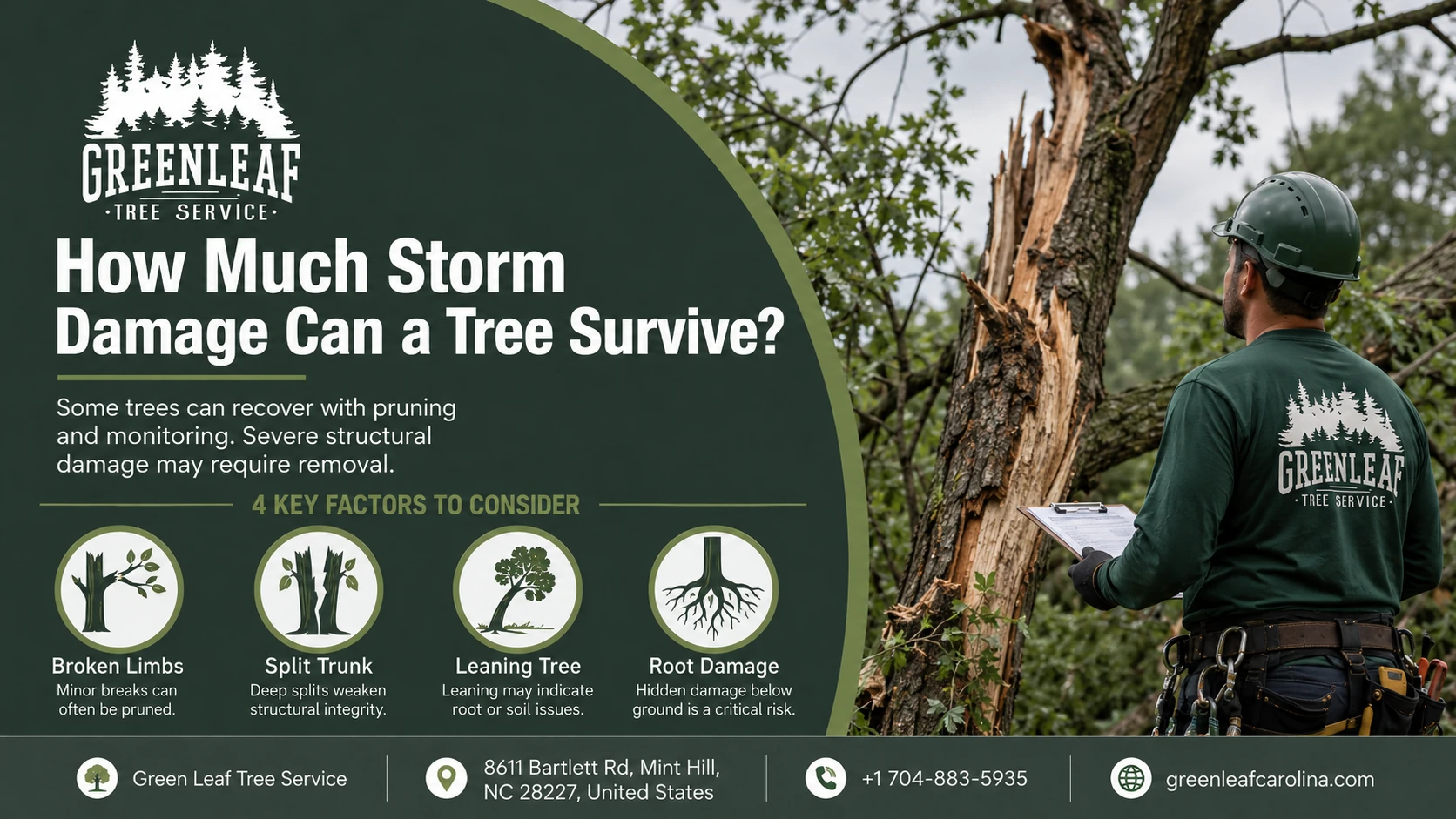
Severe Trunk Splits
A split through the main trunk or below a primary branch union is difficult to repair. Bolts and cables may support selected trees, but they cannot restore decayed or separated wood.
If the crack continues moving or the tree stands close to a structure, removal may be the safest option.

Permits, Neighbors & Property Line Tree Disputes
Tree removal sounds straightforward until neighbors, permits, and property lines get involved. What feels like a quick weekend decision can…
Major Uprooting
Once a mature tree’s root plate has rotated substantially, dependable reestablishment is uncommon. Large roots may be torn below the soil even when only part of the damage is visible.
Attempting to pull a mature tree upright does not repair broken roots and may create a false sense of security.
Extensive Root Damage
Root damage may occur from uprooting, flooding, erosion, construction, or soil movement. Because roots anchor the tree, extensive damage can create instability even when the canopy remains green.
Trees with root and lower trunk decay are especially likely to break or fall during storms.
Excessive Canopy Loss
There is no exact canopy-loss threshold that applies to every species. However, a tree that has lost most of its major branches may not retain enough foliage to support itself or enough structure to rebuild a balanced crown.
Large wounds left by primary limb failure may also develop decay.
Unacceptable Location Risk
A damaged tree may be biologically capable of surviving but still present too much risk because of its location.
The decision may differ when the tree is directly over a home, pool, road, playground, or power line. Removal decisions should consider whether the remaining risk can be reduced to an acceptable level.
What Recovery Options May Be Possible?
Trees with recoverable damage may benefit from a combination of pruning, support, monitoring, and root-zone care.
Corrective Pruning
Broken branches can often be removed back to healthy unions. Proper pruning reduces loose material while preserving as much healthy canopy as possible.
Corrective pruning may include:
- Removing broken branches
- Shortening damaged limbs to suitable unions
- Removing torn bark that prevents a proper cut
- Restoring one central leader in a young tree
- Reducing weight from a damaged union
- Removing branches that rub or cross
Topping should not be used as a storm-repair method. Cutting branches back to random stubs can stimulate weakly attached shoots, increase decay, and create future hazards.
Cabling or Bracing
Cables and braces may help support certain weak unions or partially damaged stems. These systems are not appropriate for every tree and require inspection over time.
Support systems do not make a damaged tree risk-free. They are one part of a broader management plan.
Staking Young Trees
A small, recently planted tree with minor root movement may be straightened and temporarily staked. The roots must still be capable of reestablishing.
Staking should allow limited trunk movement and is generally temporary. Leaving rigid supports installed for too long can weaken normal trunk development.
Root-Zone Care
A damaged tree needs energy to close wounds and rebuild its canopy. Protecting the root zone can support recovery.
Helpful steps may include:
- Watering during dry periods
- Applying a proper mulch layer
- Keeping mulch away from the trunk
- Avoiding soil compaction
- Preventing vehicle traffic over roots
- Delaying unnecessary construction
- Correcting drainage problems
- Avoiding excessive fertilizer
Fertilizer does not repair broken wood and should not be applied automatically after a storm. Soil conditions and tree needs should be evaluated first.
Monitoring
Some damage requires time to understand fully. A tree may leaf out normally after the storm but later develop dieback, decay, or instability.
Monitoring may include checking for:
- Expanding cracks
- New leaning
- Branch dieback
- Fungal growth
- Insect activity
- Reduced leaf size
- Early fall color
- Additional branch failure
- Changes in the root area
Follow-up inspections are especially important for mature trees, supported unions, and trees near valuable property.
Target Reduction
In some cases, risk can be reduced by changing how the area beneath the tree is used. Moving seating, play equipment, vehicles, or foot traffic away from a damaged tree may lower the consequences of branch failure while the tree is monitored.
This approach is not appropriate when the tree is likely to fail onto a permanent structure or public area.
How Green Leaf Carolina Can Help
Green Leaf Carolina helps homeowners evaluate storm-damaged trees after high winds, heavy rain, lightning, and other severe weather.
A professional assessment can examine:
- Broken and hanging branches
- Trunk cracks and splits
- Damaged branch unions
- Root plate movement
- Exposed or broken roots
- Existing decay
- Canopy loss
- Tree lean
- Nearby homes and utility lines
- The tree’s previous health
The purpose of the inspection is to determine whether the tree has a reasonable path to recovery and whether it can remain at an acceptable level of risk.
When preservation is appropriate, recommendations may include corrective pruning, support systems, root-zone care, or continued monitoring. When damage has made a tree unstable, controlled removal may be necessary to protect nearby people and property.
Homeowners should avoid working beneath unstable canopies or cutting storm-loaded branches themselves. Green Leaf Carolina can help clarify which issues require immediate action and which trees may recover with thoughtful care.
FAQs
Can a tree survive after losing several branches?
Yes. Many trees recover from losing several small or medium branches when the trunk, roots, and major framework remain healthy. Recovery depends on the amount and location of canopy loss.
How much canopy can a tree lose and survive?
There is no universal percentage. Species, age, health, season, wound size, and remaining structure all matter. Extensive loss of primary branches is more serious than the loss of smaller outer limbs.
Can a tree survive being split in half?
A tree split through the main trunk has a poor prognosis, particularly if the split extends toward the base or the sections are moving apart. Some limited branch-union splits may be supported, but they require professional evaluation.
Can an uprooted tree be saved?
A small, recently planted tree with minor root movement may sometimes be repositioned. A mature tree with a significantly lifted root plate or broken structural roots is unlikely to regain dependable stability.
Is a leaning tree always dangerous?
No. Some trees naturally lean. A new or increasing lean accompanied by exposed roots, lifted soil, or trunk cracking is more concerning and should be evaluated promptly.
What should I do if a tree is touching a power line?
Stay away from the tree and line. Do not attempt to cut or move branches. Contact the utility company or emergency services according to local procedures.
Are hanging branches an emergency?
Large hanging branches above homes, vehicles, roads, or occupied areas require prompt professional attention. Keep people and pets out of the area until the hazard is addressed.
Can a tree survive lightning damage?
Some trees survive lightning strikes, while others suffer fatal trunk, root, or internal damage. The tree should be inspected because visible bark loss may not show the full extent of injury.
Should broken branches be cut immediately?
Branches creating an immediate hazard should be addressed promptly by a qualified professional. Nonhazardous damage can be evaluated and pruned carefully rather than rushed.
Can I use a ladder to remove storm-damaged branches?
Working from a ladder with cutting equipment is dangerous, especially around branches under tension. Large, overhead, or suspended branches should be handled by trained professionals.
Should wound paint be placed on storm cuts?
Wound paint is generally not needed for ordinary pruning wounds. Proper pruning cuts and appropriate aftercare are more important. An arborist may make a different recommendation for a specific pest or disease concern.
Will fertilizer help a damaged tree recover faster?
Not automatically. Fertilizer cannot repair broken roots or branches, and unnecessary application may cause additional stress. Soil and tree condition should be evaluated first.
How long does storm-damaged tree recovery take?
Minor damage may begin closing within a growing season, while rebuilding a canopy can take several years. Large wounds may remain visible for the life of the tree.
Can cabling save a split tree?
Cabling may support certain weak or damaged unions, but it does not restore lost wood strength. Suitability depends on the tree’s condition, crack location, species, and surrounding risk.
Should a tree with exposed roots be removed?
Not always. Naturally visible surface roots are common in some species. Newly exposed, lifted, or broken roots after a storm are more concerning and should be assessed.
What are the clearest signs that removal is needed?
Major uprooting, severe root damage, deep main-trunk splits, extensive decay, a rapidly developing lean, and loss of most structural branches are strong indicators that removal may be necessary.
Can a healthy-looking tree still be unsafe after a storm?
Yes. Green foliage does not confirm structural stability. Hidden cracks, root damage, weak unions, and internal decay may remain even when the canopy looks healthy.
Should every damaged tree be removed?
No. Many trees can be preserved through proper pruning, support, care, and monitoring. Removal should be based on the tree’s structure, health, location, and likelihood of safe recovery.
What does an arborist look for after a storm?
An arborist examines the trunk, branches, roots, canopy, existing decay, tree species, age, previous condition, and nearby targets. The evaluation considers both tree health and the consequences of possible failure.
When should a tree be inspected after a storm?
Trees with hanging limbs, cracks, new leaning, root movement, or damage near structures should be inspected as soon as the area is safe. Large trees may also benefit from assessment after severe winds even when damage is not immediately obvious.
Can storm damage show up later?
Yes. Root injury, flooding stress, internal cracking, insect activity, and decay may lead to symptoms weeks, months, or years later. Continued monitoring is important.
Is pruning enough for every damaged tree?
No. Pruning helps when damage is limited to manageable branches. It cannot correct severe root failure, extensive trunk splitting, or widespread structural decay.
Who should evaluate a storm-damaged tree?
A qualified arborist should evaluate major damage. A Tree Risk Assessment Qualified arborist may be particularly useful for large trees, complex defects, or trees near buildings and occupied areas.
Can a damaged tree become stronger again?
Trees can add new wood around injuries and develop new canopy growth, but they do not heal broken wood in the same way people heal bones. The long-term outlook depends on how much stable structure remains.
How can future storm damage be reduced?
Structural pruning, removal of dead branches, regular inspections, protection of roots, and early correction of weak branch unions can reduce some risks. No tree can be made completely storm-proof, but preventative care can identify defects before severe weather.
Don’t Risk a Storm-Weakened Tree
Find out if your tree can recover or needs professional removal. Call today for trusted tree service.