
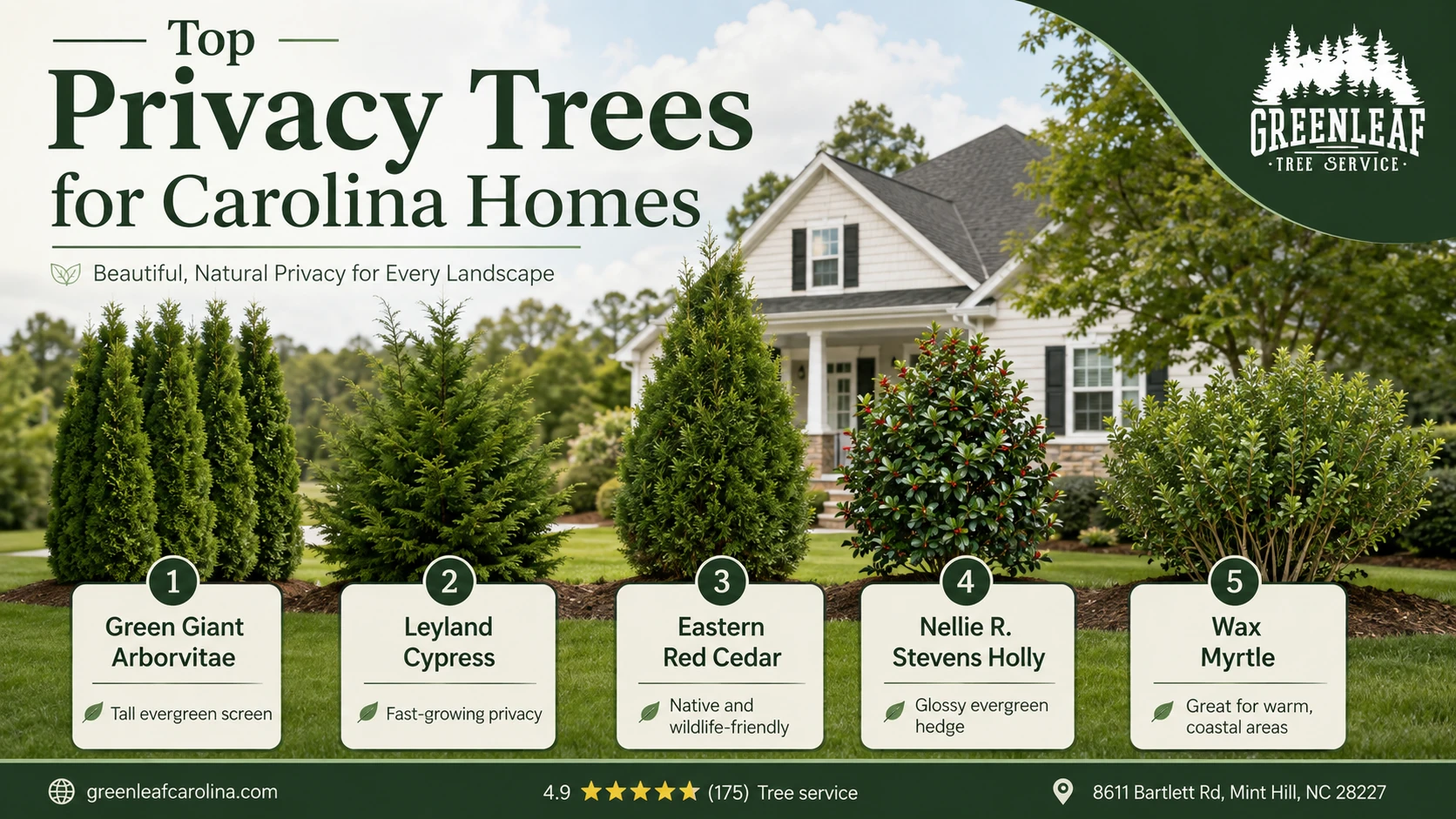
The best privacy trees NC homeowners can plant are evergreens that match the property’s available space, sunlight, soil, drainage, and desired screening height. Green Giant Arborvitae, Leyland Cypress, Eastern Red Cedar, Nellie R. Stevens Holly, and Wax Myrtle are all commonly considered because they can provide dense foliage and year-round coverage in many parts of North and South Carolina.
However, the fastest-growing tree is not automatically the best choice. A privacy screen should remain healthy, attractive, and manageable long after it blocks the original view. Homeowners should consider mature width, root space, weather exposure, maintenance needs, and planting distance before choosing a species.
Want Privacy Without the Fence?
Discover fast-growing privacy trees that add beauty, shade, and seclusion to your home. Call now for expert guidance.
What Are the Best Privacy Trees for Carolina Homes?
North and South Carolina include coastal areas, Piedmont communities, mountain regions, urban neighborhoods, and rural properties. Because growing conditions vary considerably, there is no single privacy tree that works equally well on every property.
The following trees are popular options for Carolina homes, but each has different space and maintenance requirements.
Green Giant Arborvitae
Green Giant Arborvitae is a tall, pyramidal evergreen with dense foliage that can form an effective year-round screen. It grows quickly under suitable conditions and works best on larger properties where it has enough room to reach its natural width.
NC State Extension notes that Green Giant Arborvitae performs best in moist, well-drained soil and full sun, although some afternoon shade can be beneficial. It tolerates several soil types and has resistance to many common diseases and insects. However, it does not tolerate salt spray or salty soil well.
Mature Green Giant Arborvitae can become much wider than the narrow trees displayed at a nursery. NC State guidance warns that these trees may eventually exceed 40 feet in height and reach approximately 15 to 20 feet wide, making them unsuitable for some small residential lots.
Green Giant Arborvitae may be a good choice when homeowners need:
- A tall screen between large properties
- Year-round coverage
- A formal evergreen appearance
- A windbreak along an open boundary
- Relatively fast screening with adequate space
Regular shearing is not always necessary when the trees have enough room to maintain their natural shape. Planting them too close together, however, can reduce airflow and create crowded branches as they mature.
Leyland Cypress
Leyland Cypress is known for rapid growth and thick evergreen foliage. It can produce privacy relatively quickly, especially on sunny properties with well-drained soil.
Its speed is also one of its disadvantages. Leyland Cypress can become very large and may outgrow narrow property lines, small backyards, or planting areas near buildings. Frequent pruning may be necessary when trees are installed without accounting for mature size.
Clemson Cooperative Extension reports that Leyland Cypress can also face disease and insect problems, particularly where the trees are overplanted, stressed, crowded, or placed in unsuitable growing conditions. Healthy spacing and proper site selection are important for reducing these risks.
Leyland Cypress may suit homeowners who have:
- A large, sunny property
- Plenty of room for mature growth
- A need for a tall visual barrier
- Good drainage
- Time to monitor pruning and tree health
It may not be the best choice for a narrow strip between a fence and a home. Homeowners should also avoid assuming that a tightly packed row will create a healthier screen. Crowding can increase competition for water and reduce airflow.
Eastern Red Cedar
Eastern Red Cedar is a native evergreen that can be planted individually, in groups, or as a screen and windbreak. It has dense foliage, provides wildlife cover, and is resistant to deer damage.
Because it is native to the region, Eastern Red Cedar can be a practical option for homeowners who want a less formal screen with wildlife value. Its natural shape is generally more irregular than a closely sheared hedge, making it well suited to larger yards, rural boundaries, and naturalized landscapes.
Eastern Red Cedar performs best where it receives adequate sunlight and is not planted in constantly wet soil. Mature trees need substantial vertical and horizontal space.
It may work well for:
- Rural or suburban property lines
- Wind protection
- Natural-looking privacy screens
- Wildlife-friendly landscapes
- Areas where deer browsing is a concern
Homeowners with apple or crabapple trees should also discuss cedar-apple rust considerations with a qualified planting professional because Eastern Red Cedar can serve as a host in the disease cycle.
Nellie R. Stevens Holly
Nellie R. Stevens Holly is a broadleaf evergreen that develops dense, glossy foliage and red berries. It is often used as a specimen plant, informal hedge, or privacy screen.
NC State Extension reports that it can mature to approximately 15 to 30 feet tall and 8 to 25 feet wide. It grows in full sun to partial shade, handles heat and drought better than many hollies, and tolerates several soil types, including clay. However, poorly drained or consistently wet planting sites should be avoided.
Its broad mature width makes proper spacing especially important. Trees installed too close to fences, houses, or one another may require repeated pruning.
Nellie R. Stevens Holly may be suitable when homeowners want:
- Evergreen privacy with broad leaves
- Screening in full sun or partial shade
- Red berries and seasonal interest
- A hedge that can be shaped
- Moderate to tall backyard coverage
The foliage can be dense enough to provide substantial privacy, but the plant should be allowed room to develop naturally whenever possible.
Wax Myrtle
Wax Myrtle is a fast-growing broadleaf evergreen shrub or small tree that works well for informal screens, especially in warmer and coastal areas. It can be pruned as a hedge or allowed to grow with a natural, multi-stemmed form.
NC State Extension indicates that Southern Wax Myrtle can reach approximately 20 to 25 feet tall and 8 to 10 feet wide, although many specimens remain shorter. It grows in full sun, partial shade, and a broad range of soil conditions, from wet areas to relatively dry sites after establishment. It is hardy in Zones 7 through 10 but may be only semi-evergreen in colder portions of its range.
Wax Myrtle may be a practical choice for:
- Coastal and warmer Carolina properties
- Informal backyard screens
- Sites with variable moisture
- Homeowners seeking a native or regionally adapted option
- Properties needing medium-height privacy
Because it responds well to pruning, Wax Myrtle can be managed as a hedge. However, aggressive shearing may create unnecessary maintenance. Selecting a cultivar with the right mature size can reduce future pruning.
Are Fast-Growing Trees Harder to Maintain?
Fast-growing trees are not always difficult to maintain, but rapid growth often brings tradeoffs. A tree that quickly blocks a view may also outgrow its planting area faster, require more pruning, or compete more heavily for water and nutrients.
Homeowners are often attracted to trees that promise several feet of annual growth. That speed can be helpful when screening a road, neighboring property, parking area, or commercial building. However, growth estimates usually assume favorable sunlight, soil, drainage, water, and root space.
Problems can develop when fast-growing trees are:
- Planted too close together
- Installed close to foundations or fences
- Placed beneath utility lines
- Repeatedly topped to control height
- Grown in compacted or poorly drained soil
- Allowed to dry out during establishment
- Sheared into shapes that do not match their natural habit
A rapidly growing evergreen planted six feet from a structure may seem appropriately sized for its first few years. As its canopy expands, branches may press against siding, block walkways, cross property lines, or require frequent trimming.
Fast growth can also create a privacy screen with little variety. If every tree in a single-species row becomes vulnerable to the same pest, disease, or weather event, a large portion of the screen may decline at once.
Clemson Extension recommends considering mixed screens, which combine several compatible tree and shrub species. A mixed planting can provide year-round coverage while improving visual interest and biological diversity.
The best long-term choice is usually a tree whose mature size fits the site without constant intervention.
What Should Homeowners Consider Before Planting?
Privacy trees should be chosen after evaluating the property rather than selecting a species based only on its growth rate or appearance.
Desired Height and Coverage
Homeowners should first identify what they want to screen. Blocking a nearby patio may require a different tree height than screening a two-story home or busy roadway.
Consider whether privacy is needed:
- At ground level
- From an elevated deck
- From second-story windows
- Throughout the year
- Only during spring and summer
- Along the entire property line
- In one specific area
Evergreens provide more dependable winter coverage than deciduous trees. However, a mixed planting may create a softer and more natural appearance.
Mature Width
Nursery trees are young and narrow. Their mature width is one of the most important measurements for planning a screen.
Trees should not be spaced according to their current branch spread. They should be spaced according to their expected mature size, the desired density, and recommendations for that species.
Planting trees too tightly may produce faster initial coverage, but it can eventually cause:
- Crowded branches
- Poor airflow
- Uneven growth
- Increased moisture around foliage
- Competition for sunlight and water
- Greater disease pressure
- Difficult pruning and replacement
A staggered or offset planting pattern may create better coverage than a single straight row while giving individual plants more room.
Sunlight
Most dense evergreen privacy trees perform best with substantial sunlight. Some hollies and broadleaf evergreens can tolerate partial shade, but deep shade may produce thinner growth.
Homeowners should observe the site at different times of day. Nearby houses, mature trees, fences, and slopes can create shade that is not obvious during a brief property visit.

What Homeowners Should Expect During Land Clearing
Land clearing is one of the most important early steps in transforming a raw, wooded, or overgrown property into usable…
Soil and Drainage
Even a well-adapted tree can decline in the wrong soil. Drainage is especially important because several common privacy species do not tolerate constantly saturated roots.
Before planting, homeowners should look for:
- Standing water after rain
- Compacted construction soil
- Heavy clay
- Extremely sandy soil
- Erosion
- Shallow bedrock
- Drainage from neighboring properties
- Downspouts emptying near the planting area
Soil testing can provide useful information about pH and nutrient conditions. It is generally better to choose trees suited to the existing site than to rely on major soil modification.
Utility Lines and Easements
The planting area should be checked for overhead and underground utilities. Tall trees should not be planted beneath power lines, and roots should not be placed directly over septic components, drainage lines, or underground utility corridors.
Utility easements may also restrict planting or allow future access by service crews. Trees placed within an easement could be trimmed or removed if they interfere with maintenance.
Property Lines and HOA Rules
A privacy screen should remain within the owner’s property as it matures. Homeowners should confirm property boundaries rather than relying on an existing fence or mowing line.
Homeowners associations may regulate tree species, hedge height, placement, or maintenance. Local ordinances may also limit plantings near intersections, sidewalks, drainage areas, or public rights-of-way.
Deer and Wildlife Pressure
Deer browsing can damage young privacy trees before they become established. Species described as deer-resistant may still be browsed when food is scarce.
Tree guards, temporary fencing, repellents, or more resistant species may be needed in areas with heavy deer activity.
Which Trees Work Best for Backyard Privacy?
The best backyard privacy tree depends on the size of the yard and the type of screen the homeowner wants.
Large Backyards
Green Giant Arborvitae and Eastern Red Cedar work well where there is enough space for tall, wide trees. They can screen neighboring properties, open fields, roads, and distant buildings.
Leyland Cypress may also be considered on large, well-drained properties, although homeowners should be prepared for its mature size and potential health concerns.
Medium-Sized Backyards
Nellie R. Stevens Holly can provide a dense evergreen screen without the narrow, conifer-like appearance of arborvitae or cypress. It works well as an informal hedge when given room to develop.
Wax Myrtle is another option for medium-height privacy, particularly in warm or coastal areas. Its looser, multi-stemmed growth creates a less formal look.
Small or Narrow Yards
Large privacy trees can quickly overwhelm a narrow residential lot. A smaller holly cultivar, compact evergreen shrub, or mixed screen may fit better than Green Giant Arborvitae or Leyland Cypress.
Homeowners with limited space should look for cultivars selected for narrow or compact growth. They should also verify the cultivar name rather than relying only on a general label such as “arborvitae” or “holly.”
Natural-Looking Screens
A natural screen may combine Eastern Red Cedar, Wax Myrtle, hollies, and other compatible shrubs. This approach can avoid the rigid appearance of a single straight row.
Different heights and foliage textures can create privacy while making the planting look like part of the landscape. A mixed screen may also be more resilient than a monoculture because the plants do not all share the same vulnerabilities.
How Carolina Weather Affects Privacy Trees
The Carolinas experience hot summers, periods of drought, heavy rain, thunderstorms, occasional ice, tropical weather near the coast, and colder winters in mountain communities. Privacy trees must be able to handle both regional climate and the conditions of the individual property.
Summer Heat
New trees are especially vulnerable during hot, dry periods. Their root systems have not yet expanded into the surrounding soil, so they need consistent watering during establishment.
Heat reflected from pavement, brick walls, and fences can create additional stress. Trees planted near driveways or parking areas may need more careful monitoring.
Heavy Rain and Poor Drainage
Summer storms can saturate low areas. Trees that tolerate ordinary clay soil may still decline if their roots remain underwater for extended periods.
Nellie R. Stevens Holly, for example, tolerates several soil textures but should not be planted on a persistently wet site. Wax Myrtle is more adaptable to wet conditions and may be useful where moisture levels vary.
Wind and Storms
Tall screens can be exposed to strong winds, especially when planted along open fields or property edges. Correct planting depth, healthy root development, and suitable spacing improve stability.
Young trees may need temporary staking, but supports should not remain in place longer than necessary. Overly tight stakes can prevent normal trunk movement and development.
Coastal Conditions
Salt exposure affects plant selection near the coast. Green Giant Arborvitae does not tolerate salt spray or salty soil well, so it may not be appropriate for exposed coastal properties.
Wax Myrtle is often better suited to warmer coastal conditions. Homeowners near the shoreline should choose species with documented salt and wind tolerance.
Winter Cold and Ice
Mountain and northern Piedmont properties may experience colder temperatures than coastal South Carolina. Wax Myrtle can become semi-evergreen in colder parts of its growing range, which may reduce winter screening.
Ice can bend or split tightly branched evergreens. Good structure, appropriate pruning, and spacing that allows natural growth can reduce damage.
When Should You Hire a Tree Planting Professional?
Homeowners may be able to plant a few small shrubs on their own, but a professional can be helpful when the project involves large trees, long property lines, difficult soil, drainage concerns, or precise spacing.
Professional planting may be especially valuable when:
- The screen includes many trees
- Large nursery specimens are being installed
- The property has heavy clay or poor drainage
- Access is limited
- The planting line is near utilities or easements
- Several species will be combined
- The yard slopes or collects runoff
- The correct spacing is uncertain
- The trees must screen a specific elevated view
Planting depth is one of the most important factors in long-term tree health. Trees installed too deeply may develop root problems, poor oxygen exchange, and slow decline. A professional can identify the root flare, prepare the planting area, and set the tree at the correct depth.
A professional can also calculate spacing based on mature size rather than current nursery size. This helps avoid crowded trees, excessive pruning, and gaps caused by future removals.
Fall is often a favorable planting season in the Carolinas because cooler temperatures reduce heat stress while roots continue developing. Early spring can also work well. Summer planting is possible, but newly planted trees may require much more frequent watering.
The planting schedule should account for species, location, weather, irrigation availability, and nursery stock condition.
How Green Leaf Carolina Can Help
Green Leaf Carolina helps homeowners plan and establish privacy tree screens that fit the property rather than simply planting the fastest-growing trees available.
The planning process can consider the desired screen height, property dimensions, sunlight, drainage, soil conditions, utilities, mature tree width, and long-term maintenance. Tree selection may include Green Giant Arborvitae, hollies, Eastern Red Cedar, Wax Myrtle, Leyland Cypress, or other species suited to the specific location.
Professional installation can also help ensure that trees are positioned at the correct depth and spaced for future growth. This improves the likelihood that the screen will fill in evenly without becoming overcrowded.
Homeowners can use a professionally planned privacy screen to improve backyard separation, soften unwanted views, reduce visual exposure from nearby properties, and add attractive evergreen structure to the landscape.
FAQs
What are the best privacy trees for North Carolina?
Common options include Green Giant Arborvitae, Eastern Red Cedar, Nellie R. Stevens Holly, Wax Myrtle, and Leyland Cypress. The best choice depends on the region, available space, drainage, sunlight, desired height, and maintenance expectations.
What are the best privacy trees for South Carolina?
Wax Myrtle, Nellie R. Stevens Holly, Eastern Red Cedar, Green Giant Arborvitae, and Leyland Cypress may perform well in suitable South Carolina locations. Coastal properties should prioritize heat, wind, moisture, and salt tolerance.
What is the fastest-growing privacy tree?
Green Giant Arborvitae and Leyland Cypress are known for rapid growth in suitable conditions. However, growth speed should not be the only consideration. Both can become too large for narrow residential spaces.
How far apart should privacy trees be planted?
Spacing depends on the species, cultivar, mature width, and desired effect. Trees should generally be spaced according to their mature size rather than their size at planting. Overly tight spacing can create competition, poor airflow, and long-term maintenance problems.
How long does it take privacy trees to fill in?
The timeline depends on tree size at installation, species, spacing, sunlight, soil, watering, and weather. Fast-growing trees may begin creating meaningful coverage within several growing seasons, while slower-growing species take longer.
Should privacy trees be planted in a straight line?
They can be, but a staggered arrangement often creates better visual coverage and a more natural appearance. Mixed screens with several compatible species can also improve diversity and reduce the risk of losing the entire screen to one problem.
Can privacy trees grow in clay soil?
Some species tolerate clay if drainage is adequate. Green Giant Arborvitae tolerates several soil types, while Nellie R. Stevens Holly can handle heavy clay but should not be planted in constantly wet ground.
What privacy tree works in wet soil?
Wax Myrtle tolerates a broad range of moisture conditions, including wet sites, after establishment. However, the exact cause and duration of standing water should be evaluated before planting.
Do privacy trees need full sun?
Many evergreen screening trees perform best in full sun. Some hollies and Wax Myrtle tolerate partial shade, but dense screening may develop more slowly in low-light conditions.
When is the best time to plant privacy trees in the Carolinas?
Fall is often an effective planting period because the soil remains warm while air temperatures become cooler. Early spring is another suitable option. Summer planting requires careful and consistent watering.
How often should newly planted privacy trees be watered?
New trees need regular watering while their root systems become established. The schedule should be adjusted for soil type, temperature, rainfall, tree size, and drainage. The soil should remain moist but not constantly saturated.
Do privacy trees need pruning?
Some trees need little pruning when they have enough space to grow naturally. Formal hedges and trees planted in confined areas may require regular trimming. Pruning should not be used to force a naturally large tree into a space that is too small.
Can privacy trees be planted near a fence?
Yes, but they should be placed far enough away to accommodate their mature width and allow access for maintenance. Planting directly against a fence can lead to crowded branches, uneven growth, and future property-line concerns.
Are Leyland Cypress trees still a good privacy option?
Leyland Cypress can provide fast, dense screening on large, sunny, well-drained properties. However, its mature size and susceptibility to stress-related pest and disease problems make careful site selection and spacing essential.
Is one tree species better than a mixed privacy screen?
A single species creates a uniform appearance, but a mixed screen can provide more visual interest and resilience. Combining compatible evergreens and deciduous plants may reduce the chance that one disease, pest, or weather event affects the entire screen.
Ready for a More Private Yard?
Get the right privacy trees for your Carolina landscape. Call now for professional recommendations and dependable service.