
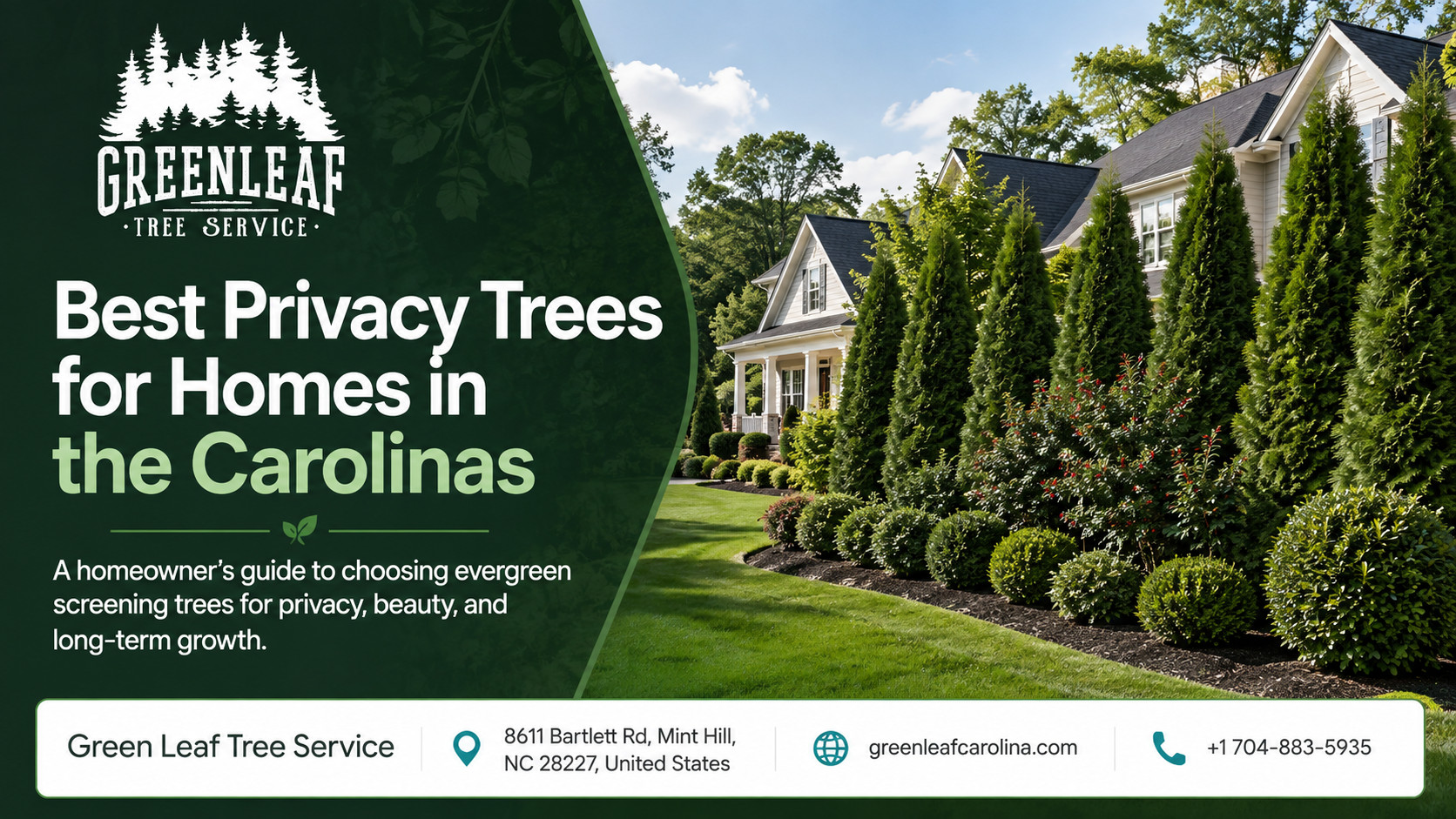
The best trees for Charlotte, NC are species that tolerate hot, humid summers, periods of limited rainfall, heavy clay soil, and occasional severe storms. Willow Oak, White Oak, Red Maple, disease-resistant American Elm cultivars, Eastern Redbud, Flowering Dogwood, Bald Cypress, Green Giant Arborvitae, and Eastern Red Cedar can all perform well when matched to the right location.
Species selection matters because even a healthy nursery tree can struggle when planted in unsuitable soil, excessive shade, poor drainage, or a space that is too small for its mature canopy and roots. Choosing the right tree for the property helps reduce future pruning, watering, disease, pavement damage, and storm-related problems.
Find the Right Trees for Charlotte
Choose trees that thrive in Charlotte’s climate. Call now for expert recommendations and professional planting.
What Trees Grow Best in Charlotte’s Climate?
Charlotte is located in North Carolina’s Piedmont region. Local landscapes commonly experience summer heat, humidity, compacted clay soil, thunderstorms, occasional drought, and short periods of winter cold. Trees planted in this environment must handle more than temperature alone.
The best choice depends on the intended purpose, available space, sunlight, soil moisture, and surrounding structures.
Willow Oak
Willow Oak is a popular large shade tree for Charlotte-area properties. It has narrow leaves, a rounded canopy, and a relatively fine-textured appearance compared with many other oak species.
It can grow approximately 40 to 75 feet tall and 25 to 50 feet wide, making it suitable for larger lawns, parks, and open residential properties. Willow Oak grows in full sun to light shade and adapts to several soil types, including clay. It also tolerates urban pollution and transplants more successfully than some other large oaks.
Willow Oak may be appropriate for homeowners who want:
- A broad shade canopy
- A large, long-term landscape tree
- Wildlife value
- A tree that tolerates Piedmont clay
- An attractive lawn or street-side tree
Its mature size must be respected. It should not be planted beneath power lines, immediately beside a house, or in a narrow strip between pavement and a property boundary.
White Oak
White Oak is a native, long-lived shade tree that can become a major landscape feature. It provides food and habitat for wildlife and develops a broad canopy when grown in an open area.
However, White Oak is not ideal for every developed property. It can be sensitive to soil compaction and disturbance around its root system. This is especially important on construction sites where heavy equipment has compressed the soil or removed the upper layer of topsoil.
White Oak works best when homeowners have:
- A large property
- Deep, suitable soil
- Room for a wide canopy
- A location away from foundations and utilities
- A long-term planting goal
Because it may establish more slowly than some faster-growing trees, White Oak is usually chosen for durability and ecological value rather than immediate shade.
Red Maple
Red Maple is widely used for shade and fall color. It adapts to full sun or partial shade and grows in a broad range of soil conditions, including clay. It generally prefers moist, slightly acidic soil with adequate drainage.
This adaptability makes it useful on many Charlotte properties, but homeowners should still pay attention to the specific cultivar. Different Red Maple cultivars vary in mature size, branching structure, fall color, and tolerance of urban conditions.
Red Maple may be suitable for:
- Medium or large lawns
- Seasonal fall color
- Moist but drained sites
- Areas with full sun or partial shade
- Homeowners seeking moderately fast shade
It should not be planted too close to sidewalks, driveways, foundations, or drainage systems. Its final placement should account for both canopy spread and root development.
Disease-Resistant American Elm Cultivars
American Elm was historically valued for its tall, vase-shaped canopy and ability to shade streets and large properties. Dutch elm disease eliminated many mature trees, but resistant cultivars such as ‘Princeton’ are now available.
A disease-resistant cultivar can provide a substantial canopy and traditional shade-tree form. However, homeowners should confirm the exact cultivar rather than purchasing an unidentified elm seedling. Ordinary seedlings may remain vulnerable to Dutch elm disease.
Elms generally prefer moist, well-drained soil and full sun to partial shade. Depending on the selection, they may become very large and require considerable open space.
An elm cultivar may work well for:
- Large front or back lawns
- Street-tree settings with adequate soil volume
- Homeowners seeking an arching shade canopy
- Properties where mature height is not restricted
Eastern Redbud
Eastern Redbud is a smaller native flowering tree that typically reaches about 20 to 30 feet tall and 20 to 35 feet wide. Its pink or purple spring flowers appear before the leaves and provide an early source of seasonal interest.
Redbud works well as an ornamental tree near patios, woodland edges, front yards, and planting beds. It tolerates full sun or partial shade, but afternoon shade can help reduce stress during hot Carolina summers.
It is a better option than a large oak when homeowners need a tree that fits beneath taller canopies or within a moderately sized landscape.
Eastern Redbud may be appropriate for:
- Small or medium yards
- Spring flowers
- Pollinator-friendly gardens
- Woodland-edge settings
- Partial-shade areas
Although relatively adaptable, it should not be placed in constantly wet or heavily compacted soil.
Flowering Dogwood
Flowering Dogwood is a native ornamental tree known for its white or pink spring bracts, red fruit, and fall color. It is strongly associated with North Carolina landscapes but requires more careful placement than many homeowners expect.
In the Piedmont, Flowering Dogwood often benefits from partial shade, particularly protection from intense afternoon sun. It prefers slightly acidic, organic, well-drained soil. A layer of mulch can help keep its shallow roots cooler and more evenly moist during summer.
Dogwood may work well for:
- Woodland gardens
- Front-yard ornamental planting
- Morning sun and afternoon shade
- Areas with good drainage
- Homeowners seeking flowers and wildlife value
It may struggle in exposed areas surrounded by heat-reflecting pavement or in heavy clay that remains saturated after storms. Improved or hybrid cultivars may offer better disease resistance, but the planting site remains important.
Bald Cypress
Bald Cypress is a deciduous conifer that can perform well in both wet and moderately dry landscapes. It tolerates a wide range of soil moisture, from ordinary upland conditions to areas that periodically hold standing water.
This adaptability makes Bald Cypress useful in low areas, rain gardens, pond edges, and spacious properties with drainage challenges. Although it is associated with swamps, it can also grow successfully in ordinary lawns when it receives adequate moisture during establishment.
Bald Cypress may be useful for:
- Large properties
- Low or periodically wet areas
- Pond and stream edges
- Tall shade or specimen planting
- Landscapes needing a distinctive tree form
It becomes a large tree and may develop woody knees in consistently wet soil. It should not be placed where these structures could interfere with mowing, paving, or pedestrian access.
Green Giant Arborvitae
Green Giant Arborvitae is commonly used for year-round privacy. It develops dense evergreen foliage and a tall pyramidal form. It grows best in full sun or some afternoon shade and prefers moist, well-drained soil.
It adapts to several soil types, but mature trees can exceed 40 feet in height and become approximately 15 to 20 feet wide. This makes it more appropriate for larger properties than for narrow planting beds.
Green Giant Arborvitae may be suitable for:
- Tall privacy screens
- Property boundaries
- Wind protection
- Screening roads or nearby buildings
- Medium or large landscapes
Homeowners should avoid planting the trees too closely for faster coverage. Crowding can reduce airflow, increase competition, and create maintenance problems as the screen matures.
Eastern Red Cedar
Eastern Red Cedar is a native evergreen that tolerates heat, drought, poor soil, deer pressure, and exposed conditions after establishment. It can provide year-round privacy, wildlife cover, and wind protection.
Its natural appearance is less formal than a row of arborvitae, making it particularly useful on large residential, rural, or naturalized properties.
Eastern Red Cedar may be a strong choice for:
- Natural privacy screens
- Wildlife-friendly landscapes
- Dry or exposed sites
- Windbreaks
- Larger property boundaries
Standard Eastern Red Cedars can become broad, so they need more room than narrow nursery specimens suggest. Homeowners with limited space may need a narrower cultivar or a different evergreen species.
Are Native Trees Easier to Maintain?
Native trees are often well adapted to regional rainfall, temperature patterns, soils, wildlife, and seasonal changes. This can make them more resilient than poorly adapted exotic species. However, native does not automatically mean maintenance-free.
A native tree can still fail when it is:
- Planted too deeply
- Installed in the wrong moisture conditions
- Placed in too much or too little sunlight
- Crowded against a structure
- Damaged during construction
- Planted in severely compacted soil
- Given insufficient water during establishment
White Oak, Eastern Redbud, Flowering Dogwood, Eastern Red Cedar, Red Maple, Willow Oak, and Bald Cypress are all native to North Carolina or the broader southeastern region. Each occupies a different ecological setting.
For example, Dogwood naturally grows as an understory tree and often benefits from afternoon shade. Bald Cypress naturally tolerates wet environments. Eastern Red Cedar performs well in sunny, exposed sites. Planting each species in conditions that resemble its natural preferences can reduce stress and maintenance.
Native trees also support local insects, birds, and other wildlife. Oaks are especially valuable because their acorns, foliage, branches, and bark provide food and shelter for many species.
Well-adapted nonnative trees or cultivated varieties can also be practical choices. Green Giant Arborvitae and disease-resistant elm cultivars are examples of trees that may serve a specific landscaping purpose when correctly placed.
The most useful principle is not simply “plant native.” It is “plant the right tree in the right place,” which is also central to NC State Extension’s plant-selection guidance.

How Often Should You Trim Your Trees?
Trees may look fine from a distance, but that does not always mean they are getting the care they need.…
What Should Homeowners Consider Before Planting?
Selecting a tree should begin with an evaluation of the property rather than a trip to the nursery. Homeowners need to consider how the tree will function in 10, 20, or 40 years.
Mature Height and Width
A young tree may only be six or eight feet tall when purchased, but its mature canopy could eventually cover much of the yard.
Homeowners should compare mature measurements with:
- Distance from the house
- Property lines
- Driveways
- Sidewalks
- Decks and patios
- Septic systems
- Utility easements
- Overhead power lines
- Nearby trees
Large trees such as Willow Oak, White Oak, American Elm, and Bald Cypress need substantial room. Smaller trees such as Eastern Redbud and Flowering Dogwood are better suited to modest residential spaces.
Soil Drainage
Charlotte’s clay soil can hold moisture and become compacted. Clay itself is not necessarily unsuitable, but drainage differs from one property to another.
Homeowners should observe what happens after heavy rainfall. Water that disappears within a reasonable period may indicate workable drainage. Water that remains for several days may require a moisture-tolerant species or drainage improvement.
Willow Oak tolerates clay and medium-to-wet soil, while Bald Cypress handles a broad range of moisture conditions. Dogwood prefers well-drained soil and may decline in a saturated planting site.
Sunlight
Most large shade trees need full sun to develop a balanced canopy. Flowering Dogwood and Eastern Redbud can tolerate partial shade and may benefit from afternoon protection during hot summers.
The site should be observed at several times during the day. A planting area that appears sunny in the morning may be shaded by a house or mature canopy for most of the afternoon.
Root Space
Tree roots often extend well beyond the visible canopy. A large tree planted in a small pocket of soil surrounded by pavement may become stressed as it grows.
Adequate root space helps trees access water, oxygen, and nutrients. It also reduces conflicts with foundations, sidewalks, drainage lines, and retaining walls.
Homeowners should not assume that roots will remain within the original planting hole.
Property Goals
The best tree depends on what the homeowner wants it to accomplish.
Common goals include:
- Cooling the home with afternoon shade
- Screening a neighboring property
- Adding spring flowers
- Supporting birds and pollinators
- Stabilizing a moist area
- Improving curb appeal
- Reducing views of a roadway
- Creating a long-term canopy
A tree selected for flowers may not provide substantial shade. A tall privacy tree may overwhelm a small lawn. A moisture-tolerant species may perform poorly on a dry hillside.
Maintenance Expectations
Different trees produce different maintenance needs. Homeowners should consider leaf drop, fruit, acorns, cones, pruning, irrigation, surface roots, and potential storm debris.
A properly placed tree should not require frequent pruning simply to keep it away from a roof, road, or utility line.
Local Requirements
Charlotte maintains tree-preservation and planting requirements for certain development projects, street rights-of-way, and regulated properties. The city’s current urban forestry resources include species lists, planting standards, preservation rules, and permitting information.
Before planting within a public right-of-way or near a street, homeowners should determine whether approval is required. The City of Charlotte also operates a street-tree program for eligible planting strips and rights-of-way.
Which Trees Handle Carolina Heat and Storms Best?
No tree is storm-proof. Wind resistance depends on species, root health, soil conditions, pruning history, trunk structure, and exposure.
Trees are more likely to perform well during storms when they have:
- A strong central trunk
- Proper branch spacing
- Healthy, unrestricted roots
- Adequate soil volume
- Correct planting depth
- No severe decay or structural defects
- Enough space to develop naturally
Willow Oak
Willow Oak tolerates heat, clay, and urban conditions. Its fibrous root system also helps it transplant successfully. However, like any large tree, it requires sufficient root space and proper structural pruning while young.
Shumard Oak
Although not included in every residential planting plan, Shumard Oak is another option worth considering for open spaces. It tolerates drought, dry soil, urban pollution, short-term flooding, and wind. It can reach approximately 70 feet tall and 40 feet wide.
Bald Cypress
Bald Cypress performs well in heat and can tolerate both wet periods and somewhat dry upland soil once established. Its ability to handle variable moisture makes it useful where Charlotte storms cause temporary saturation.
Eastern Red Cedar
Eastern Red Cedar is durable in exposed settings and handles drought better than many moisture-loving trees. It is often appropriate for natural windbreaks and sunny boundaries.
Red Maple
Red Maple adapts to clay and variable moisture, but homeowners should choose a cultivar with strong branch structure. Improper pruning or weak branch unions can increase storm damage.
Fast growth alone should not be used as a measure of storm resistance. A moderately growing tree with durable wood and healthy branch structure may provide better long-term performance than a rapidly growing species planted in poor soil.
What Trees Work Best for Shade or Privacy?
Shade and privacy are different landscaping goals. A shade tree generally develops a broad canopy above the ground, while a privacy tree needs dense foliage closer to eye level.
Best Trees for Shade
Willow Oak is a strong choice for large lawns and open residential areas. It develops a broad canopy and tolerates clay and urban conditions.
White Oak provides long-term shade and wildlife value but needs significant space and protection from soil compaction.
Red Maple offers moderately fast shade and fall color in moist, adequately drained locations.
Disease-resistant American Elm cultivars can create a tall, arching canopy where enough room is available.
Bald Cypress can provide tall shade in wet, low, or spacious areas.
Large shade trees should generally be planted far enough from the home for the mature canopy and roots to develop safely. Strategic placement on the western or southwestern side of a home may help reduce afternoon heat, but trees should not be placed where branches will immediately conflict with the roof.
Best Trees for Privacy
Green Giant Arborvitae provides dense, year-round coverage on properties with enough width and height clearance.
Eastern Red Cedar works well for natural screens, rural boundaries, and wildlife-friendly landscapes.
Nellie R. Stevens Holly, although not a required species for every Charlotte landscape, is another broadleaf evergreen option for medium-height screening.
Privacy trees should be selected according to the height of the unwanted view. A patio may only need screening 10 to 15 feet high, while second-story windows require taller trees.
For small yards, homeowners should avoid defaulting to the fastest or tallest species. Narrow cultivars, smaller hollies, or layered shrub-and-tree screens may provide sufficient privacy without consuming the entire yard.
Best Trees for Ornamental Beauty
Eastern Redbud provides early spring flowers and fits comfortably into many residential landscapes.
Flowering Dogwood adds spring flowers, berries, fall color, and a layered canopy in partially shaded sites.
Using both large and small trees can create a more complete landscape. A large oak may provide overhead shade, while Redbud or Dogwood adds flowers and visual interest beneath or near the edge of the canopy.
When Should You Hire a Tree Planting Professional?
Homeowners may successfully plant small trees on straightforward sites, but professional guidance becomes valuable when the project involves large nursery stock, difficult soil, drainage concerns, utility conflicts, or long-term screening plans.
Professional planting may be appropriate when:
- Several trees are being installed
- The property has compacted clay
- Water regularly collects in the planting area
- Large shade trees are being positioned near structures
- The planting site is sloped
- Underground utilities are nearby
- Privacy-screen spacing is uncertain
- Trees must block a particular view
- The homeowner is unsure which species fits the site
Species selection is only one part of successful planting. The root flare should remain visible at the soil surface, and the planting hole should accommodate the root system without burying the trunk.
Trees planted too deeply may appear healthy at first but decline gradually as the roots receive less oxygen and girdling roots develop around the trunk.
A tree professional or qualified arborist can also identify defects before planting. Co-dominant stems, damaged roots, circling roots, poor trunk taper, and weak branching may create future problems. Charlotte’s residential urban forestry notes emphasize vigorous nursery stock with healthy root systems and appropriate branch structure.
Professional planning can also prevent the most common placement mistake: installing the right species in the wrong location.
How Green Leaf Carolina Can Help
Green Leaf Carolina helps homeowners select and plant trees that match Charlotte-area properties and long-term landscape goals.
The planning process may consider:
- Desired shade or privacy
- Available planting space
- Mature tree size
- Soil texture and drainage
- Sun exposure
- Nearby buildings and pavement
- Utility lines and easements
- Property boundaries
- Maintenance expectations
- Wildlife and ornamental goals
The appropriate recommendation may be a large shade tree such as Willow Oak, a flowering ornamental such as Eastern Redbud, a wet-site tree such as Bald Cypress, or an evergreen screen using Green Giant Arborvitae or Eastern Red Cedar.
Professional placement and installation can help trees establish healthier root systems, grow with fewer structural conflicts, and remain manageable as they mature. The objective is not simply to plant more trees. It is to choose trees that can thrive in their specific locations and continue serving the property for many years.
FAQs
What is the best overall tree for Charlotte, NC?
There is no single best tree for every property. Willow Oak is useful for large shade areas, Eastern Redbud fits smaller ornamental spaces, Bald Cypress performs well in moist locations, and Green Giant Arborvitae can create tall privacy screens. The best choice depends on soil, sunlight, space, and the homeowner’s goal.
What trees grow well in Charlotte clay soil?
Willow Oak, Red Maple, Bald Cypress, Green Giant Arborvitae, and several other adapted species can tolerate clay when drainage and planting depth are appropriate. Clay that remains waterlogged may require a moisture-tolerant species or drainage correction.
Are oak trees good for Charlotte homes?
Yes, provided there is enough room. Willow Oak, White Oak, and Shumard Oak can become valuable shade trees. Their mature height, canopy width, and root space should be evaluated before planting.
Is Willow Oak a good residential tree?
Willow Oak can be an excellent shade tree for a large residential lot. It tolerates clay and urban conditions, but it may reach 40 to 75 feet tall and up to 50 feet wide. It is too large for many narrow planting areas.
Can Dogwood handle Charlotte summers?
Flowering Dogwood can grow successfully in Charlotte, but it often benefits from afternoon shade, well-drained acidic soil, mulch, and consistent moisture during dry periods. An exposed, hot site may cause stress.
Is Eastern Redbud suitable for a small yard?
Yes. Eastern Redbud usually reaches approximately 20 to 30 feet tall and has a rounded canopy. It is smaller than most shade trees and works well near patios, woodland edges, and front yards.
What tree is best for a wet yard?
Bald Cypress is one of the most adaptable choices for wet or periodically flooded areas. It can also grow in ordinary upland soil when properly established.
What is the best tree for year-round privacy?
Green Giant Arborvitae and Eastern Red Cedar provide evergreen coverage. Green Giant has a more uniform pyramidal shape, while Eastern Red Cedar creates a more natural-looking screen.
How close can a tree be planted to a house?
The correct distance depends on the tree’s mature width, branch structure, and root system. Large trees should generally be placed much farther away than small ornamental trees. Homeowners should base distance on mature measurements rather than nursery size.
Can trees be planted under power lines?
Only trees that remain safely below the utility clearance should be planted beneath overhead lines. Large oaks, elms, maples, cypress, and tall evergreens are inappropriate for these locations.
Do native trees need less watering?
Native trees still need consistent watering during establishment. Once established in a suitable site, some native species may tolerate local weather more effectively than poorly adapted trees.
What is the best time to plant trees in Charlotte?
Fall is often a favorable planting season because cooler air reduces stress while the soil remains warm enough for root growth. Late winter and early spring can also work. Summer planting requires closer watering and heat management.
How long should a newly planted tree be watered?
Watering needs vary according to tree size, soil, rainfall, temperature, and drainage. Newly planted trees require regular moisture until roots expand into the surrounding soil. The root zone should be moist but not continuously saturated.
Should soil amendments be added to Charlotte clay?
Large amounts of amended soil placed only in the planting hole can create drainage and root-growth problems. It is generally better to choose a species suited to the existing soil and improve a broader planting area when necessary.
Is an arborist needed before planting?
An arborist or tree professional is especially helpful when planting large trees, working near existing mature trees, managing drainage problems, creating a long privacy screen, or selecting species for a difficult site.
Choose the Best Trees for Your Yard
Make sure your trees can handle Charlotte’s weather. Call now for professional tree selection and planting.