
A professional tree inspection is a detailed review of a tree’s health, structure, roots, trunk, canopy, and surrounding risk factors. During the tree inspection process, an arborist looks for signs of decay, disease, storm damage, weak limbs, root problems, and conditions that could make a tree unsafe.
For property owners, an inspection provides clarity before small concerns become expensive or dangerous. A tree may look healthy from the street while hiding internal decay, root stress, or structural weakness. Understanding what arborists evaluate can help homeowners make better decisions about maintenance, pruning, treatment, or removal.
Not Sure If Your Tree Is Safe?
Schedule a professional tree inspection and get clear answers before small issues become costly problems.
Why Tree Inspections Matter
Tree inspections matter because trees can develop problems long before obvious failure occurs. By the time a large limb drops, the trunk splits, or the tree starts leaning, the issue may already be advanced.
A professional inspection helps identify warning signs early. It also helps separate normal tree changes from concerns that need action.
Not every crack, dead branch, or patch of fungus means a tree must be removed. Some trees need pruning. Some need soil care. Some need monitoring. Others may need more serious attention if they are structurally unstable.
The value of an inspection is the professional judgment behind it. Arborists look at the whole tree, not just one symptom.
They consider the tree’s species, age, growth pattern, location, previous damage, soil conditions, and proximity to structures. A tree near a driveway, home, walkway, or power line requires a different level of concern than a tree in an open area.
Tree inspections also help property owners plan ahead. If a tree is declining, you can decide how to manage it before storms, heavy rain, or seasonal stress make the problem worse.
For homeowners who want a clear assessment, Green Leaf Carolina offers professional tree inspection services focused on safety, tree health, and practical recommendations.
Is Hidden Tree Damage Dangerous?
Yes, hidden tree damage can be dangerous because it may weaken the tree without changing its appearance right away. A tree can still have leaves, shade, and normal-looking bark while suffering from internal decay or root damage.
Hidden damage is one reason the tree inspection process is important.
A weakened tree may fail during wind, heavy rain, saturated soil, or routine yard activity. In some cases, a large limb or trunk section can break with little warning.
Internal Decay
Internal decay can develop inside the trunk or major limbs. From the outside, the tree may only show small signs such as fungal growth, cavities, soft wood, or bark changes.
Decay reduces the amount of strong wood supporting the tree. If enough structural wood is lost, the tree may become unstable.
Root Problems
Root damage is often difficult for homeowners to spot. Roots can be affected by construction, trenching, compacted soil, poor drainage, erosion, or disease.
When roots are weakened, the tree may lose anchoring strength. This is especially serious after heavy rain or strong wind.
Weak Branch Unions
Some trees develop tight branch unions where two stems grow close together. These areas can trap bark and create weak attachment points.
A tree may look full and healthy, but one major limb may be more likely to split away under stress.

Should You Remove a Tree Close to Your Home?
A tree too close to a house does not automatically need to be removed. Many trees grow safely near homes…

What Should Property Owners Watch For?
Property owners should watch for changes in the tree’s structure, canopy, trunk, roots, and surrounding soil. You do not need to diagnose the problem yourself. The goal is to notice signs that deserve a closer look.
Warning Signs in the Canopy
Look for dead branches, hanging limbs, thinning leaves, broken limbs, or sections of the canopy that no longer produce healthy growth.
A few small dead branches may be normal. Large dead limbs over a roof, driveway, deck, or walkway are more serious.
Warning Signs on the Trunk
Check for cracks, splits, missing bark, cavities, soft spots, insect activity, or mushrooms growing from the trunk.
Deep cracks or open seams can indicate structural weakness. Cavities may suggest decay inside the tree.
Warning Signs Near the Roots
Look for exposed roots, lifting soil, fungal growth at the base, erosion, or a tree that appears to be shifting.
If the ground is raised on one side of the tree, the root plate may be moving. That can be a serious stability concern.
Changes After Weather Events
After strong storms, homeowners should look for new leaning, broken limbs, fresh cracks, or branches hanging in the canopy.
Do not walk under damaged limbs or stand close to a tree that appears unstable.
When Should You Schedule an Inspection?
You should schedule a tree inspection when you notice warning signs, after major storms, before construction near trees, or when a tree is close to important parts of your property.
An inspection is also useful when you are unsure whether a tree is healthy or declining.
Schedule an inspection if you see:
- A new or worsening lean
- Large dead branches
- Cracks in the trunk
- Hanging limbs
- Fungal growth near the base
- Exposed roots
- Soil lifting around the tree
- Sudden canopy thinning
- Storm damage
- Branches over your roof
- Trees growing close to power lines
- Construction work near mature trees
Inspections are especially important before problems become urgent. A professional may be able to recommend pruning, monitoring, soil care, or healthcare treatments before the tree becomes unsafe.
In some cases, the inspection may show that a tree is too compromised to preserve. In other cases, it may confirm that the tree is stable and only needs routine care.
If you are concerned about disease, pests, or long-term decline, Green Leaf Carolina’s arborist tree healthcare services can help evaluate the tree’s overall condition and recommend care options.
What Will an Arborist Inspect?
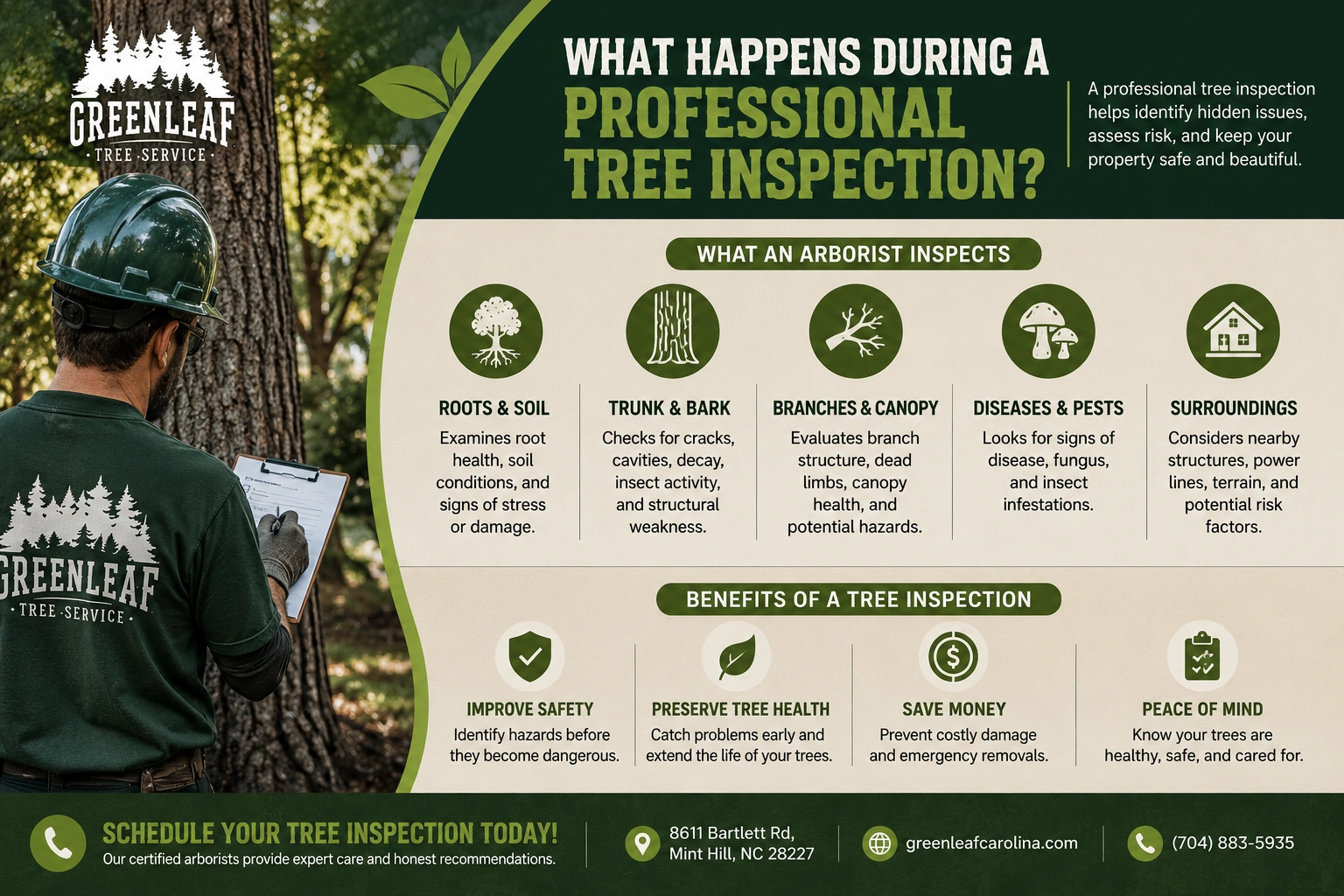
An arborist inspects the entire tree system, from the roots to the canopy. The goal is to understand health, structure, stability, and risk.
Site Conditions
The inspection often starts with the site around the tree. Arborists look at drainage, soil compaction, grading, erosion, nearby construction, and available growing space.
Poor site conditions can stress trees over time. Compacted soil can limit oxygen and water movement. Standing water can contribute to root decline.
The surrounding area also affects risk. A tree over a home, parking area, fence, or walkway may need closer attention.
Root Flare and Root Zone
The root flare is where the trunk widens at the base. It should be visible above the soil.
If the root flare is buried by mulch or soil, the tree may develop decay or girdling roots. Girdling roots wrap around the trunk or other roots and can restrict growth.
An arborist may also inspect for root damage, fungal growth, soil lifting, and signs that the tree is not properly anchored.
Trunk Condition
The trunk is checked for cracks, cavities, decay, wounds, missing bark, insect activity, and signs of past injury.
Arborists also look at trunk taper. A strong tree usually has good taper from the base upward. Poor taper can suggest structural weakness.
Large wounds, hollow sections, and deep cracks do not always mean immediate removal, but they do deserve professional evaluation.
Branch Structure
The arborist looks at how the limbs attach to the trunk. Strong branch attachments are important for long-term stability.
Weak unions, co-dominant stems, included bark, and overextended limbs can increase the risk of branch failure.
This is especially important for trees near homes, patios, sidewalks, and driveways.
Canopy Health
The canopy can reveal stress. Arborists look for deadwood, thinning leaves, discoloration, uneven growth, broken limbs, and dieback.
Canopy symptoms may point to root stress, disease, pest issues, drought, or structural decline.
Disease and Pest Signs
An arborist may look for fungal bodies, boring insects, leaf spots, cankers, unusual swelling, oozing, or bark damage.
Pests and diseases do not always require removal. Many issues can be managed if they are found early enough.
Risk and Recommendations
The final part of the tree inspection process is the recommendation. The arborist may suggest pruning, deadwood removal, cabling, soil improvement, treatment, monitoring, or removal.
The recommendation depends on the condition of the tree and the level of risk to the property.
What Homeowners in Rock Hill Commonly Miss
Homeowners in Rock Hill often notice broken branches but miss root and trunk issues. Those hidden problems can matter more than visible canopy damage.
Rock Hill properties often include mature trees near homes, driveways, fences, and utility lines. That creates more risk when trees weaken.
Heavy rain, wind, clay-heavy soil, and seasonal storms can all affect tree stability. Saturated soil may reduce root support, especially when strong winds move through the area.
Commonly missed issues include:
- Soil lifting near the base
- Small trunk cracks that deepen over time
- Fungal growth around roots
- Hidden cavities behind bark
- Large limbs with weak attachments
- Roots damaged by landscaping or construction
- Canopy thinning on one side of the tree
- Branches rubbing against the roof
Many homeowners also miss gradual changes because they see the tree every day. A professional inspection provides a more objective view.
Green Leaf Carolina serves homeowners throughout the area, including those looking for tree care in Rock Hill, SC.
How Green Leaf Carolina Can Help
Green Leaf Carolina helps property owners understand what is happening with their trees before problems become larger safety concerns.
Our inspection approach is practical and educational. We look at tree health, structure, visible defects, root conditions, storm damage, and property risk.
We do not treat every concern as a removal issue. If a tree can be managed with pruning, healthcare, or monitoring, we will explain those options. If a tree is structurally unsafe, we will help you understand why and what the next step should be.
A professional tree inspection gives you a clearer path forward. It can help protect your home, preserve healthy trees, and reduce the chance of surprise failures.
If you are unsure about a tree on your property, Green Leaf Carolina can inspect it and provide honest recommendations through our tree inspection services.
FAQs
What happens during a professional tree inspection?
During a professional tree inspection, an arborist evaluates the roots, trunk, branches, canopy, site conditions, and nearby property risks. The goal is to identify health issues, structural problems, and potential safety concerns.
How long does a tree inspection take?
The time depends on the size of the property, number of trees, and complexity of the concerns. A single-tree inspection is usually more straightforward than a full property assessment.
What does an arborist look for in a tree?
An arborist looks for decay, cracks, cavities, weak limb attachments, dead branches, root damage, disease, pests, canopy thinning, soil problems, and signs of instability.
Can a tree look healthy but still be dangerous?
Yes. A tree can have green leaves and still have internal decay, weak roots, or structural defects. That is why inspections look beyond the canopy.
Should I schedule a tree inspection after a storm?
Yes, you should schedule an inspection after a severe storm if you notice leaning, broken limbs, hanging branches, trunk cracks, or soil movement around the roots.
Do tree inspections always lead to removal?
No. Many inspections lead to pruning, monitoring, soil care, or healthcare recommendations. Removal is usually considered when the tree is structurally unsafe or cannot be managed safely.
How often should trees near a house be inspected?
Trees near a house should be inspected after major storms, when warning signs appear, or periodically as part of property maintenance. Older trees and trees close to structures may need closer monitoring.
Why are tree inspections important in Rock Hill?
Tree inspections are important in Rock Hill because mature trees, storms, heavy rain, and clay-heavy soil can create stability concerns. Inspections help homeowners catch risks before limbs or trees fail.
Concerned About a Tree Near Your Home?
Let our experts check its health, stability, and safety so you can make the right decision with confidence.