
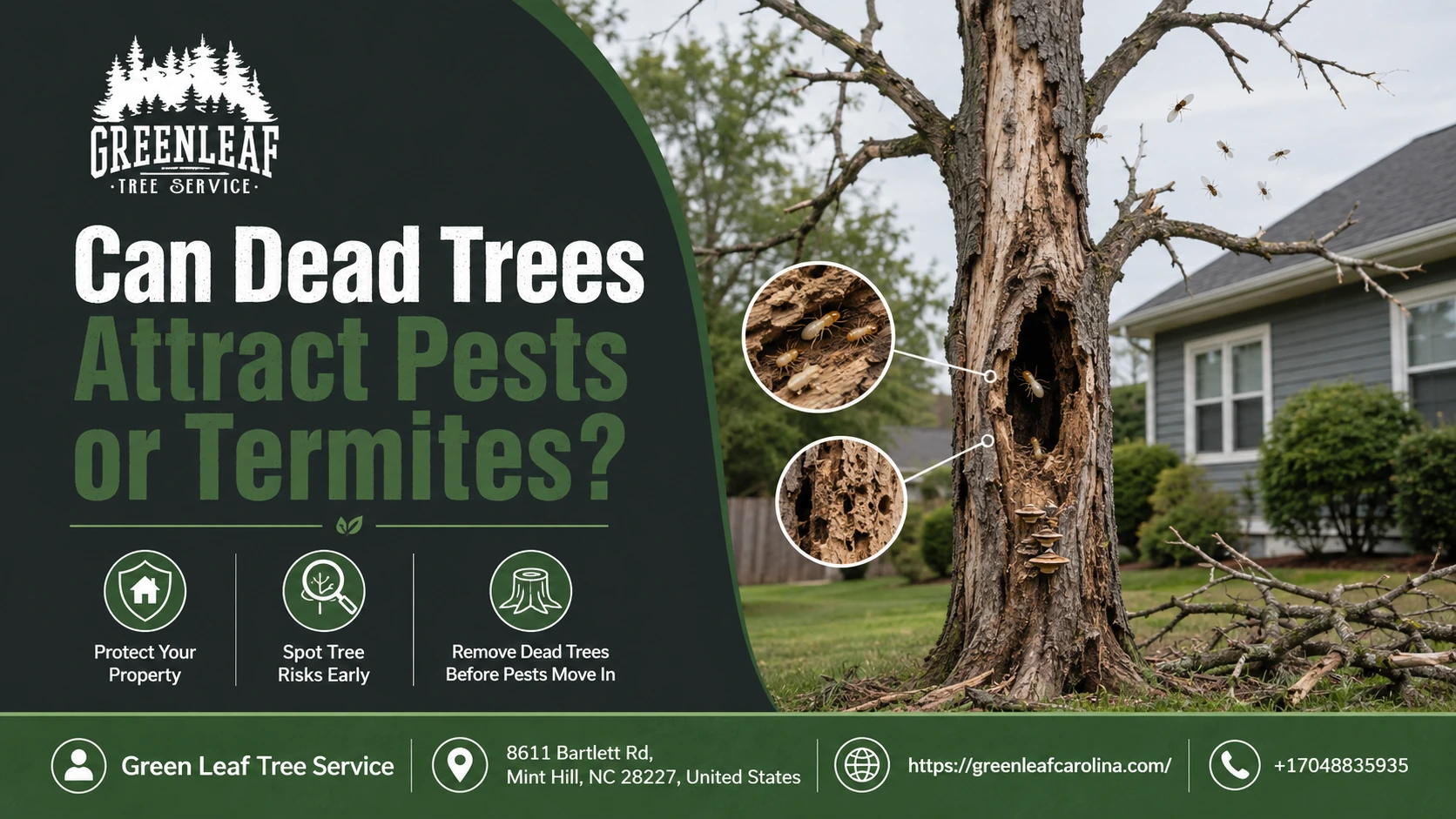
Yes, dead trees attract termites, carpenter ants, wood-boring beetles, fungi, and other organisms that feed on or shelter inside decaying wood. A dead tree does not automatically cause a termite infestation inside a nearby house, but it can provide food, moisture, and protected habitat for pest activity within the landscape.
Dead and dying trees can also create safety concerns unrelated to insects. As wood loses strength, branches may fall, trunks may split, and root systems may become less stable. Recognizing decay early and arranging a professional evaluation can help homeowners address pest activity and structural risks before the tree becomes more difficult to manage.
Dead Tree Bringing Unwanted Pests?
Remove the risk before termites and other pests spread. Call today for professional tree removal.
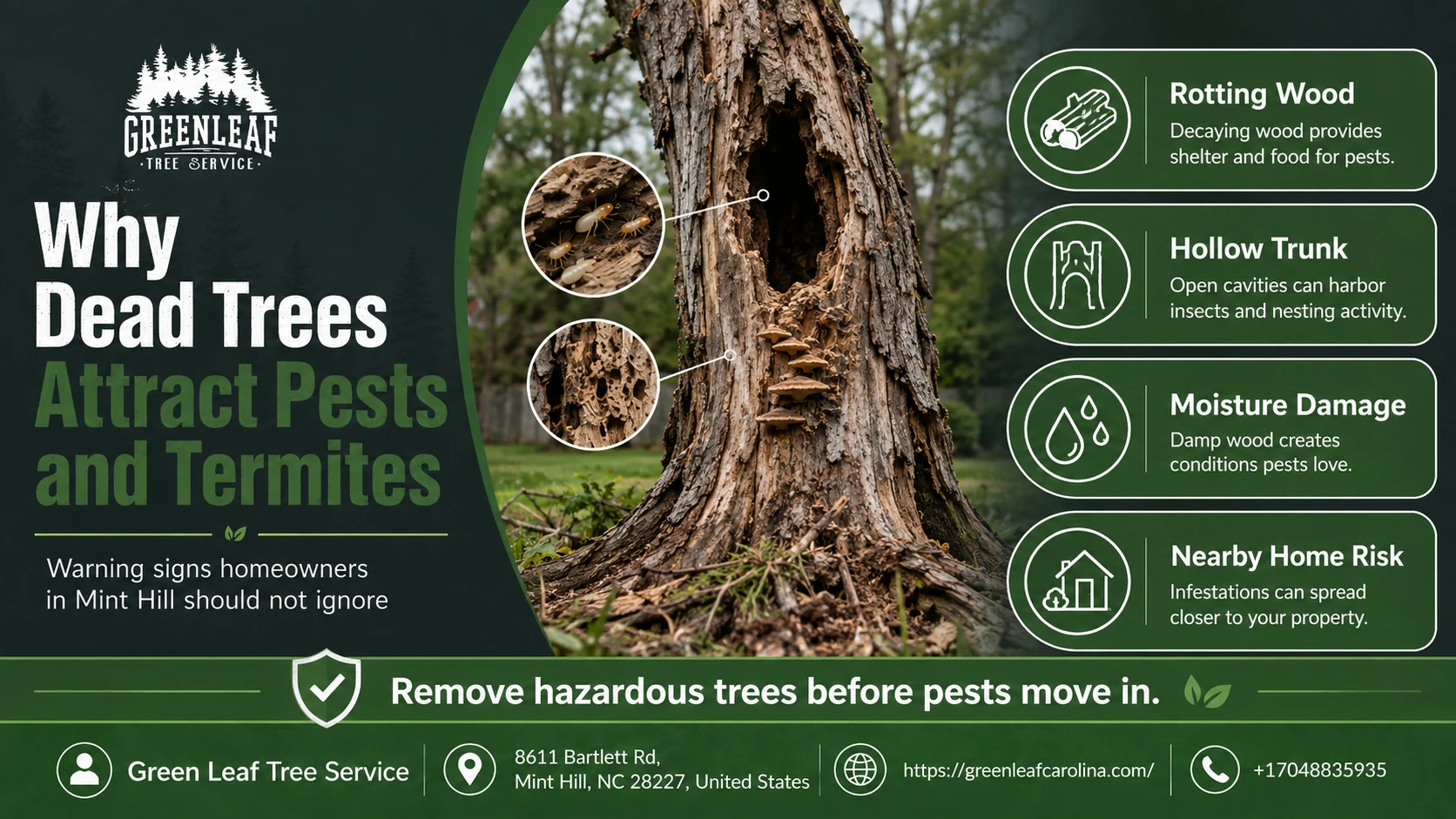
Why Dead Trees Attract Pests and Termites
Dead wood is part of the natural decomposition cycle. In forests, fallen trees and dying trunks are gradually broken down by insects, fungi, bacteria, and other organisms. The same process occurs in residential yards.
Termites are attracted to cellulose, the organic material found in wood. Moist, decaying wood is often easier for them to use than healthy, living tissue. Stumps, fallen logs, buried roots, dead trunks, and damp firewood can all support termite activity.
Finding termites in a stump or dead tree does not necessarily mean they are moving directly toward the house. Extension guidance explains that termites found in landscape wood away from a building are usually performing their natural role of breaking down dead material. Their presence can still serve as a reminder to confirm that the home has been inspected and properly protected.
Other pests commonly associated with declining or dead wood include:
- Carpenter ants
- Bark beetles
- Wood-boring beetles
- Powderpost beetles
- Wasps and bees using old cavities
- Centipedes and other moisture-loving organisms
- Fungi that break down wood fibers
Carpenter ants frequently nest in logs, stumps, hollow trees, and moisture-damaged wood. Unlike termites, they do not eat wood. They excavate softened material to create galleries for nesting. Their presence inside a tree is usually an indication that decay was already present rather than the original cause of the damage.
Wood-boring beetles may use weakened, dying, or recently dead trees as breeding material. Small exit holes, tunnels beneath loose bark, and sawdust-like material can indicate that beetles or other boring insects are present.
A dead tree can therefore support an entire collection of organisms. Many are simply participating in natural decay, but their presence becomes more concerning when the tree is near a house, deck, garage, play area, driveway, or healthy landscape trees.
Is a Dead Tree Dangerous to Nearby Structures?
A dead tree can become dangerous because its wood and root system gradually lose strength. The tree may remain standing for months or years, but its condition can change without producing obvious warning signs at ground level.
Branches are often the first parts to fail. Large dead limbs may break during wind, rain, or completely calm weather. If the canopy extends over a home, driveway, fence, utility line, or neighboring property, a falling branch can cause substantial damage.
The trunk may also develop hidden decay. A tree can appear solid from one side while containing a large hollow area or extensive internal rot. Cracks, cavities, fungal growth, and loose bark may indicate that the remaining wood is no longer supporting the tree effectively.
Potential hazards include:
- Branches falling onto roofs or vehicles
- Trunks splitting during storms
- Trees falling across roads or driveways
- Damage to fences, sheds, and utility lines
- Injury to people or pets
- Roots lifting as the tree begins to lean
- Increased difficulty and expense of removal
Tree-risk guidance recommends checking for large dead branches, hanging limbs, loose bark, trunk cracks, splits, and previous branch failures. Once defects are identified, an arborist can evaluate whether pruning, monitoring, or removal is the most appropriate response.
Location matters as much as the tree’s condition. A dead tree in an unused wooded area may present less immediate risk than a smaller dead tree beside a home entrance. Tree professionals evaluate both the likelihood of failure and what could be struck if failure occurs.
Pest activity can also extend beyond the tree. Carpenter ants nesting in a hollow trunk may forage around nearby buildings. Termites in landscape wood do not automatically infest a house, but moisture-damaged structural wood, direct soil-to-wood contact, leaking pipes, or unprotected foundations can give them opportunities to enter.
Homeowners who discover termites inside a building, mud tubes on the foundation, or swarmers emerging indoors should contact a licensed pest management professional. Tree removal alone does not treat an established structural termite infestation.
What Should Homeowners Check Around the Yard?
Homeowners can perform occasional visual inspections from the ground, particularly after storms, extended drought, or major changes in the tree’s appearance. The inspection should include the canopy, trunk, base, exposed roots, nearby stumps, and surrounding ground.
No climbing, probing deep cavities, or cutting branches is necessary. These actions can be dangerous and may further weaken the tree.
Peeling or Missing Bark
Healthy bark protects the trunk from injury and moisture loss. Large areas of peeling, loose, or missing bark may indicate that the tissue beneath it has died.
Some tree species shed bark naturally, so bark appearance should be considered alongside other symptoms. Sudden bark loss, soft wood underneath, insect galleries, or darkened areas are more concerning.
Large Dead Branches
A tree may be declining even when part of the canopy remains green. Large leafless branches, repeated branch loss, and dieback spreading through the crown can indicate serious stress or structural weakness.
Dead branches do not bend and recover like healthy wood. They become brittle and may fall unexpectedly.
Hollow Areas and Cavities
Cavities can form after wounds, broken branches, lightning strikes, improper pruning, or internal decay. A hollow tree is not automatically unsafe, since some trees can remain structurally sound with internal cavities.
The location and extent of the decay must be evaluated. A large opening near the base, a cavity combined with cracks, or a hollow trunk supporting a heavy canopy deserves professional attention.
Fungal Growth
Mushrooms, conks, or shelf-like fungal structures on the trunk, roots, or soil near the base may indicate internal wood decay.
Fungal growth does not always mean the tree will fail immediately. However, some root and trunk rots can weaken structural wood significantly. Trees with soft, spongy wood and fungal growth may be more likely to break or fall during storms.
Insect Exit Holes
Round, oval, or D-shaped holes may be left behind by wood-boring insects. The size and shape of the opening can help identify the pest.
Exit holes should be evaluated with other signs, such as:
- Loose bark
- Declining foliage
- Dead branches
- Tunnels beneath the bark
- Sap or resin flow
- Sawdust or frass
- Insect activity around the trunk
Not every insect found on a dead tree requires treatment. Many insects arrive after the tree has already declined. Identification helps determine whether the pest threatens nearby healthy trees or is simply using dead wood.
Sawdust-Like Material
Carpenter ants and wood-boring insects may push wood particles, insect waste, and other material out of their galleries. Small piles may collect at the base of the tree, inside cavities, or on nearby surfaces.
Carpenter ant material is often associated with smooth internal galleries because the ants remove decayed wood rather than consume it.
Excessive Woodpecker Activity
Woodpeckers feed on insects beneath bark and inside wood. Frequent activity concentrated on one trunk or group of branches may indicate a large insect population.
Woodpecker activity alone does not prove that termites are present. Beetle larvae, ants, and other insects may also attract feeding birds.
Mud Tubes or Termite Swarmers
Subterranean termites build mud tubes to travel between soil and wood while remaining protected from dry air and predators. Tubes may appear on tree trunks, stumps, foundations, support piers, or other surfaces.
Termite swarmers may emerge from landscape wood or buildings. Swarmers found outdoors away from the home are not always an emergency. Swarmers appearing indoors or around the foundation are more concerning and justify a structural pest inspection.
Leaning or Soil Movement
A newly developing lean, raised soil, exposed roots, or cracking ground around the base may indicate root instability.
After major storms, larger trees near people or property should be inspected for trunk cracks, hanging limbs, and soil heaving, even if they still appear upright.
How Rotting Wood Increases Pest Problems
As wood decays, its physical and chemical properties change. Fungi begin breaking down the structural fibers, the wood becomes softer, and cavities may form. Moisture can remain trapped beneath loose bark or inside hollow areas.
These conditions benefit many organisms.
Termites can consume cellulose in dead and moisture-damaged wood. Carpenter ants can more easily excavate galleries through softened areas. Beetles can lay eggs beneath loose bark, while larvae tunnel through the inner bark or sapwood.
Rotting wood can also provide shelter for:
- Cockroaches
- Millipedes
- Centipedes
- Spiders
- Rodents
- Snakes
- Bees and wasps
- Small mammals
These organisms do not all damage buildings or healthy trees. However, a decaying tree close to the home can increase pest activity near patios, crawl spaces, garages, firewood storage areas, and foundations.
Moisture is an important part of the problem. Dead wood that remains dry may decay relatively slowly. Wood in contact with damp soil, leaking irrigation, clogged drainage, or heavy shade can remain moist and become more attractive to decomposers.
Common conditions that encourage pest activity include:
- Stumps left at soil level
- Logs lying directly on the ground
- Firewood stacked against the house
- Mulch piled against trunks or foundations
- Poor drainage around dead roots
- Irrigation repeatedly wetting decayed wood
- Buried wood and construction debris
- Hollow trees that collect rainwater
Removing a dead tree does not remove all termites from the surrounding environment. Subterranean termite colonies live in the soil and may forage across a wide area. The practical goal is to remove unnecessary sources of decaying wood near the home and correct conditions that allow moisture to remain against structural materials.
Homeowners should also avoid carrying infested logs indoors or stacking freshly cut dead wood against a garage or foundation. Firewood should be stored off the ground and away from the building.
When Should You Remove a Dead Tree?
A completely dead tree near a home or frequently used area should usually be evaluated promptly. Dead trees do not recover, and their structural strength generally decreases as decomposition continues.
Removal may be recommended when the tree:
- Is completely dead
- Has large dead limbs over a structure
- Contains extensive trunk or root decay
- Has begun leaning unexpectedly
- Shows cracks or splits in the trunk
- Has loose, hanging branches
- Is dropping limbs repeatedly
- Contains major cavities near the base
- Is close to utility lines
- Blocks safe access
- Has become a significant pest habitat
- Could damage neighboring property if it falls
Not every tree with a dead branch needs to be removed. A tree may have isolated storm damage or limited dieback that can be managed through proper pruning and care.
A professional should distinguish between a dead tree, a severely declining tree, and a tree with a treatable problem. Premature removal can eliminate a tree that could recover, while delayed removal can allow a hazardous tree to become less stable.
Timing is especially important after storms. A cracked or partially uprooted tree may be under considerable tension. Homeowners should stay away from hanging branches, split trunks, trees contacting utility lines, and trees leaning over occupied areas.
Tree removal can also become more complex as decay progresses. Climbers may not be able to rely on compromised wood, and branches may break unpredictably. Specialized equipment, such as a bucket truck or crane, may be necessary to complete the work safely.
Removal should not be viewed as a direct treatment for a termite-infested home. When termites are found in structural wood, homeowners need a licensed pest management company to inspect and protect the building. Extension guidance advises against attempting structural termite treatment as a do-it-yourself project.

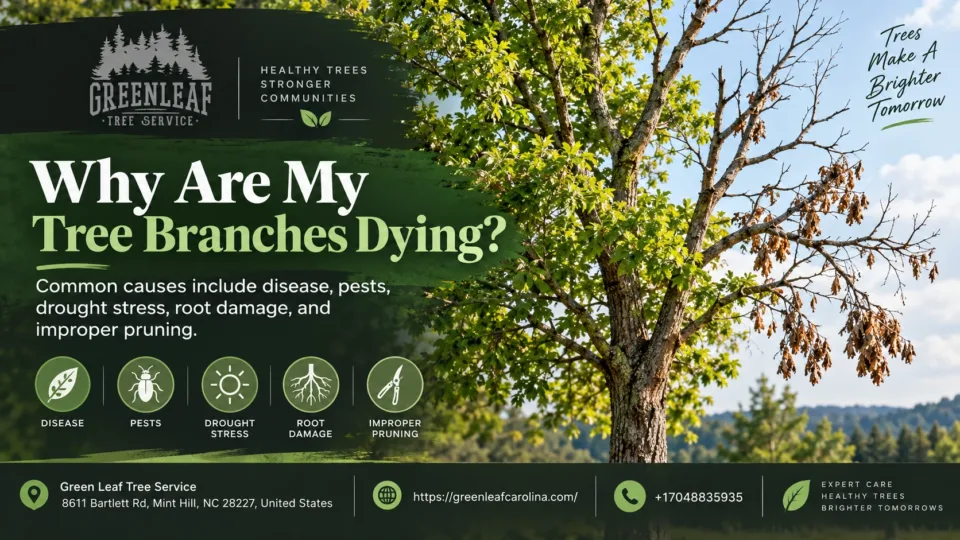
Why Are My Tree Branches Dying?
Common causes of dying tree branches include drought stress, root damage, fungal or bacterial disease, insect infestations, storm injuries, compacted…
What Will a Tree Company Inspect?
A tree company or qualified arborist will usually begin by evaluating the tree from the ground and reviewing what surrounds it. The inspection should consider both tree health and the consequences of possible branch or trunk failure.
Canopy Condition
The inspector may look for:
- Dead branches
- Sparse foliage
- Uneven leaf development
- Broken limbs
- Hanging branches
- Previous topping or poor pruning
- Dieback concentrated on one side
- Branches touching structures
The pattern of decline can help indicate whether the problem began in the roots, trunk, or canopy.
Trunk Structure
The trunk may be examined for:
- Cracks
- Splits
- Cavities
- Loose bark
- Decay
- Previous wounds
- Weak branch attachments
- Multiple competing trunks
- Fungal growth
- Insect holes or galleries
A hollow sound alone does not determine whether the tree is dangerous. The amount and location of sound supporting wood are more important.
Root Zone and Base
The area around the base may reveal:
- Fungal growth
- Root decay
- Soil movement
- Uprooting
- Buried root flares
- Construction damage
- Compaction
- Trenching injuries
- Girdling roots
- Excess moisture
Root damage can be especially serious because it affects both tree health and stability.
Pest Evidence
The inspector may note mud tubes, carpenter ant activity, exit holes, frass, beetle galleries, loose bark, or woodpecker feeding.
A tree company may identify likely pest categories, but structural termite treatment belongs to a licensed pest management professional. When both a tree and a home may be affected, homeowners may need separate inspections.
Nearby Targets
Risk is partly determined by what is within falling distance. The inspection will usually consider:
- Houses
- Garages
- Vehicles
- Play areas
- Patios
- Walkways
- Roads
- Utility lines
- Neighboring property
- Frequently occupied spaces
The same defect may create very different risk levels depending on the tree’s location.
Appropriate Next Steps
After evaluating the tree, the professional may recommend:
- Monitoring
- Removing dead branches
- Corrective pruning
- Pest or disease identification
- Improving root-zone conditions
- Reducing nearby targets
- Removing the tree
An arborist can also determine whether an apparently dead tree still has living tissue and a reasonable chance of recovery. Construction-damaged and storm-damaged trees sometimes require immediate professional assessment to determine their viability and risk.
How Green Leaf Carolina Can Help
Green Leaf Carolina helps homeowners evaluate dead, declining, and structurally damaged trees before they become larger safety or pest concerns.
An inspection can consider visible decay, canopy dieback, pest evidence, cavities, trunk defects, root conditions, and the tree’s distance from homes, driveways, utility lines, and other occupied areas. This helps distinguish between a tree that may benefit from pruning or monitoring and one that should be removed.
When removal is appropriate, careful planning is important because dead wood can be brittle and unpredictable. The work may require controlled dismantling, specialized equipment, and debris management to protect nearby structures and landscaping.
Green Leaf Carolina can also help homeowners identify remaining stumps, fallen timber, and decaying wood that may continue to provide habitat for insects after a tree is removed. The objective is not to eliminate every naturally occurring insect from the property. It is to reduce avoidable hazards and remove deteriorated wood from locations where it could affect people, structures, or healthy trees.
FAQs
Do dead trees attract termites?
Yes. Termites feed on cellulose and commonly use dead, decaying, or moisture-damaged wood. A dead tree, stump, fallen log, or buried root can provide food and shelter.
Will termites in a dead tree infest my house?
Not necessarily. Termites commonly live in landscape wood without entering nearby buildings. However, a dead tree close to the home indicates termite activity in the area and may justify checking the home’s termite protection and inspection history.
How close is too close for a termite-infested tree?
There is no single distance that guarantees safety. The condition of the house, foundation protection, soil moisture, drainage, wood-to-soil contact, and termite species all influence risk. A dead tree beside the foundation deserves more attention than one far from the home.
Do termites attack healthy trees?
Most subterranean termites prefer dead or moisture-damaged wood. Termite activity in a living tree may indicate internal decay, dead roots, cavities, or another underlying problem rather than an attack on healthy tissue.
Do carpenter ants eat dead trees?
Carpenter ants do not eat wood. They remove softened or decaying wood to create nesting galleries. Their presence is often evidence that decay already exists.
What is the difference between termite and carpenter ant damage?
Termites consume wood and may leave soil or mud inside their galleries. Carpenter ants excavate wood and remove material from their nests, sometimes creating piles of coarse sawdust-like debris. Accurate identification may require a pest professional.
Do wood-boring beetles live in dead trees?
Many wood-boring beetles use weakened, dying, recently dead, or seasoned wood. Their larvae tunnel beneath bark or through wood before adults leave through visible exit holes.
Does fungal growth mean a tree is dead?
Not always. Fungal growth can occur on dead branches, old wounds, surface roots, or internal decay while portions of the tree remain alive. Fungal structures on the trunk or base should be professionally evaluated because they may indicate weakened wood.
What are the clearest signs of a dead tree?
Common signs include a completely leafless canopy during the growing season, brittle twigs, peeling bark, extensive dead branches, fungal growth, trunk cavities, and no living tissue beneath the outer bark. Species and season must be considered before confirming death.
Is a hollow tree always dangerous?
No. Some hollow trees retain enough sound outer wood to remain standing. The size, location, and shape of the cavity, along with trunk condition and nearby targets, determine the level of concern.
Can a dead tree fall without warning?
Yes. Decay can weaken roots, branches, or the trunk internally. Failure may occur during storms or calm weather, particularly when large branches have become brittle.
Should a dead tree be removed immediately?
A dead tree near a home, road, utility line, playground, or occupied area should be evaluated promptly. The urgency depends on its condition, size, lean, defects, and what it could strike.
Can I remove a dead tree myself?
Small trees in open areas may appear manageable, but dead wood is unpredictable and can break suddenly. Trees near buildings, utility lines, roads, or other targets should be handled by trained professionals with appropriate equipment.
Will stump grinding reduce pest activity?
Grinding removes much of the above-ground stump and can reduce the amount of decaying wood available. Roots remain underground and will decay gradually. The best approach depends on the stump’s location and intended future use of the area.
Should I treat a dead tree with insecticide before removal?
Usually, pest identification should come first. Spraying a dead tree may not address the colony, underlying decay, or structural risk. Termites found in a building require inspection and treatment by a licensed pest management professional.
Can a dead tree spread disease to healthy trees?
Some tree diseases and insects can move from declining material to susceptible nearby trees, while others cannot. The species, cause of death, pest involved, and condition of surrounding trees must be identified before determining whether sanitation or removal is needed.
What should I do if I find termite mud tubes on a tree?
Avoid disturbing the tubes until they can be examined. Have the tree assessed if it is declining, and consider arranging a termite inspection for the home, particularly if the tree is close to the foundation or the building’s protection history is unknown.
Why are woodpeckers repeatedly visiting one tree?
Woodpeckers may be feeding on ants, beetle larvae, or other insects beneath the bark. Concentrated activity can be a sign of insect infestation or internal decay, although it does not identify the specific pest.
Should fallen branches and logs be removed from the yard?
Removing unwanted dead wood near buildings can reduce hiding places and food sources for pests. Logs retained for wildlife value should be placed well away from the house and areas where falling or pest activity would create concern.
Who should inspect a tree with termites?
A qualified tree professional or arborist should evaluate the tree’s health and structural condition. A licensed pest management professional should inspect the home and address any structural termite activity.
Don’t Let a Dead Tree Attract Termites
Protect your home and property with safe, professional dead tree removal. Call now to schedule service.