
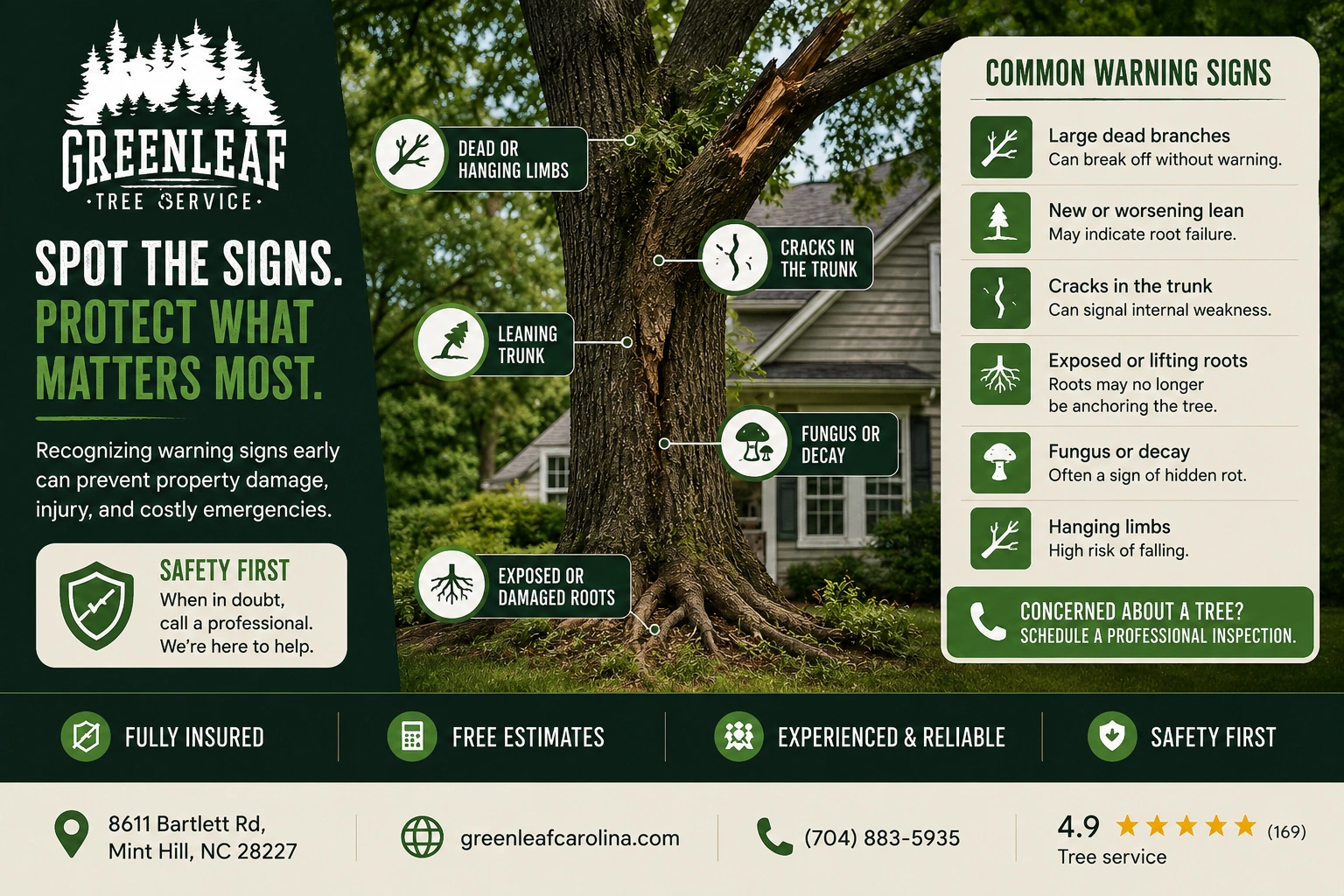
A dangerous tree often shows warning signs such as leaning, cracking, dead limbs, exposed roots, fungus, or branches hanging over your home. These signs can mean the tree is structurally weak and may fail during wind, rain, or normal yard activity.
For homeowners, the safest approach is not to guess. A tree can look stable from a distance while hiding decay, root damage, or limb failure. Knowing the most common dangerous tree signs helps you decide when to keep your distance, protect your property, and schedule a professional tree inspection.
Trees close to homes, driveways, fences, walkways, garages, or power lines should always be taken seriously. Even one weak limb or unstable root system can create a safety risk.
Don’t Ignore a Dangerous Tree
Spot the signs early and prevent costly property damage. Call now for professional tree removal.
What Makes a Tree Dangerous?
A tree becomes dangerous when part of its structure can no longer support its weight safely. This may involve the trunk, roots, main branches, or canopy.
Some trees become hazardous after storms. Others weaken slowly from disease, pests, poor soil, root damage, or age. The risk increases when the tree is close to a home, driveway, fence, walkway, garage, or power line.
Common dangerous tree signs include:
- Large dead branches
- A new or worsening lean
- Cracks in the trunk
- Split branch unions
- Exposed or lifting roots
- Mushrooms near the base
- Hollow areas or cavities
- Peeling bark
- Hanging limbs
- Soil movement around the root plate
A tree does not have to be fully dead to be unsafe. One compromised section can create a serious hazard, especially during high winds or heavy rain.
Location also matters. A weak tree in an open field may be less urgent than a weak tree hanging over a roof. When a tree can strike people, buildings, vehicles, or utility lines, it should be evaluated quickly.
Is a Leaning or Cracked Tree Unsafe?
A leaning or cracked tree can be unsafe, but the level of risk depends on the cause, age of the damage, and location of the tree.
When a Leaning Tree Is a Concern
Some trees naturally grow at an angle. A long-standing lean is not always an emergency.
A new lean is different.
If a tree starts leaning after a storm, construction work, or heavy rain, it may have root failure. Check the soil around the base from a safe distance. Raised ground, cracked soil, or exposed roots can mean the root system has shifted.
A tree leaning toward your home, driveway, sidewalk, or power line should be inspected as soon as possible.
When Cracks Are Serious
Cracks in the trunk can signal internal weakness. Deep vertical cracks, open splits, or cracks that run into a major branch union are especially concerning.
A cracked tree may still stand for a while, but its strength has already been reduced. Wind, rain, or additional limb weight can make the damage worse.
Do not try to push, pull, brace, or cut a cracked tree yourself. Large trees store a lot of weight and pressure. Improper cutting can cause sudden movement.
If you see cracking near the trunk or base, schedule a professional inspection through Green Leaf Carolina’s tree inspection services.
What Should Homeowners Check First?
Homeowners should inspect from a safe distance. Do not walk under damaged limbs or stand close to a tree that appears unstable.
Start with the areas that reveal the most serious risks.
Check the Base of the Tree
The root area can tell you a lot about stability. Look for lifting soil, exposed roots, cracked ground, or separation between the trunk and soil.
If the base looks disturbed, the tree may not be firmly anchored.
Also watch for mushrooms or fungal growth around the trunk. Fungi can indicate decay in the roots or lower trunk.
Look at the Trunk
The trunk is the tree’s main support system. Watch for cracks, cavities, missing bark, soft wood, sawdust, insect activity, or large wounds.
A hollow tree is not always dangerous, but hollowing reduces strength. The more decay spreads through the trunk, the higher the risk of failure.
Look Up at the Canopy
Stand back and look at the branches. Dead limbs often have no leaves, brittle twigs, peeling bark, or a gray, dry appearance.
Hanging limbs are a major warning sign. They can fall without notice, especially after wind or rain.
If large branches hang over your roof, driveway, deck, or children’s play area, take the risk seriously.
Check Nearby Targets
A hazardous tree becomes more urgent when something important is within reach. Look at what the tree could hit if it failed.
High-risk targets include:
- Homes
- Garages
- Cars
- Fences
- Decks
- Walkways
- Play areas
- Power lines
- Neighboring property
A tree does not need to fall completely to cause damage. A single large limb can damage a roof, break windows, crush gutters, or injure someone below.

Same-Day Tree Removal Services: Are They Worth It?
Trees are essential to our landscapes, but sometimes, they become a hazard. Whether it's due to storm damage, disease, or…
When Should You Schedule a Tree Inspection?
You should schedule a tree inspection when you see warning signs that suggest structural weakness or falling risk.
The most important time to call is before the tree fails. Waiting until a limb falls or the tree leans further can make the situation more dangerous and more expensive.
Schedule an inspection if you notice:
- A new lean
- Deep trunk cracks
- Splitting where large limbs connect
- Large dead branches
- Hanging limbs
- Exposed roots
- Soil lifting near the base
- Fungal growth around the trunk
- A tree too close to your home
- Storm damage
- Sudden canopy thinning
- Branches touching the roof
You should also schedule an inspection before buying a home, after severe weather, or before major landscaping or construction near mature trees.
Tree roots can be damaged by digging, grading, trenching, driveway work, and compacted soil. A tree may not show stress immediately, but structural problems can appear later.
If an inspection shows the tree cannot be made safe, Green Leaf Carolina can discuss safe options, including professional tree removal services.
What Will a Tree Expert Look For?
A tree expert looks at the full tree, not just one visible problem. The goal is to understand whether the tree is stable, declining, or likely to fail.
Root Stability
The inspection often starts at the base. Roots anchor the tree and absorb water and nutrients.
A tree expert may look for root plate movement, girdling roots, decay, soil heaving, drainage issues, and signs of construction damage.
If the root system is compromised, the tree may be unsafe even if the canopy still looks healthy.
Trunk Condition
The trunk is checked for cavities, cracks, decay, wounds, insect damage, and weak spots.
Experts may also look for included bark, co-dominant stems, or old storm damage. These structural defects can make the tree more likely to split.
Limb and Canopy Health
The canopy shows how the tree is responding to stress. Deadwood, thinning leaves, broken limbs, and uneven weight distribution can all point to risk.
A tree expert will also consider whether pruning can reduce the hazard or whether the tree is too compromised to keep safely.
Surrounding Property Risk
Location is a major part of the inspection. A tree near a home, driveway, or power line requires a different level of concern than a tree in an open yard.
The expert may recommend pruning, cabling, monitoring, or removal depending on the level of risk.
The goal is not to remove every imperfect tree. The goal is to identify trees that may become dangerous and recommend the safest practical solution.
Common Tree Risks in Fort Mill and Nearby Areas
Fort Mill and nearby areas have many mature trees growing close to homes, roads, fences, and utility lines. That makes tree safety an important part of property maintenance.
Storms, heavy rain, saturated soil, and strong wind can expose weak trees quickly. In some neighborhoods, large trees sit close to roofs, driveways, and backyards where families spend time.
Common local risks include:
- Mature trees with heavy limbs over homes
- Root systems affected by clay-heavy or saturated soil
- Storm-weakened branches
- Trees near power lines
- Trees crowded by development or landscaping
- Older hardwoods with decay or trunk cavities
- Limbs extending over fences, patios, or driveways
Homeowners in Fort Mill should pay attention after storms and seasonal weather changes. A tree that looked fine last year may show new signs of decline after repeated wind, rain, or soil movement.
For homeowners in the area, Green Leaf Carolina also serves local properties through its Fort Mill tree service area.
How Green Leaf Carolina Can Help
Green Leaf Carolina helps homeowners identify dangerous tree signs before they turn into serious property or safety problems.
Our team can inspect leaning trees, cracked trunks, dead limbs, exposed roots, storm damage, and trees growing too close to your home. We focus on clear recommendations, not guesswork.
If the tree can be managed with pruning or monitoring, we will explain that. If the tree is structurally unsafe, we can walk you through safer removal options.
A professional inspection gives you a clearer answer about what is happening and what to do next.
If you are concerned about a tree near your home, schedule an inspection with Green Leaf Carolina through our tree inspection services. We will help you understand the risk and choose the safest next step.
FAQs
What are the most common dangerous tree signs?
The most common dangerous tree signs include leaning, cracked trunks, dead branches, hanging limbs, exposed roots, fungal growth, cavities, and soil movement near the base.
Is a tree dangerous if it leans toward my house?
A tree leaning toward your house can be dangerous, especially if the lean is new or getting worse. It should be inspected to determine whether the roots or trunk are compromised.
Can a cracked tree be saved?
Some cracked trees can be managed, but deep trunk cracks or splits near major limbs are serious. A tree expert should inspect the damage before deciding whether pruning, support, or removal is safest.
Should I remove a dead branch over my roof?
A dead branch over your roof should be handled by a professional. Dead limbs can break without warning and may damage shingles, gutters, windows, or nearby structures.
How often should trees near a home be inspected?
Trees near a home should be inspected after major storms, when warning signs appear, or every few years as part of property maintenance. Older trees or trees near structures may need closer monitoring.
Are mushrooms near a tree bad?
Mushrooms near the base can be a warning sign of root or trunk decay. They do not always mean the tree is dangerous, but they are a good reason to schedule an inspection.
When is tree removal necessary?
Tree removal may be necessary when the trunk, roots, or main limbs are too damaged to support the tree safely. Removal is also more likely when the tree threatens a home, utility line, driveway, or walkway.
What should I do if a tree touches a power line?
Stay away and call the utility company. Do not touch the tree, limb, or nearby objects. Trees near power lines require specialized handling and should never be treated as normal yard cleanup.
Worried About a Tree Near Your Home?
Know the warning signs before it causes damage. Call today for safe, professional tree service.