
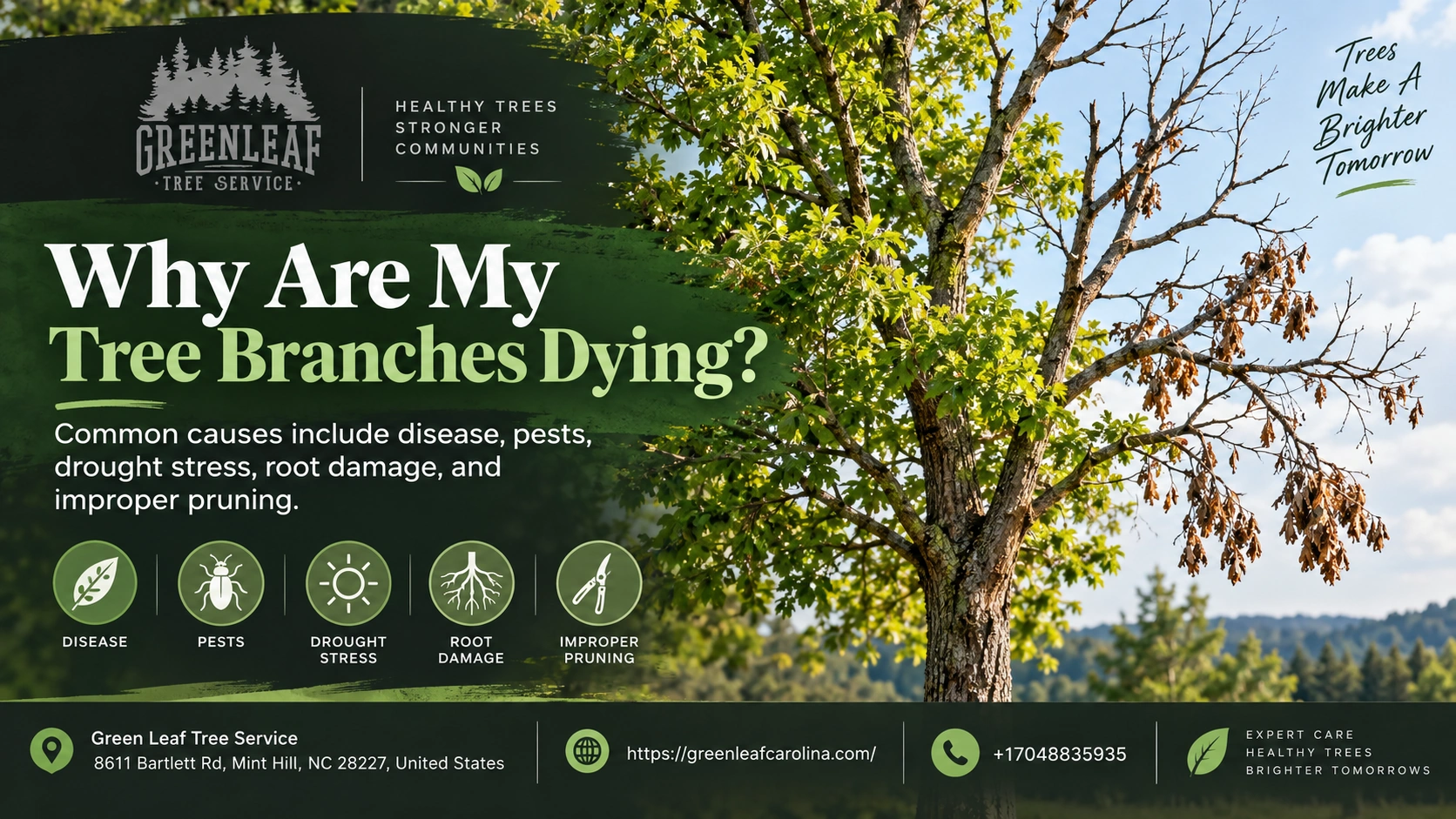
Common causes of dying tree branches include drought stress, root damage, fungal or bacterial disease, insect infestations, storm injuries, compacted soil, poor drainage, and natural aging. An isolated dead branch does not always mean the entire tree is dying, especially when the remaining canopy appears healthy and vigorous.
Widespread or recurring branch dieback deserves closer attention. When dead limbs appear throughout the canopy or occur with peeling bark, cankers, fungal growth, undersized leaves, or premature leaf drop, the tree may be experiencing a larger health problem. Homeowners should inspect the canopy, trunk, root flare, and surrounding soil rather than focusing only on the most visible branch.
Why Tree Branches Start Dying
Branches die when they can no longer receive enough water, nutrients, or stored energy to maintain living tissue. The interruption may begin within the branch itself, but it can also result from problems in the trunk, roots, or surrounding soil.
Trees sometimes allow less productive branches to die naturally. Small shaded branches inside a dense canopy may receive too little sunlight to support themselves. The tree may gradually stop directing resources to them while maintaining healthier exterior growth.
This natural process usually affects small interior branches rather than large limbs throughout the canopy.
More concerning causes of branch dieback include:
- Extended drought
- Root injury
- Soil compaction
- Poor drainage
- Fungal cankers
- Bacterial infections
- Wood-boring insects
- Scale insects
- Storm damage
- Frost or winter injury
- Improper pruning
- Construction damage
- Girdling roots
- Internal decay
The pattern of dying branches can provide useful clues. One dead limb may indicate a localized wound or canker. Dieback concentrated on one side may suggest root damage beneath that area. Decline throughout the canopy may point to drought, poor soil, root disease, or another system-wide problem.
Drought Stress
Trees lose water through their leaves and replace it through their roots. During extended dry weather, the roots may not be able to supply enough moisture to the canopy.
The outermost leaves and branch tips often show stress first. Leaves may wilt, develop brown margins, fall early, or remain smaller than normal. Severe drought can cause individual branches to die.
Drought damage may continue appearing after rainfall returns. Fine roots can die during the dry period, reducing the tree’s ability to absorb water in later seasons.
Recently planted trees, trees growing in compacted soil, and trees surrounded by pavement are particularly vulnerable because their available root zones may be limited.
Root Problems
Roots supply the entire canopy. When roots are cut, decayed, compacted, buried, or restricted, branches may begin dying even though the visible problem appears far above the ground.
Root-related dieback may result from:
- Trenching
- Foundation work
- Driveway installation
- Utility repairs
- Soil compaction
- Excess mulch
- Deep planting
- Girdling roots
- Flooding
- Root rot
- Changes in soil grade
Stem-girdling roots can restrict water and nutrient movement and may produce branch dieback, stunted growth, poor summer color, leaf scorch, or early autumn leaf drop.
Symptoms may not appear immediately after root damage. A mature tree can rely on stored energy for a period before the canopy begins thinning.
Localized Branch Injury
A branch may die after being cracked, partially torn, improperly pruned, or damaged by rubbing limbs.
The branch can remain attached even when its internal water-conducting tissue has been disrupted. Leaves beyond the injury may wilt or fail to emerge the following spring.
Small localized injuries may only affect one limb. Larger wounds near a main branch union can lead to more extensive dieback or decay.
Natural Aging
Older trees often develop more deadwood than young trees. Interior branches may decline as the canopy becomes larger and more shaded.
A limited amount of deadwood can be expected in mature trees. However, a rapid increase in large dead branches may indicate declining roots, disease, internal decay, or structural stress rather than ordinary aging.
Is Branch Dieback Dangerous?
Branch dieback can create both tree-health and safety concerns. The seriousness depends on the size and location of the dead branch, the cause of decline, and what the limb could strike if it falls.
Small dead twigs inside a canopy generally present less risk than a large dead limb over a roof, driveway, walkway, road, or play area.
Dead branches gradually lose moisture and flexibility. As the wood becomes brittle, the limb may break during wind, rain, or calm weather. Tree-risk guidance identifies dead branches as an obvious potential hazard, with the risk depending largely on branch size and the distance to possible targets.
When One Dead Branch May Be Localized
A single branch may die because of:
- A storm crack
- A pruning wound
- A localized canker
- Mechanical injury
- Branch rubbing
- An insect infestation limited to one area
- Excessive shade
If the rest of the canopy remains full and healthy, proper pruning and monitoring may be sufficient.
The cause should still be identified before the branch is removed. A canker near the branch attachment, for example, may extend farther into the tree than the dead foliage suggests.
When Dieback May Indicate a Larger Problem
Widespread dieback is more concerning when it appears:
- Throughout the upper canopy
- On several major limbs
- On one entire side of the tree
- Along with smaller leaves
- With premature leaf discoloration
- After construction near the roots
- With fungal growth near the trunk base
- With bark cracking or cankers
- With a new tree lean
- Repeatedly over several seasons
These patterns may indicate that the tree is not receiving enough water or nutrients because of root damage, vascular disease, soil problems, or severe environmental stress.
Dead Branches Over Structures
A dead branch over a home does not always require removal of the entire tree. The branch itself may be removed while the remaining tree is preserved.
Removal becomes more urgent when the limb is:
- Large
- Hanging or partially detached
- Cracked at the trunk
- Resting on another branch
- Over a frequently occupied area
- Near power lines
- Attached to decayed wood
- One of several repeatedly failing branches
Homeowners should not attempt to cut large dead limbs from ladders or from beneath the canopy. Dry branches can break unpredictably, and nearby limbs may also be damaged.
What Should Homeowners Inspect First?
A homeowner can perform a basic inspection from the ground. The objective is to notice patterns and warning signs, not to diagnose the exact problem without training.
Inspect the entire tree, beginning with the canopy and continuing down the trunk to the root flare and surrounding soil.
Confirm That the Branch Is Dead
A branch without leaves is not necessarily dead if the tree is dormant or the species produces leaves later than nearby trees.
During the growing season, likely signs of a dead branch include:
- No leaves or buds
- Dry, brittle twigs
- Bark falling away
- No flexible young growth
- Cracks along the limb
- Fungal growth
- Small branches snapping easily
Avoid breaking or cutting large branches to test them. A professional can confirm whether living tissue remains and identify an appropriate pruning point.
Examine the Pattern of Dieback
Consider where the dead branches appear.
One isolated limb: This may indicate a local wound, canker, storm injury, or pest problem.
Branch tips throughout the canopy: This may relate to drought, root stress, soil compaction, or environmental exposure.
One side of the tree: This can suggest root damage, construction disturbance, reflected heat, or a localized trunk problem.
Upper canopy decline: This may occur when roots cannot supply sufficient water to the tallest portions of the tree.
Lower interior branches: Some shaded interior dieback may be part of normal canopy development.
The pattern alone does not confirm the cause, but it helps narrow the possibilities.
Look for Cankers
Cankers are areas of dead bark and underlying tissue. They may interrupt water movement and cause branches beyond them to wilt and die.
Cankers may appear as:
- Sunken areas
- Rough or cracked bark
- Discolored patches
- Raised wound ridges
- Peeling bark
- Small fungal structures
- Sap or fluid leakage
Penn State Extension recommends looking for localized roughened or cracked bark, especially near wounds and branch stubs, along with ridged callus tissue or fungal structures.
Do not scrape away bark or cut into the canker. This can enlarge the wound and make identification more difficult.
Inspect the Trunk
Check the trunk from several angles for:
- Deep cracks
- Cavities
- Peeling bark
- Loose sections of wood
- Fungal conks
- Old pruning wounds
- Lightning scars
- Insect holes
- Sap leakage
- Areas where multiple stems are separating
A dead branch connected to a cracked or decayed trunk may represent a larger structural concern.
Check the Root Flare
The root flare is the widening area where the trunk meets the main roots. It should generally remain visible at the soil surface.
Warning signs include:
- The trunk entering the ground like a straight pole
- Soil or mulch piled against the bark
- Circling roots
- Mushrooms near the base
- Soft or decayed tissue
- Root injuries
- Cracked soil
- Raised turf
- Recent excavation
Root problems frequently produce canopy symptoms before homeowners can see the damaged roots.
Review the Leaves
Leaves on affected branches may provide important clues.
Look for:
- Yellowing
- Brown edges
- Wilting
- Spots or lesions
- Unusually small leaves
- Premature fall color
- Early leaf drop
- Leaves remaining attached after turning brown
- Distorted shoots
Diseases such as fire blight can cause shoots to wilt and darken, while drought commonly produces browning along leaf margins and branch extremities.
Look for Insects and Frass
Frass is a mixture of insect waste and wood particles. It may resemble sawdust and collect around holes, bark cracks, or the base of a tree.
Other signs of pest activity include:
- Round or D-shaped exit holes
- Galleries beneath loose bark
- Sticky residue
- Scale-like bumps
- Webbing
- Sap flow
- Woodpecker activity
- Visible larvae or adult insects
Not every insect on a dying branch caused the problem. Some pests move into wood after the tissue has already become stressed or dead.
How Disease, Drought, and Pests Affect Branches
Branch dieback often develops through a combination of stresses. Drought may weaken the tree first, followed by insects or fungi that take advantage of damaged tissue.
Fungal Cankers
Canker fungi frequently enter through wounds, pruning cuts, branch stubs, or natural openings in the bark.
The infection may remain limited for a time before expanding along the branch. As the canker grows around the branch, it restricts water movement and causes leaves beyond the infected area to wilt and die.
Botryosphaeria canker is more likely to affect wounded plants already experiencing drought stress. Leaves on infected branches may wilt as the branch dies.
Canker management depends on:
- The tree species
- The pathogen
- The canker’s location
- The number of infected branches
- The tree’s overall health
- Whether the main trunk is involved
Removing an infected branch may help in selected cases, but pruning must be done at the correct location and time.
Bacterial Diseases
Bacterial infections can affect blossoms, shoots, branches, and trunks. Symptoms may include:
- Rapid shoot wilting
- Blackened leaves
- Dark or sunken bark
- Sap or bacterial ooze
- Crooked shoot tips
- Cankers
- Leaves remaining attached after death
Some bacterial diseases spread through rain, insects, or contaminated pruning tools. Proper identification is necessary before pruning or treatment.
Vascular Diseases
Vascular diseases interfere with tissues that move water through the tree. Branches may wilt or die because their water supply has been blocked.
Dieback may begin on one side or appear in scattered sections of the canopy. Sapwood beneath the bark may show discoloration or streaking, but homeowners should not cut into the tree simply to check.
Laboratory testing may be necessary when symptoms resemble drought or root damage.
Drought and Heat
Drought reduces water availability, while high temperatures increase the amount of moisture lost through leaves.
A tree under drought stress may close leaf pores and reduce growth to conserve water. If stress continues, branch tips and smaller limbs may die.
Heat reflected from buildings, pavement, fences, and stone can intensify stress. Trees in parking areas or narrow planting beds may experience much hotter and drier conditions than trees growing in open soil.
Flooding and Poor Drainage
Too much water can produce symptoms similar to drought because saturated roots cannot obtain enough oxygen.
The canopy may show:
- Yellow leaves
- Sparse growth
- Wilting
- Branch dieback
- Premature leaf drop
- Reduced annual growth
Trees vary in their tolerance of wet soil. A species adapted to well-drained ground may decline rapidly where water collects after rain.
Boring Insects
Wood-boring insects tunnel through bark or sapwood. Their feeding may interrupt the movement of water and nutrients.
Possible signs include:
- Exit holes
- Frass
- Bark splitting
- Sap or resin
- Galleries
- Canopy thinning
- Dead branch tips
- Woodpecker activity
Borers frequently attack trees already stressed by drought, injury, disease, or poor planting conditions.
Scale Insects
Scale insects attach to branches and feed on plant fluids. Heavy infestations can weaken branches and cause dieback.
They may look like small shells, bumps, cottony masses, or discolored patches rather than obvious insects. Severe oystershell scale infestations, for example, can contribute to branch dieback.
Winter and Frost Injury
Cold temperatures can damage branch tissue, particularly after warm weather causes early growth.
Affected branches may fail to leaf out in spring or may produce leaves that quickly wilt and die. Dark streaking can sometimes occur in damaged sapwood.
Winter injury may affect exposed branches more severely than protected parts of the canopy.
When Should You Schedule Tree Healthcare?
Homeowners should consider a professional evaluation when branch dieback is widespread, increasing, or combined with other signs of decline.
Tree-health guidance identifies discolored leaves, dead branches, and premature leaf drop as symptoms that may warrant contacting an arborist.
Schedule an inspection when you notice:
- Several large dead branches
- Dieback spreading through the canopy
- Repeated branch loss
- Cracked or sunken bark
- Fungal growth
- Insect exit holes
- Sawdust-like material
- Premature leaf discoloration
- Small or sparse leaves
- Bark peeling from the trunk
- A new tree lean
- Root or soil movement
- Recent construction near the tree
- Significant storm damage
- Branches dying over a house or walkway
When Immediate Attention Is Needed
Prompt evaluation is appropriate when a dead or damaged branch is:
- Hanging over a home
- Above a driveway or entrance
- Touching a utility line
- Partially attached
- Cracked at a major union
- Resting in another tree
- Large enough to cause serious damage
Keep people, vehicles, and pets away from the potential fall area.
When Monitoring May Be Reasonable
Monitoring may be appropriate when:
- Only a small branch is affected
- The remaining canopy is healthy
- No trunk or root defects are visible
- The branch is not over an occupied area
- The cause appears limited and stable
Take dated photographs so changes can be compared over time. New dieback, fungal growth, or branch failure should prompt another evaluation.
Why Early Diagnosis Matters
Early diagnosis may allow the underlying stress to be corrected before the tree loses a large portion of its canopy.
Potentially manageable issues include:
- Improper watering
- Excess mulch
- Soil compaction
- Limited cankers
- Early pest infestations
- Minor storm damage
- Correctable pruning defects
Once severe root decay, extensive vascular disease, or advanced structural deterioration develops, preservation options may be limited.
What Will an Arborist Recommend?
Recommendations depend on the cause of dieback, the tree’s overall condition, and whether dead branches create a safety risk.
An arborist may recommend one or several of the following approaches.
Monitoring
A small, stable area of dieback may only require observation.
Monitoring can include:
- Photographing the canopy
- Tracking leaf development
- Watching for new dead branches
- Checking for fungal growth
- Reassessing after storms
- Scheduling a future inspection
Monitoring is an active management strategy, not a decision to ignore the tree.
Corrective Pruning
Dead, broken, or diseased branches may be removed back to appropriate branch unions.
Correct pruning can:
- Remove falling hazards
- Prevent torn branches from worsening
- Improve canopy structure
- Eliminate selected infected tissue
- Provide clearance from roofs or roads
Removing too much live canopy can further stress the tree. Pruning should preserve healthy foliage whenever possible.
Topping should not be used to manage branch dieback. Cutting major limbs back to random stubs creates large wounds and encourages weakly attached sprouts.
Disease Management
When a disease is confirmed, recommendations may include:
- Removing infected branches
- Timing pruning to reduce spread
- Sanitizing pruning tools
- Improving tree vigor
- Managing moisture
- Applying a targeted treatment when appropriate
- Monitoring nearby susceptible trees
Not every disease can be treated with a fungicide or antibiotic. The diagnosis, disease stage, and tree species determine whether treatment is useful.
Pest Management
A confirmed insect problem may be managed through:
- Pruning infested limbs
- Improving tree health
- Removing heavily infested material
- Targeted insect treatment
- Monitoring pest activity
- Protecting nearby trees
Treatments should be based on pest identification. Applying general insecticides without knowing the insect may be ineffective and can affect beneficial organisms.
Soil and Root-Zone Improvements
When root stress contributes to branch dieback, recommendations may focus below ground.
Possible steps include:
- Correcting mulch depth
- Improving watering practices
- Reducing soil compaction
- Redirecting drainage
- Protecting roots from traffic
- Addressing girdling roots
- Preventing additional excavation
- Conducting soil testing
- Improving available rooting space
Fertilizer is not an automatic solution. It does not repair severed roots, reverse decay, or correct poor drainage.
Structural Support
Cabling or bracing may be considered when a tree has weak branch unions but remains otherwise manageable.
Support systems do not restore damaged wood. They require professional installation and periodic inspection.
Removal
Removal may be recommended when:
- Most major branches are dead
- Dieback continues despite reasonable care
- The trunk or roots are severely decayed
- A major disease cannot be managed
- Structural stability is compromised
- Large branches repeatedly fail
- The tree is dead or unlikely to recover
- The risk to nearby people or property is unacceptable
The presence of a few dead limbs is not enough by itself to justify removal. The recommendation should consider the whole tree and the likelihood of safe recovery.
How Green Leaf Carolina Can Help
Green Leaf Carolina helps homeowners determine whether dying branches represent a localized issue or a broader tree-health concern.
A tree assessment can examine:
- The location and pattern of dieback
- Canopy density
- Leaf size and color
- Branch wounds
- Cankers
- Insect activity
- Fungal growth
- Trunk condition
- Root flare health
- Soil and drainage
- Construction history
- Storm damage
- Nearby homes and occupied areas
When the tree can be preserved, recommendations may focus on corrective pruning, root-zone care, disease or pest management, and continued monitoring.
When dead branches are connected to extensive root decay, trunk failure, severe disease, or widespread canopy decline, the inspection can help homeowners understand whether removal is the safest option.
The objective is not simply to cut away every branch without leaves. It is to identify why the dieback developed, reduce immediate hazards, and improve the tree’s long-term condition whenever preservation is practical.
FAQs
Does one dead branch mean the entire tree is dying?
No. One branch may die because of a local injury, canker, storm crack, pest infestation, or lack of sunlight. The rest of the tree should be inspected for additional symptoms.
What causes several branches to die at once?
Widespread branch dieback may result from drought, root damage, flooding, vascular disease, severe pest activity, soil compaction, or construction disturbance.
How can I tell whether a branch is dead?
During the growing season, a dead branch may lack leaves and buds, have brittle twigs, show peeling bark, or contain dry, cracked wood. Avoid breaking large branches to test them.
Can a dead branch grow back?
The dead branch itself cannot recover. The tree may produce new growth elsewhere, but dead wood should not be expected to become living tissue again.
Should every dead branch be removed?
Not necessarily immediately. Small dead branches in low-risk locations may be monitored, but large dead limbs over homes, walkways, vehicles, or utility lines should be evaluated promptly.
Can drought kill only part of a tree?
Yes. Severe drought may cause individual branches or sections of the canopy to die, particularly when roots are restricted or damaged.
Why are the branch tips dying first?
Branch tips are farthest from the roots and may receive less water during drought or root stress. Tip dieback can also result from pests, disease, frost, or chemical injury.
Can overwatering cause dying branches?
Yes. Saturated soil reduces oxygen around roots, which can limit water uptake and cause canopy thinning, yellow leaves, and branch dieback.
Can damaged roots cause branches to die years later?
Yes. Mature trees may use stored energy after root injury, with canopy decline becoming noticeable months or years after construction or excavation.
What is a branch canker?
A canker is an area of dead bark and underlying tissue. It may interrupt water movement and cause the branch beyond it to wilt or die.
Are cankers contagious?
Some canker pathogens can spread to other branches or susceptible trees. Others primarily affect stressed tissue. Identification is needed to determine the risk.
Why is bark peeling from a dying branch?
Bark may loosen when the tissue beneath it has died. Peeling can result from cankers, insects, frost injury, storm damage, or internal decay.
Do mushrooms mean the branches are dying from decay?
Mushrooms or conks may indicate decay in the trunk, roots, or branches. Their location and the tree’s other symptoms determine their significance.
What does sawdust around a tree mean?
Sawdust-like material may be frass produced by wood-boring insects or carpenter ants. It can indicate insect activity within stressed or decaying wood.
Why are woodpeckers visiting a dying branch?
Woodpeckers may be feeding on insects beneath the bark. Their activity can indicate beetle larvae, ants, or other insects, although it does not identify the exact pest.
Can scale insects kill branches?
Heavy scale infestations can weaken branches, reduce growth, and cause dieback by feeding on plant fluids.
Can dead branches fall without wind?
Yes. Dead wood becomes brittle and may fall during calm weather, especially after decay has weakened the attachment.
Is a dead branch over a roof an emergency?
A large, hanging, cracked, or partially detached branch over a roof should receive prompt professional attention. Keep people away from the area until it is evaluated.
Can pruning stop branch dieback?
Pruning can remove dead, broken, or selected diseased branches, but it will not correct root rot, drought, poor drainage, or systemic disease by itself.
Will fertilizer bring dying branches back?
No. Dead branches cannot be revived. Fertilizer may also be inappropriate when the real problem is root damage, drought, disease, or saturated soil.
Should I seal a pruning cut?
Wound sealants are generally not needed for routine pruning. Properly placed cuts and correct timing are more important unless a professional recommends otherwise for a specific condition.
Can a tree survive widespread branch dieback?
Some trees recover if the underlying cause is corrected and enough healthy canopy remains. Extensive loss of major limbs, root decay, or severe trunk damage lowers the likelihood of recovery.
Why is only one side of my tree dying?
One-sided dieback may relate to root damage, construction, reflected heat, drainage, trunk injury, vascular disease, or exposure to wind and weather.
Can storm damage cause delayed branch death?
Yes. A branch may remain attached after being cracked or twisted but die later because its internal tissues were damaged.
What does premature leaf drop indicate?
Early leaf loss can result from drought, root problems, disease, pests, flooding, or heat stress. It is more concerning when it occurs repeatedly or with branch dieback.
When should I call an arborist?
Arrange an evaluation when dieback is widespread, spreading, affecting major limbs, accompanied by fungal or insect activity, or located over people and property.
What will an arborist inspect?
An arborist will examine the canopy, branches, trunk, root flare, visible roots, soil, drainage, pest evidence, disease symptoms, and recent site changes.
Can an arborist save a tree with dead branches?
Possibly. If the trunk and roots remain healthy, pruning and correcting the underlying stress may preserve the tree. The outcome depends on the cause and extent of decline.
When does branch dieback mean the tree should be removed?
Removal may be necessary when most major limbs are dead, the trunk or roots are severely decayed, the tree is structurally unstable, or the risk cannot be managed through pruning and care.
How often should a tree with branch dieback be monitored?
The appropriate interval depends on the cause, tree size, branch location, and severity. Follow-up inspections may be recommended after storms or during the next growing season.