
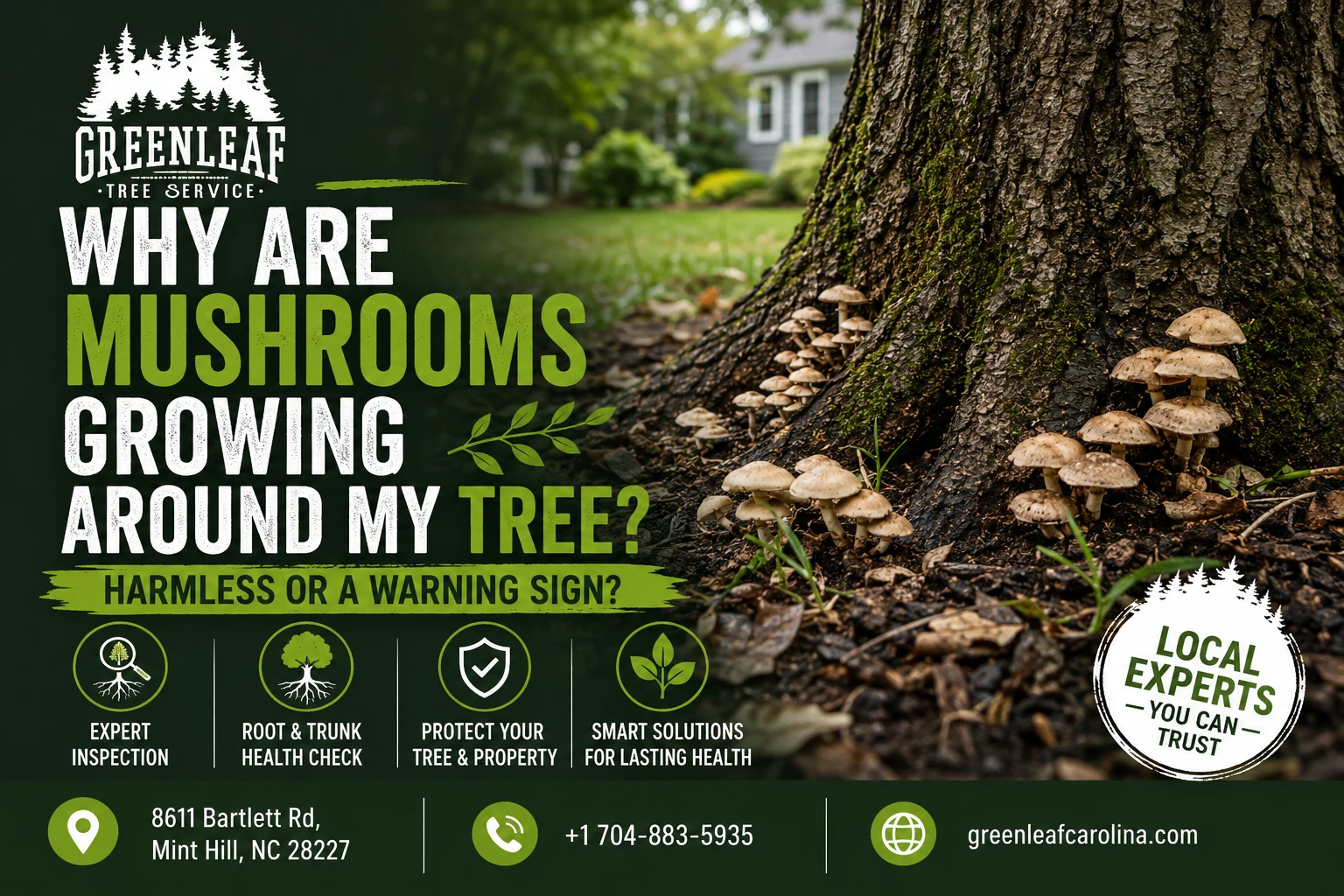
Mushrooms grow around trees because moisture and decaying organic material create the conditions fungi need to develop. They may be feeding on dead roots, buried wood, old mulch, or weakened tissue connected to the tree.
Some mushrooms are harmless signs of healthy soil activity, while others can indicate root rot or internal decay. The difference is not always visible from the surface. Homeowners should check the tree’s roots, trunk, canopy, and recent changes before assuming the growth is harmless. Early inspection can help identify structural risks before serious failure occurs.
Mushrooms Growing Around Your Tree?
Don’t ignore what could be happening below the surface. Call now for a professional tree inspection and expert recommendations.
Why Do Mushrooms Grow Around Trees?
Mushrooms are the visible fruiting bodies of fungi living in soil, wood, roots, or mulch. The main fungal network usually stays hidden underground.
Moisture and Organic Matter
Fungi become more active when soil stays damp and organic material begins breaking down. Heavy rain, overwatering, poor drainage, and thick mulch can create favorable conditions.
Old roots, buried stumps, and wood chips can support mushrooms without harming a living tree.
Dead or Dying Roots
Mushrooms near the trunk may be feeding on roots that have already died. Root death can result from compaction, construction damage, flooding, drought, disease, or age.
Repeated mushrooms in one location may indicate established decay rather than temporary moisture.
Is Fungus Around a Tree Dangerous?
Fungus is not automatically dangerous. Many soil fungi help decompose organic matter and return nutrients to the soil.
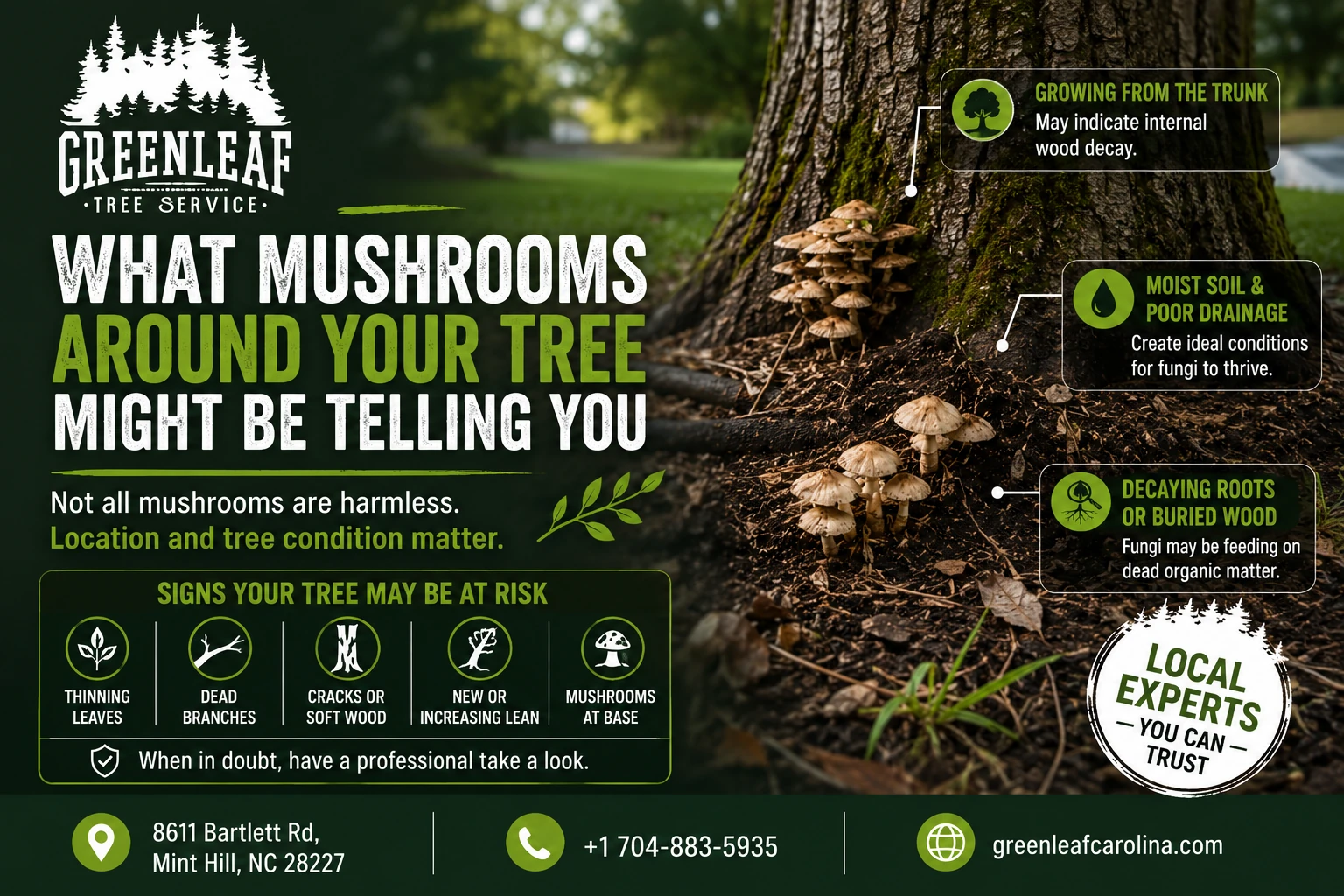
The concern increases when mushrooms grow directly from the trunk, root flare, large roots, or old wounds.
Location Matters
Mushrooms scattered through mulch may be feeding on wood chips. Mushrooms forming in clusters at the tree’s base may indicate decay in structural roots or lower trunk tissue.
Conks, shelves, or brackets attached to the trunk deserve prompt attention because they can signal internal wood decay.
Tree Condition Matters
A healthy canopy and stable trunk do not rule out hidden damage. Some trees remain green even after major root decay has begun.
Fungus becomes more concerning when it appears with thinning leaves, dead branches, bark loss, trunk cavities, or a new lean.
What Should Homeowners Check Near the Roots?
Inspect safely before touching mushrooms or disturbing soil.
Look at the Root Flare
The root flare is where the trunk widens and meets the ground. It should be visible rather than buried under deep mulch or added soil.
Check for soft wood, cracks, dark staining, loose bark, cavities, or mushrooms growing from the flare.
Check Soil and Drainage
Notice whether water collects around the tree after rain or irrigation. Saturated soil reduces oxygen and can weaken roots over time.
Check for irrigation leaks, downspout discharge, compaction, and grading changes.
Watch for Movement
Fresh soil cracks, lifting roots, or a changing lean may indicate instability. Do not push or shake the tree to test it.
Keep people and vehicles away if the tree appears unstable, especially after rain or strong winds.
How Root Rot Weakens Trees Over Time
Root rot is a general term for diseases and decay that damage root tissue. Different fungi affect different species and conditions.
Loss of Water and Nutrient Uptake
Healthy roots absorb water and nutrients. As roots decay, the tree may struggle to support its canopy.
Symptoms can include smaller leaves, early fall color, slow growth, branch dieback, and thinning foliage.
Reduced Structural Support
Large woody roots anchor the tree. When those roots decay, the tree may lose stability even if the trunk still looks solid.
A weakened tree may fail during wind, heavy rain, or saturated soil conditions.
Limited Recovery Potential
Some root problems can be managed by correcting drainage, reducing stress, or protecting the root zone. Advanced structural root decay usually cannot be reversed.
The goal may shift from treatment to risk reduction when too much supporting wood has been lost.
When Should You Schedule a Tree Inspection?
Schedule an inspection when mushrooms repeatedly appear at the base, grow from the trunk, or return after being removed.
Prompt evaluation is important near a large tree close to structures, roads, play areas, or utility lines.

How Much Storm Damage Can a Tree Survive?
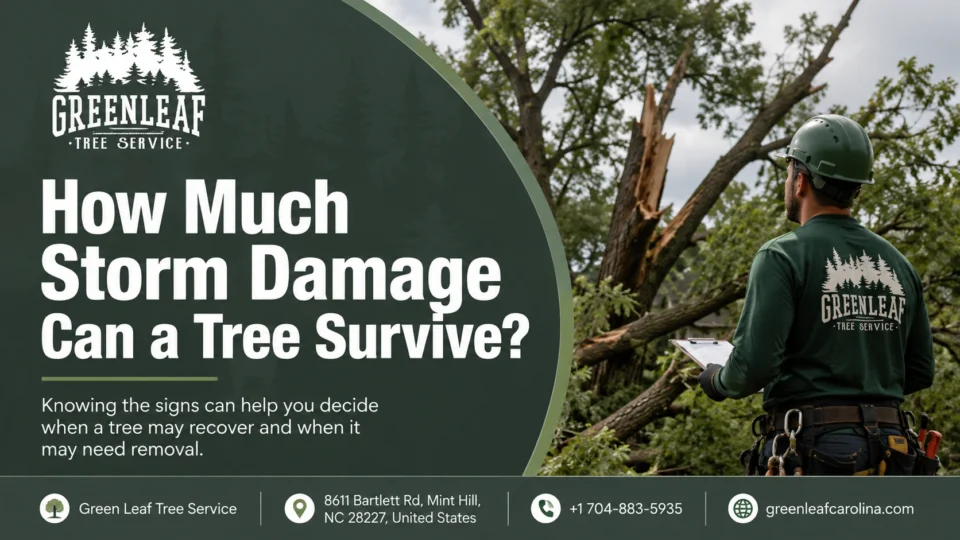
A tree may recover from broken branches, moderate canopy loss, minor bark wounds, or limited root disturbance when its trunk,…
Warning Signs That Need Attention
Call a professional when you notice:
- Mushrooms attached to the trunk or root flare
- Shelf-like fungal growth on the bark
- A sudden or increasing lean
- Dead branches in the upper canopy
- Soft, hollow, or crumbling wood
- Cracks near the base
- Soil lifting around major roots
- Repeated mushroom clusters after rain
An inspection is also wise after construction, trenching, flooding, or major root disturbance.
What Will an Arborist Evaluate?
An arborist will evaluate both tree health and structural safety. The inspection includes the canopy, trunk, roots, soil, and nearby targets.
Fungal Location and Type
The location, shape, texture, and growth pattern of the fungus can provide useful clues. Identification may help determine whether the fungus is feeding on dead debris or living tree tissue.
A field identification is not always conclusive, so recommendations should also consider the tree’s condition.
Trunk and Root Integrity
The arborist may check for cavities, cracks, loose bark, decay, root movement, and abnormal swelling.
Sounding tools, probes, or advanced testing may be used when hidden decay is suspected.
Overall Risk
Risk depends on the likelihood of failure and what could be struck. A decayed tree in an open area presents a different concern than one beside a bedroom, parking space, or busy walkway.
How Green Leaf Carolina Can Help
Green Leaf Tree Service can inspect fungal growth around a tree and determine whether it is connected to harmless organic decay, root disease, or structural deterioration.
The team evaluates roots, trunk condition, canopy health, drainage, soil changes, and nearby property risks. This review avoids decisions based only on mushrooms.
Recommendations may include monitoring, corrective pruning, improving site conditions, reducing stress, or removing a tree that cannot be made reasonably safe. Early evaluation gives homeowners more time to plan and may help preserve trees when the underlying problem is still manageable.
FAQs
Should I remove mushrooms growing near my tree?
You can remove mushrooms for appearance or to reduce accidental contact, but removal does not eliminate the underground fungus. The source must be identified if growth continues.
Does fungus mean my tree is dying?
Not always. Mushrooms may be decomposing mulch, buried wood, or dead roots. Fungus attached to the trunk or root flare is more concerning.
Can root rot be treated?
Some early root problems can be managed by improving drainage and reducing stress. Advanced decay in structural roots usually cannot be restored.
Are mushrooms poisonous to pets?
Some mushrooms are toxic. Keep pets and children away from unidentified fungi and remove accessible mushrooms carefully.
Can a healthy-looking tree have root decay?
Yes. Trees can maintain green leaves while hidden roots or internal wood continue deteriorating.
Will removing mulch stop mushrooms?
Reducing thick or constantly wet mulch may reduce growth, but it will not solve decay inside roots or the trunk.
Schedule a Tree Inspection Before Problems Grow
Mushrooms around a tree can be harmless, but they can also reveal hidden decay that affects long-term stability. The safest response is to carefully consider their location, frequency, and connection to changes in the tree.
Green Leaf Tree Service helps homeowners identify the source of fungal growth and understand whether monitoring, site correction, pruning, or removal is appropriate. A professional inspection can clearly clarify risk before another storm or period of saturated soil increases pressure on weakened roots. Schedule an evaluation when mushrooms return or appear near the trunk.
Key Takeaways
Mushrooms grow around trees because fungi are breaking down organic material, dead roots, or weakened wood. Growth in mulch may be harmless, while mushrooms attached to the trunk, root flare, or major roots can indicate serious decay. Homeowners should check drainage, root exposure, canopy health, trunk condition, and changes in the tree’s lean. Root rot can reduce nutrient uptake and structural support before obvious failure occurs. A professional inspection helps identify the fungus, evaluate risk, and determine whether monitoring, treatment, pruning, or removal is appropriate before damage becomes more severe.
Seeing Mushrooms Near Your Tree?
Mushrooms may signal hidden root or wood decay. Get your tree professionally assessed before the problem gets worse.